

Last summer, a friend of mine in Karnal spent a good amount on a pretty wooden pergola. By May, he’d stopped sitting under it. The slats threw stripes of sun on his chairs, and by 2 pm the whole thing was too hot to enjoy. His neighbour put up a gazebo, and it’s been the family’s favourite spot ever since.
That’s the real Pergola vs Gazebo question. It isn’t about which looks better. It’s about what your weather, your space, and your habits will actually allow.
Pergola: Pretty, Breezy, Needs Some Patience
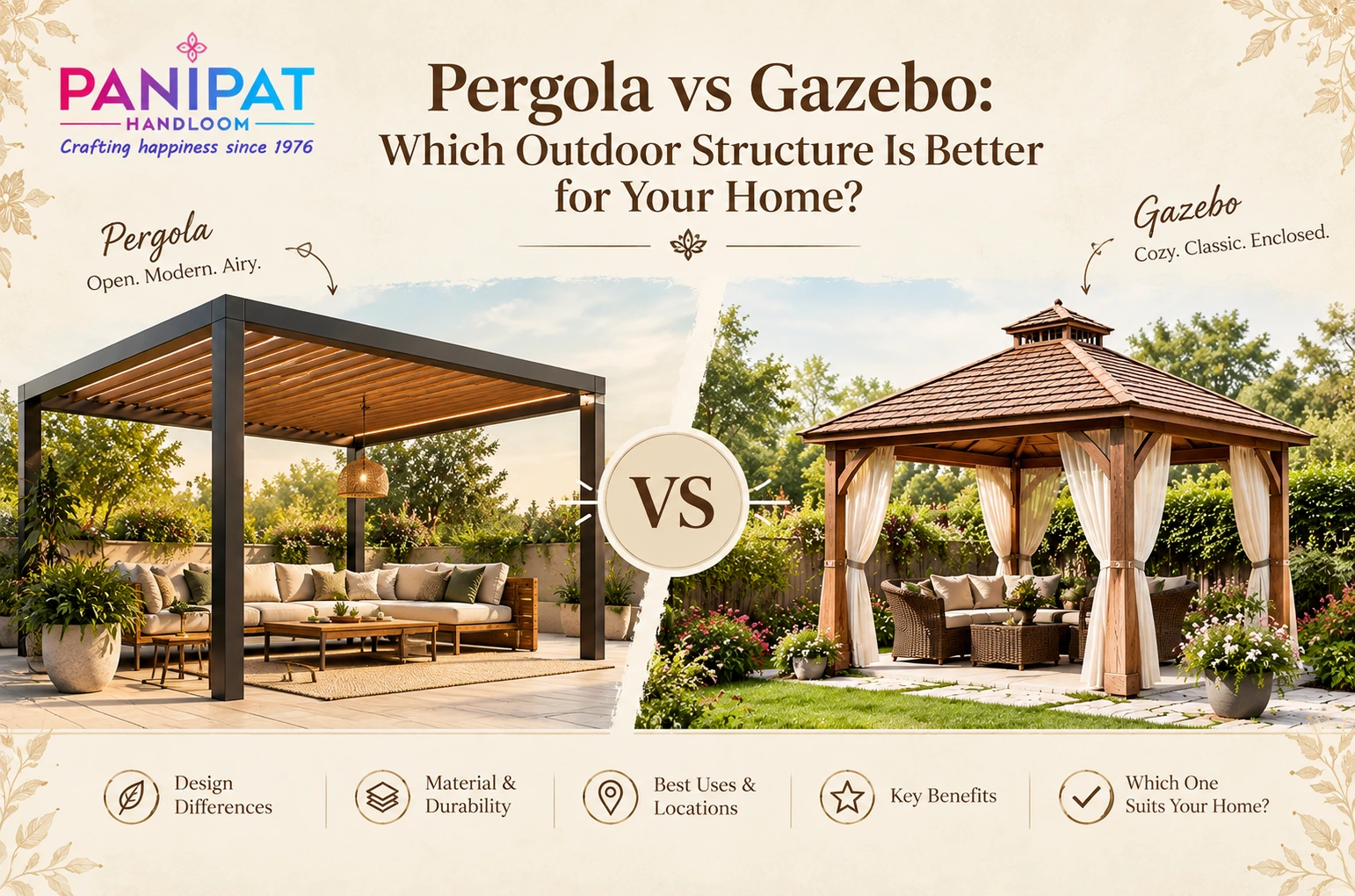
A pergola is a frame. Posts hold up beams, and the beams carry open slats. There’s no solid roof, so you get filtered light rather than proper shade.
It works best when it’s attached to a wall or placed over a terrace, because the wall gives it support and the house gives the space a purpose. Climbers like bougainvillea or madhumalti turn it into a green canopy, though that takes a season or two. Until then, you’re mostly sitting under bare wood.
The big limitation is rain. Water comes straight through, so cushions and furniture need to be moved or covered. A retractable cover fixes that, but it adds to the cost.
Gazebo: Less Fuss, More Cover
Gazebo is something between a little room without walls. It is independent, has a roof, and most often has an accompanying floor as well. Set it up in a garden, install fans and some lighting in it, and there you have it – the center of gathering.
It can be equipped with curtains or mosquito nets on the sides, and this detail is much more important than one would think. Evenings in North India can be rather busy with insects, and mosquito netted gazebo makes the difference between spending an hour outside and spending the whole evening outdoors.
The drawback is space requirements – gazebo needs flat space around it.
How They Compare
|
Pergola |
Gazebo |
|
|
Roof |
Open slats |
Solid |
|
Rain |
Not protected |
Protected |
|
Placement |
Attached or standalone |
Mostly standalone |
|
Cost |
Lower |
Higher |
|
Best for |
Terraces, patios |
Lawns, bigger gardens |
Weather Should Decide This
If you live in Delhi NCR, Haryana, or Punjab, you know what the year looks like. Summers cross 44°C, the monsoon arrives all at once, dust storms show up without warning, and winter brings fog.
For peak summer, a plain pergola does very little at noon. One covered in creepers is far better, but only once the plants have grown. For the monsoon, a gazebo is the clear winner, since nobody enjoys sitting on a damp sofa. If your area is dusty or windy, a gazebo with side panels gives you shelter that a pergola can’t.
If you honestly can’t choose, a pergola with adjustable louvres sits in the middle. You can angle the slats open on a pleasant day and close them when the sun turns harsh.
The Cost Isn’t Only the Build
A pergola costs less initially, as it uses fewer materials and is easier to erect. Wood requires sealing from termite damage and moisture, while metal only requires cleaning and repainting.
A gazebo costs more because you are paying for not only the roof but also its structure and support. At the end of each monsoon, climb up and look at the roof for minor leaks that can later become bigger problems.
A common mistake I see people make is using all the money on construction and none on seating, lighting, and mosquito netting.
An empty gazebo is just an expensive shed.
Before You Decide
A few honest questions help here. Will you sit out there every day, or only when guests visit? Is your space tight or wide open? Does heat bother you more than rain? And will you actually keep up with the maintenance? Your answers usually make the choice for you.
Your Windows Matter Too
One thing that people tend to overlook is the room adjacent to the outdoor structure. The problem being that your pergola or gazebo is built adjacent to a living room or balcony door, and glass will bring in all the sunlight and heat. You may enjoy the garden, but the room adjacent to it is too hot.
A good set of window blinds for home can sort out the issue without causing too much trouble. They block the light and prevent your furniture and curtains from getting faded.
Why Honeycomb Blinds Are Popular
Honeycomb window blinds are constructed by folding the fabric into several honeycomb-shaped cells. The air pocket formed within the cell prevents heat transfer inside or outside the window, thus making the room cooler during summer and warm during winter, and hence reducing your energy consumption for your AC system. These window shades diffuse excessive light from outside and also reduce outside sounds coming into the room.
What Shapes Window Blinds Price
You won’t find one fixed number for window blinds price, because several things move it. The style matters, whether it’s roller, Roman, wooden, or honeycomb. The fabric matters too, since blackout material costs more than sheer. Most quotes are based on window area, and motorised blinds cost more than cord or chain ones. Made-to-measure is dearer than ready-made.
Ask for a per-square-foot rate and check the warranty. A cheap blind that fades after one summer isn’t really cheap.
So, Which Should You Choose?
Go for a pergola if you want something open, affordable, and kind to plants, and you’re fine with partial shade. Pick a gazebo if you want dependable cover through all seasons and a spot that feels like a real hangout.
Whichever you choose, give the indoor side some thought too. Panipat Handloom offers home furnishing options that suit rooms facing the garden, so the inside of your home feels as good as the outside.
10 Frequently Asked Questions
- What is the difference between a pergola and a gazebo?
A pergola has an open, slatted roof that gives partial shade. A gazebo has a solid roof that protects from sun and rain, and it’s usually freestanding. - Which costs less, a pergola or a gazebo?
A pergola usually costs less because it needs fewer materials and simpler construction. A gazebo adds a full roof and base, which raises the price. - Is a pergola waterproof?
No, not on its own. A retractable canopy or polycarbonate sheets can make it rain-ready. - Can a pergola be attached to a house?
Yes, pergolas are commonly fixed to an exterior wall over a patio or terrace. Gazebos normally stand on their own. - Which is better for a small space?
A pergola, since it fits over patios, balconies, and narrow paths. A gazebo needs open, level ground. - What are honeycomb window blinds?
They’re cellular blinds with air pockets that trap heat or cold. This insulates the window, softens light, and can cut energy use. - Are honeycomb blinds good for hot weather?
Yes. The trapped air slows heat moving through the glass, so rooms stay cooler and AC use may drop. - What affects window blinds price?
Blind type, fabric, window size, control type, and customisation all play a part. Motorised and made-to-measure options usually cost more. - Which window blinds are best for home use?
Roller, Roman, and honeycomb blinds are popular. The best pick depends on your need for privacy, insulation, and light control. - How do I choose between a pergola and a gazebo?
Consider your climate, space, budget, and how often you’ll use it. Choose a pergola for open shade and a gazebo for full weather cover.