

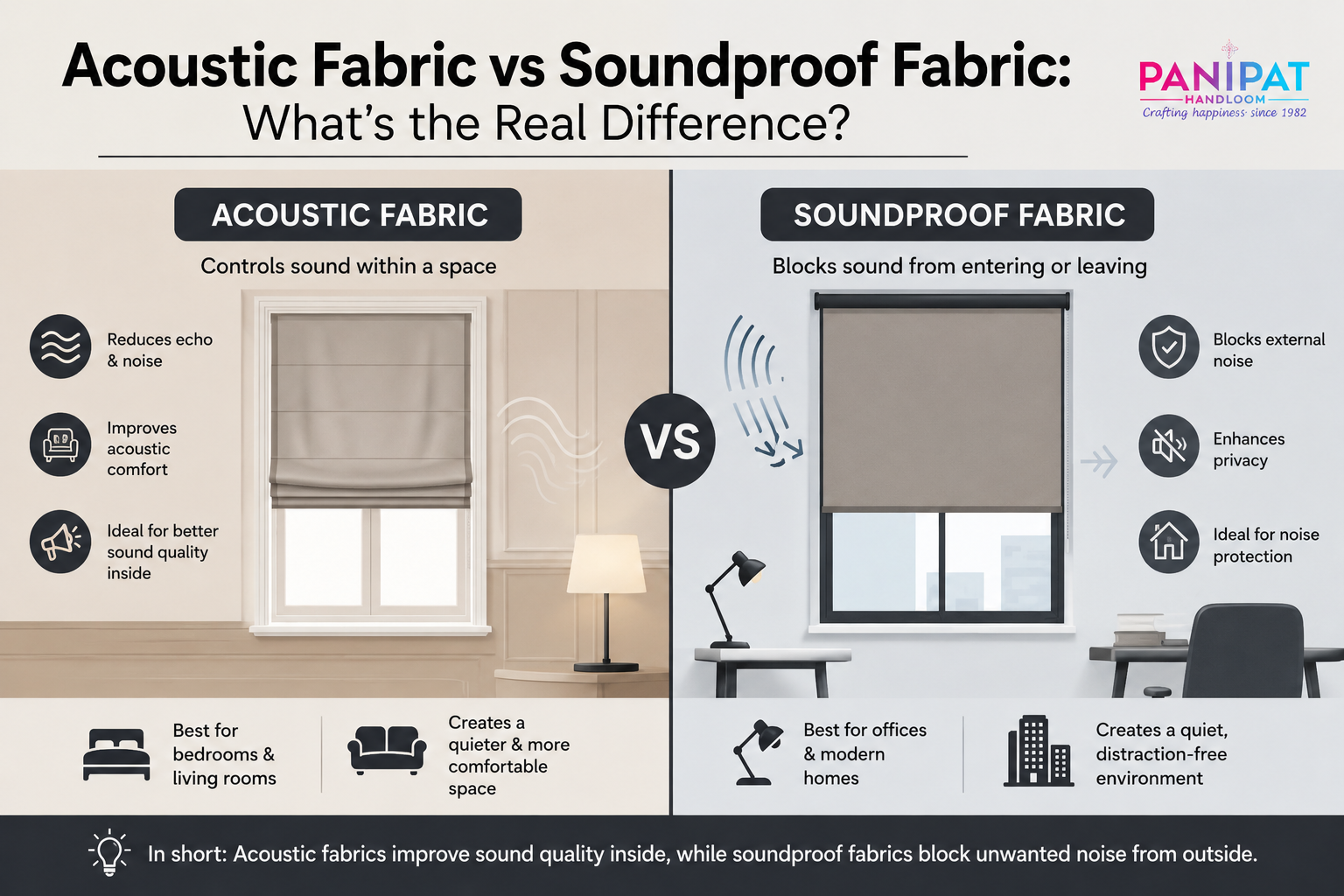
Acoustic Fabric vs Soundproof Fabric: What's the Real Difference?
The number of clients walking into our Delhi and Gurugram showrooms asking for "soundproof curtains" has gone up sharply in the last two years. What they almost always need is acoustic fabric, not soundproof fabric. The two get used interchangeably online but they do completely different jobs. Confusing one for the other is the single most common reason people end up disappointed with their noise control results.
The Panipat Handloom Acoustic Treatment Team has been specifying fabric solutions across hundreds of homes, home theatres and small offices in Delhi NCR. The pattern is consistent. Clients who understand the difference upfront get the result they expected. Clients who don't, end up spending Rs 25000 on a curtain expecting silence then complain when traffic noise still leaks through.
This blog clears the confusion. It covers what each fabric actually does, the price ranges in the Indian market, where each one fits best and which combination delivers real noise control for an Indian apartment or villa.
What Acoustic Fabric Actually Is
Acoustic fabric is a sound absorbing material. Its job is to soak up sound that already exists inside a room so the room sounds cleaner, calmer and less echoey. Acoustic fabric reduces what audio specialists call reverberation. That's the lingering echo you hear in an empty marble lobby or a glass-walled restaurant.
When sound waves hit acoustic fabric, the fibre structure breaks them up and converts the energy into a tiny amount of heat by friction. The sound doesn't bounce back into the room. It just fades away. This is why a velvet drape or a thick wool curtain makes a room feel warmer and more intimate the moment you hang it.
The technical rating to look for is NRC, which stands for noise reduction coefficient. NRC measures how much sound a material absorbs on a scale of 0 to 1. An NRC of 0.70 means the fabric absorbs 70 percent of the sound that hits it. Indian acoustic fabrics that we stock typically range from 0.35 NRC for medium grade options to 0.85 NRC for studio grade material.
What Soundproof Fabric Actually Is (And Why It's a Misleading Term)
Here's the part most websites won't tell you. There is no such thing as a truly soundproof fabric. No fabric, on its own, can fully block sound from entering or leaving a room. Soundproofing is a structural job. It requires mass, density and air sealing across the walls, ceiling, floor, doors and windows.
What the market calls "soundproof fabric" is actually a layered composite. It usually combines a face fabric (velvet or polyester) with a dense interlining like mass loaded vinyl (MLV) or a high density felt core, then a backing layer. The whole assembly together blocks some of the sound transmission. The fabric alone does almost nothing.
The technical rating to look for here is STC, which stands for sound transmission class. STC measures how much sound a material stops from passing through it. Most decent quality soundproof curtain assemblies in India achieve STC 25 to STC 29. For reference, a normal apartment wall is usually STC 33 to STC 45. So even a heavy soundproof curtain is weaker than the wall it hangs against.
Sound Absorption vs Sound Blocking: The Core Difference
This is where most clients have their lightbulb moment. There are two completely different problems people are trying to solve.
Problem 1 is echo inside the room. The TV sounds harsh. Voices on calls sound thin. Music gets muddy. The room feels noisy even when the windows are shut. This is a sound absorption problem. The fix is acoustic fabric.
Problem 2 is noise from outside the room. Traffic from Outer Ring Road. The neighbour's dog. Construction next door. Temple bells at 6 am. This is a sound blocking problem. Acoustic fabric will barely touch it. You need a soundproof curtain assembly plus better windows plus wall mass.
Mixing these up costs people money. A homeowner in Sector 62 Gurugram spends Rs 80000 on heavy velvet drapes hoping to block highway noise. The drapes look beautiful and the room sounds calmer. But the highway is still audible because velvet is an absorber, not a blocker.
Quick Reality Check Table
|
What You Want |
Real Problem Type |
Fabric You Need |
Realistic Result |
|---|---|---|---|
|
Less echo in living room |
Sound absorption |
Acoustic fabric (velvet, wool blend) |
40 to 70 percent echo gone |
|
Quieter calls in home office |
Sound absorption |
Acoustic fabric plus wall panels |
Cleaner audio, less reverb |
|
Block highway noise |
Sound blocking |
Soundproof curtain assembly plus window upgrade |
10 to 20 dB reduction |
|
Block neighbour's TV |
Sound blocking |
Wall mass plus door seal plus soundproof curtain |
15 to 25 dB reduction |
|
Home theatre clarity |
Both |
Acoustic panels plus soundproof curtains plus carpet |
Cinema-grade acoustics |
The table covers 80 percent of real-world residential cases. Anything beyond this usually requires a site visit and a proper noise survey.
Acoustic Fabric Types Used in Indian Homes
Indian homes use several acoustic fabric categories. Each one has a sweet spot. The Panipat Handloom Acoustic Treatment Team works with all of these every week across our Delhi and Gurugram showrooms.
Velvet and Velour
Velvet is the most popular acoustic fabric for Indian living rooms and bedrooms. Its dense pile traps mid and high frequency sound effectively. The visual richness suits the way Indian homes are decorated. Velvet absorbs in the 0.50 to 0.65 NRC range depending on weight. The Panipat velvet range covers weights from 280 GSM to 450 GSM with the heavier options performing better acoustically.
Suede and Suede Blends
Suede works similarly to velvet but with a flatter visual finish. The microfibre surface offers moderate absorption at 0.40 to 0.55 NRC. Good for clients who want acoustic benefit without the formality of velvet. Our suede fabric range for upholstery and curtains is available in both Indian and imported variants.
Heavy Linen and Cotton Blends
Linen and cotton in heavy GSM ranges (350 plus) deliver light absorption around 0.30 to 0.40 NRC. These are popular for clients chasing a natural look in a Japandi or Wabi-Sabi style room. Not the best pure performers but they combine well with wall panels behind them. The Panipat curtain linen fabric collection covers this exact use case.
Acoustic Polyester (Engineered Acoustic Fabric)
This is specifically engineered for acoustic performance, usually used as the face fabric on acoustic wall panels. NRC ratings climb to 0.75 to 0.85 because the fibre structure is optimised for sound absorption. Used heavily in our home theatre and studio installations.
Wool Felt and Wool Blends
Wool is naturally one of the best acoustic fibres. Wool felt acoustic panels achieve 0.70 to 0.85 NRC. The downside in India is cost and humidity sensitivity. Wool blends work better than pure wool in Delhi summers.
Soundproof Fabric: Why True Soundproofing Needs More Than Cloth
If you're serious about blocking outside noise, you need to think in terms of layers not just fabric.
A real soundproof curtain assembly in the Indian market typically looks like this. A face fabric (usually 350 GSM velvet or acoustic polyester). A middle barrier layer (mass loaded vinyl at 1 kg per square metre or a dense felt core at 500 GSM). A backing fabric for finish. The whole thing weighs 4 to 5 kg per square metre, which is six to ten times heavier than a normal curtain.
This weight is exactly why it blocks more sound. Mass blocks sound transmission. Light fabric doesn't. That's the rule.
But here's the catch. Even the best soundproof curtain only delivers STC 25 to 29. To actually block traffic noise, you also need:
- Window upgrade. Single pane glass leaks sound badly. Switching to DGU (double glazed unit) or laminated glass cuts external noise by 8 to 12 dB before the curtain even matters. Our UPVC doors and windows range addresses this layer.
- Edge sealing. A curtain that leaves a 5 cm air gap on the sides leaks 40 percent of its potential noise blocking. Side tracks or wrap-around brackets fix this.
- Door seal. If the room door has a 1 cm gap at the bottom, the curtain on the window does very little overall. Door seals and acoustic door bottoms close this.
- Wall mass. Shared walls with neighbours need extra mass through wall panels or partition systems like the honey comb partition door range.
Skip any of these and the soundproof curtain alone underperforms. Clients who treat soundproofing as a layered system get real results. Clients who treat it as a single product purchase don't.
Acoustic Fabric vs Soundproof Fabric: Side by Side Comparison
This table is the one to bookmark.
|
Parameter |
Acoustic Fabric |
Soundproof Fabric (Assembly) |
|---|---|---|
|
Primary job |
Absorbs sound inside the room |
Blocks sound from entering or leaving |
|
Key rating |
NRC (0.30 to 0.85 typical) |
STC (25 to 29 typical for curtains) |
|
Weight range |
280 to 500 GSM |
1500 to 4500 GSM total assembly |
|
Effect on echo |
High. Makes rooms sound cleaner |
Low. Doesn't address echo on its own |
|
Effect on outside noise |
Minimal. 2 to 4 dB reduction at most |
Meaningful. 10 to 20 dB reduction |
|
Best installation |
Wall panels, curtains, ceiling |
Window curtains, door covers, partitions |
|
Price range India |
Rs 250 to Rs 900 per sq ft |
Rs 450 to Rs 1500 per sq ft |
|
Common materials |
Velvet, suede, linen, acoustic polyester, wool |
Velvet plus MLV plus felt plus backing |
|
Works as standalone |
Yes. Hangs as a curtain or panel |
No. Needs window, door and wall coordination |
|
Best for |
Echo control, voice clarity, home theatre treatment |
Traffic noise, neighbour noise, street noise |
The takeaway: most Indian homes need both not one. Acoustic fabric for the inside, soundproof assembly for the outside. The right specification depends on the room.
Acoustic Fabric Price in India: What You Actually Pay
The Indian market has matured over the past three years. Both fabric pricing and product availability have become more transparent. Here's what the Panipat Handloom Acoustic Treatment Team currently quotes across recent residential and small commercial projects.
Acoustic Fabric Price Bands (Per Square Foot, Material Only)
|
Fabric Category |
Entry |
Mid |
Premium |
|---|---|---|---|
|
Acoustic Velvet |
Rs 250 to 380 |
Rs 400 to 580 |
Rs 600 to 900 |
|
Suede Blend |
Rs 220 to 320 |
Rs 350 to 480 |
Rs 500 to 700 |
|
Heavy Linen |
Rs 180 to 250 |
Rs 280 to 400 |
Rs 420 to 600 |
|
Acoustic Polyester |
Rs 280 to 380 |
Rs 400 to 550 |
Rs 580 to 800 |
|
Wool Felt Panel Fabric |
Rs 450 to 600 |
Rs 650 to 850 |
Rs 900 to 1400 |
Fabric only. Stitching, lining and installation add roughly Rs 80 to Rs 150 per square foot depending on style.
Soundproof Curtain Assembly Pricing
A complete soundproof curtain installed for a standard 5 by 7 foot window in Delhi or Gurugram runs as follows.
|
Tier |
What You Get |
Installed Price (5x7 ft window) |
|---|---|---|
|
Entry |
Heavy velvet face, single barrier layer, basic track |
Rs 12000 to Rs 18000 |
|
Mid |
Premium velvet, MLV core, side tracks, edge sealing |
Rs 22000 to Rs 35000 |
|
Premium |
Acoustic polyester face, MLV core, felt back, motorised track |
Rs 40000 to Rs 65000 |
Premium installations typically only make sense for home theatres, recording spaces and bedrooms facing very high noise zones like main roads in South Delhi or sector roads in Gurugram. For most apartments mid tier gets the job done.
For pure aesthetic curtains where acoustic absorption is a nice side effect rather than the goal, the Panipat curtains collection and D'Decor curtain range deliver good absorption with much wider style and pattern choices.
Where Each Fabric Works in a Real Home
Let's get specific by room. This is what the Panipat Handloom Acoustic Treatment Team usually recommends across Delhi NCR projects.
Living Room
Goal is usually voice clarity for guests and TV viewing. Acoustic fabric does 90 percent of the work here. Velvet curtains across the largest wall, a heavy carpet on the floor, soft furnishings on the sofa. The absorption stack handles the echo problem easily. Soundproof curtains are only required if the living room faces a main road. The wall to wall carpet range is the second biggest absorber after the curtain in this room.
Master Bedroom
Goal is restful sleep. Both fabrics earn their place here. Acoustic fabric on the curtains for inside comfort plus a soundproof curtain assembly on the window facing the road if there's external noise. The Panipat blackout fabric range is often layered behind a velvet front curtain to combine light blocking with sound absorption.
Home Theatre
Goal is studio level clarity. This room needs everything. Acoustic fabric panels on the walls (40 to 60 percent wall coverage). Heavy curtains across the projector wall and rear wall. Wall to wall carpet. Soundproof door treatment. The Accosting Panel range is the core product for the wall coverage, paired with velvet or acoustic polyester curtains. We've covered the home theatre specification in detail in a separate buying guide on the blog.
Home Office and Calls Room
Goal is clean voice on calls. Modest acoustic treatment is enough. A heavy curtain on the window, an acoustic wall panel behind the camera position and a carpet under the desk. Total cost stays under Rs 50000 for most setups. The foam tiles for wall range is a quick add-on here.
Kids Room and Study
Goal is concentration and noise dampening. A simple acoustic velvet curtain on the window plus a soft area rug delivers most of the benefit. Soundproof assembly isn't needed unless the room shares a wall with a noisy area.
Common Mistakes Home Buyers Make
In our experience working with Delhi and Gurugram homeowners, these mistakes show up again and again.
Buying "soundproof curtains" expecting silence. No fabric delivers silence. The realistic expectation is a 10 to 20 dB reduction in transmitted noise, which feels meaningful but isn't silence.
Skipping the window upgrade. Most people pay Rs 30000 for a soundproof curtain and don't realise their single pane window is leaking 70 percent of the sound. Upgrade the glazing first or do both together.
Ignoring the side gaps. A curtain that doesn't have side tracks or wrap brackets leaves air gaps. Sound takes the path of least resistance so air gaps drop curtain performance by 30 to 50 percent.
Treating acoustic as decoration only. Some clients pick acoustic fabric purely on look then complain when the room still echoes. Coverage matters. You need 30 to 40 percent of total room surface treated for noticeable absorption.
Trying to block bass with fabric. Low frequency sound (below 250 Hz) passes through almost any fabric assembly. Blocking bass needs structural changes like decoupled walls and resilient mounting, not curtains.
Key Takeaways
Acoustic fabric absorbs sound inside a room. Soundproof fabric (or rather, soundproof assembly) blocks sound from passing through. The two are not the same. NRC is the rating for absorption. STC is the rating for blocking. Velvet, suede and acoustic polyester are the main acoustic fabrics used in Indian homes. Soundproof curtains in India typically achieve STC 25 to 29 and deliver 10 to 20 dB external noise reduction, not silence. Real soundproofing needs a system that includes window upgrade, edge sealing, door treatment and wall mass, not just a curtain. Price ranges run from Rs 180 per sq ft for entry linen up to Rs 1400 per sq ft for premium wool felt. Most Indian homes benefit from both fabric types working together, sized to the specific room and noise problem.
The Final Word
The acoustic fabric vs soundproof fabric question gets clearer once you separate the two problems being solved. Inside-the-room sound (echo, reverb, harshness) is an absorption job. Acoustic fabric is the answer. Outside-the-room noise (traffic, neighbours, street activity) is a blocking job. Even the best soundproof curtain only handles part of it. The honest specification combines both, scaled to the actual room and budget.
For a full site walkthrough of bedroom, living room, home theatre and home office acoustic requirements across Gurugram and Delhi, the Panipat Handloom Acoustic Treatment Team covers measurement, fabric selection, wall panel coordination and installation in a single engagement. Walk in to our N-14 South Extension Part 1 store in New Delhi or the Dharam Plaza store in Sector 62 Gurugram. Browse the full window treatment shop category before the consultation.
Frequently Asked Questions
Q: What is the real difference between acoustic fabric and soundproof fabric?
Acoustic fabric absorbs sound inside a room to reduce echo and reverberation. Soundproof fabric, more accurately a soundproof curtain assembly, blocks sound from transmitting between rooms or from outside. Acoustic fabric uses NRC ratings (0 to 1 scale) while soundproof assemblies use STC ratings. Most Indian homes need both, not one or the other.
Q: Can a curtain really make a room soundproof?
No fabric makes a room soundproof on its own. A well designed soundproof curtain assembly with mass loaded vinyl core, edge sealing and a proper window underneath can deliver 10 to 20 dB external noise reduction. That's a meaningful improvement but not silence. True soundproofing requires structural changes to walls, ceiling and floor.
Q: What is the price of acoustic fabric in India?
Acoustic fabric prices in India range from Rs 180 per square foot for heavy linen at entry level to Rs 1400 per square foot for premium wool felt acoustic panels. Mid grade acoustic velvet sits at Rs 400 to Rs 580 per square foot. Installation, stitching and lining add Rs 80 to Rs 150 per square foot on top of fabric cost.
Q: Which fabric is best for blocking outside traffic noise?
For blocking traffic noise the best fabric choice is a layered soundproof curtain assembly that combines a heavy velvet or acoustic polyester face fabric, a mass loaded vinyl (MLV) middle barrier and a backing layer. Total assembly weight should be 4 to 5 kg per square metre. Combine with a DGU window and edge sealing tracks for best results.
Q: How much noise reduction can I realistically expect?
Acoustic fabric reduces echo and improves room sound quality but only reduces external noise by 2 to 4 dB. Soundproof curtain assemblies deliver 10 to 20 dB external noise reduction when paired with a proper window upgrade and edge sealing. For 25 to 35 dB reduction you need full structural soundproofing, not just fabric.
Q: Does velvet really absorb sound?
Yes. Heavy velvet at 350 GSM and above absorbs sound effectively in the mid and high frequency range. Velvet's dense pile traps sound waves and converts the energy through friction. NRC ratings for velvet typically fall between 0.50 and 0.65. Velvet does not block sound from transmitting through, which is a separate function handled by mass loaded barriers.
Q: Can I use acoustic fabric in a small flat in Delhi or Gurugram?
Yes. Acoustic fabric works well in small flats and apartments across Delhi NCR. For a typical 2 BHK or 3 BHK apartment, heavy curtains in the living room and bedroom plus a wall to wall carpet or area rug delivers most of the absorption benefit. Soundproof curtain assemblies are worth adding only for rooms facing main roads or noisy neighbours.
Q: How do I know if my home needs acoustic or soundproof treatment?
Acoustic treatment is needed when the room echoes, voices sound thin or the TV sounds harsh even with windows shut. Soundproof treatment is needed when external noise leaks in despite closed windows. Many homes need both. A site visit from the Panipat Handloom Acoustic Treatment Team includes a basic noise survey to identify which problem dominates and what specification fits the budget.