

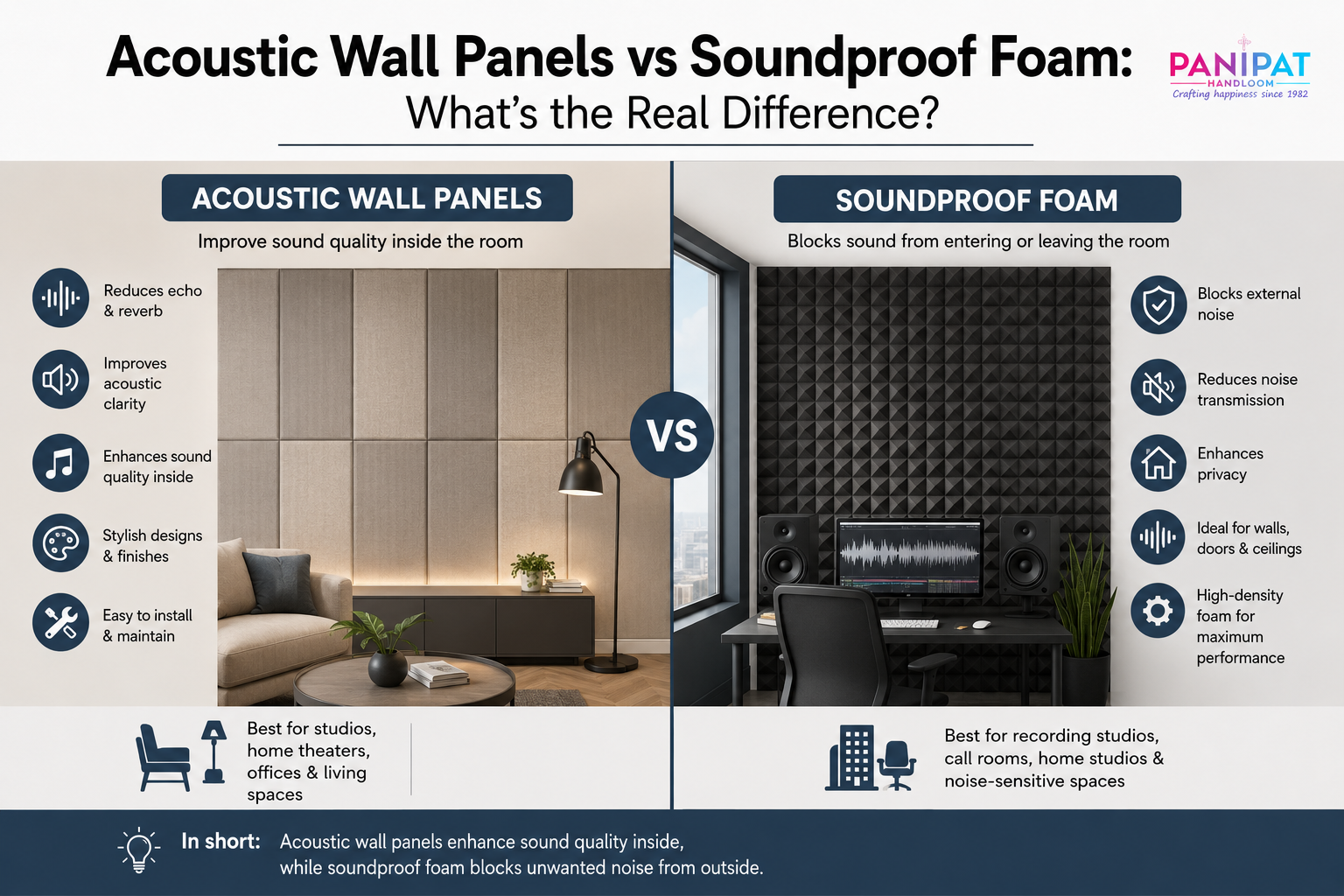
Acoustic Wall Panels vs Soundproof Foam: Pick the Right Treatment
Walk into any music studio or home theatre review on YouTube and you'll see two products doing the same job in two completely different ways. Acoustic wall panels (flat, fabric wrapped, often quite attractive) and soundproof foam (egg-crate or pyramid shaped, usually black or grey). Most clients in our Delhi and Gurugram showrooms assume these are the same thing. They aren't.
Both absorb sound. Neither actually blocks it. But the way they absorb, the frequency range they cover, the look they bring to a room and the price they command are all very different. The Panipat Handloom Wall Decor Team has installed both across home theatres, offices, podcast rooms and recording setups. Here's the honest breakdown of when each one earns its place.
What Acoustic Wall Panels Are
Acoustic wall panels are dense core boards (usually mineral wool, fibreglass, polyester fibre or wood wool) wrapped in a fabric finish. Thickness typically runs 9 mm to 50 mm. NRC ratings range from 0.70 to 0.95 depending on core density and thickness. They cover a wide frequency range, including the mid range where the human voice sits (250 Hz to 2000 Hz). This is why panels do better in home offices and meeting rooms where speech clarity matters.
The fabric face also means panels match interior design. You can spec them in velvet, linen, jute or printed fabric. Our Accosting Panel range covers most fabric finish options with custom sizing.
What Soundproof Foam Is
Soundproof foam (technically acoustic foam, since no foam actually soundproofs anything) is open-cell polyurethane or melamine foam moulded into pyramid, wedge or egg-crate shapes. Thickness 25 mm to 100 mm. NRC ratings climb past 0.85 but the absorption is heavily skewed toward high frequencies above 1000 Hz. Bass and lower mids slip through almost untouched.
The shape isn't decorative. The peaks and valleys increase surface area and create varying air gaps. Together these absorb high frequency reflections better than a flat surface would. The trade-off is the look. Most foam is visibly industrial and not always a fit for a living room or bedroom. Our Foam Tiles for Wall range covers the standard pyramid and wedge formats.
Acoustic Wall Panels vs Soundproof Foam: Side by Side
|
Parameter |
Acoustic Wall Panels |
Soundproof Foam |
|---|---|---|
|
Core material |
Mineral wool, fibreglass, polyester, wood wool |
Polyurethane or melamine foam |
|
Finish |
Fabric wrapped, customisable |
Bare foam, pyramid or wedge shape |
|
NRC rating |
0.70 to 0.95 |
0.50 to 0.90 (mostly highs) |
|
Frequency strength |
Mid and high range. Covers speech well |
High range only. Misses speech mids |
|
Thickness |
9 mm to 50 mm |
25 mm to 100 mm |
|
Aesthetic |
Looks like wall art |
Looks like studio gear |
|
Fire safety |
Class A available as standard |
Check certification carefully |
|
Lifespan |
10 plus years |
5 to 8 years (degrades faster) |
|
Best for |
Home theatres, offices, living rooms, bedrooms |
Recording booths, gaming rooms, spot treatment |
|
Price India |
Rs 180 to Rs 700 per sq ft |
Rs 50 to Rs 250 per sq ft |
The simplest way to remember it. Panels are full-room treatment for living spaces. Foam is spot treatment for utility spaces. If the room has guests or family in it, lean panels. If it's a closed door studio or vocal booth, foam works fine.
Prices in India: What You Actually Pay
|
Tier |
Acoustic Wall Panels |
Soundproof Foam |
|---|---|---|
|
Entry |
Rs 180 to Rs 280 per sq ft |
Rs 50 to Rs 90 per sq ft |
|
Mid |
Rs 320 to Rs 480 per sq ft |
Rs 100 to Rs 160 per sq ft |
|
Premium |
Rs 500 to Rs 700 per sq ft |
Rs 180 to Rs 280 per sq ft |
Installation runs Rs 60 to Rs 150 per sq ft on top of material for both, depending on whether the wall needs prep work. Premium panels with custom fabric or designer profiles can push past Rs 1000 per sq ft when paired with options from the designer wall panelling collection.
For full room treatment, a typical home theatre with 30 percent wall coverage runs Rs 65000 to Rs 1.4 lakh installed using panels. The same coverage using foam comes down to Rs 22000 to Rs 55000 installed but with a noticeably less premium look.
Which One to Pick for Your Room
Home theatre. Use panels. Speech clarity matters and the room is meant to look polished. Foam belongs only on hidden walls behind the projector or inside in-wall speaker boxes.
Home office, podcast or video call setup. Use panels. Voice frequencies sit in the mid range where panels outperform foam significantly. A single 4 ft x 2 ft panel behind the camera position handles 70 percent of the problem.
Recording vocal booth. Either works. Foam wins on cost. Booths are small, closed and the look doesn't matter.
Gaming room or teenager's room. Foam is the budget pick, easy to install with adhesive backing and replaceable cheaply. Pair with a heavy curtain on the window for the full effect.
Living room or bedroom that needs sound calming. Panels every time. Foam has no place in residential living spaces unless tucked behind furniture.
Restaurant, café or small retail. Panels with printed or coloured fabric. They double as decor. Foam looks unprofessional in any customer-facing area.
For broader wall treatment that handles acoustics alongside aesthetics, the wall panelling shop category covers louver, fluted and slat profiles that provide light acoustic benefit while delivering full visual coverage. The charcoal wall louver range is a particularly common pick for Delhi NCR living rooms that want acoustic dampening without the studio look.
Key Takeaways
Acoustic wall panels and soundproof foam both absorb sound but neither blocks it. Panels cover a wider frequency range and look like part of the interior. Foam is a budget option that handles high frequencies well but misses the mid range where speech sits. Panels suit living areas, home theatres and offices. Foam suits closed booths, studios and budget-driven utility rooms. Indian pricing runs Rs 180 to Rs 700 per sq ft for panels and Rs 50 to Rs 250 per sq ft for foam. Coverage matters more than thickness. Plan 30 to 40 percent wall coverage for noticeable results in either format.
The Final Word
The acoustic wall panels vs soundproof foam debate isn't really a competition. It's a matching exercise. Match the product to the room and the people who use it. Panels for the spaces you live in and entertain in. Foam for the spaces you work behind a closed door. Most home theatre installations across Delhi and Gurugram use both, with panels on visible walls and foam tucked behind speakers or inside door panel cavities.
The Panipat Handloom Wall Decor Team handles measurement, fabric matching for panels, foam grade selection and installation across both showrooms. Walk in to our N-14 South Extension Part 1 store in New Delhi or the Dharam Plaza store in Sector 62 Gurugram. Browse the full wall decor shop category before the consultation.
Frequently Asked Questions
Q: Are acoustic wall panels better than soundproof foam?
For most home and office uses, yes. Acoustic wall panels cover a wider frequency range, last longer and look better in residential settings. Foam is cheaper and works well in closed studio or vocal booth applications where high frequency absorption is the only goal.
Q: Does soundproof foam actually soundproof a room?
No. Soundproof foam absorbs sound reflections inside a room but does not block sound transmission through walls. The name is misleading. True soundproofing requires structural mass and air sealing, not foam.
Q: What is the price of acoustic wall panels in India?
Acoustic wall panel prices in India start at Rs 180 per square foot for entry level fabric wrapped polyester panels and climb to Rs 700 per square foot for premium mineral wool or wood wool panels. Designer custom panels can cross Rs 1000 per square foot. Installation adds Rs 60 to Rs 150 per square foot.
Q: Can I install acoustic foam over an existing wall in my Delhi flat?
Yes. Most acoustic foam tiles come with adhesive backing or can be mounted with command strips. The wall surface must be clean and dry. Avoid foam on freshly painted walls (wait 30 days) and avoid pasting over wallpaper or fabric surfaces.
Q: How much wall coverage do I need for acoustic treatment to work?
For noticeable echo reduction, treat 30 to 40 percent of total wall surface area. Below 20 percent the effect is minimal. For home theatres and recording rooms, 50 to 60 percent coverage delivers studio level acoustics. Spreading the coverage evenly across multiple walls works better than concentrating it on one wall.