

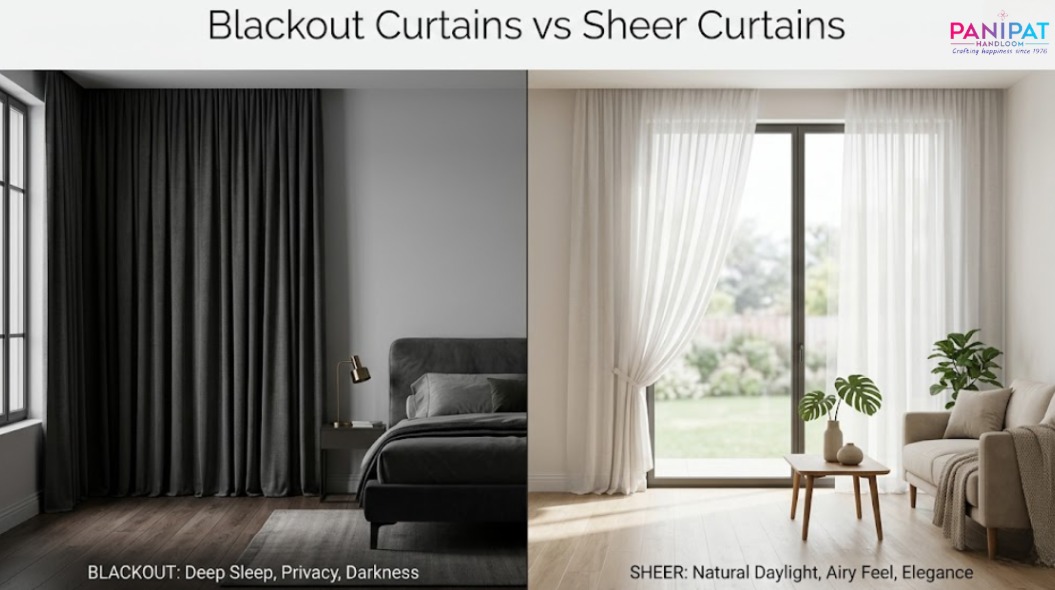
Blackout Curtains vs Sheer Curtains: Which Should You Choose?
Curtains are the most expressive window treatment in any home; they define the mood, the privacy, and the character of a room more than almost any other element, much like Sabyasachi wallpapers. But choosing between blackout and sheer curtains leaves many Indian homeowners uncertain. Each type has a fundamentally different function, and using the wrong one in the wrong room is a common interior design mistake.
This guide provides a complete, honest comparison of blackout and sheer curtains — covering fabric, function, light control, privacy, maintenance, cost, and room-wise recommendations for Indian homes in 2026.
What Are Blackout Curtains?
Blackout curtains are made from tightly woven or foam-backed fabric that blocks the majority of incoming light — typically 85–99% depending on the fabric and liner. The term 'blackout' refers to the light-blocking performance of the fabric, not the colour. Blackout curtains are available in a wide range of colours, patterns, and textures from plain white polyester to embroidered velvet, leatherette fabric finishes, to printed linen.
The blackout performance is achieved through one of three construction methods:
- Triple-weave fabric: Three layers woven together with a black yarn core. Dense, no coating, breathable to some degree.
- Foam-backed fabric: A foam layer bonded to the back of the face fabric. The most common and affordable blackout construction.
- Blackout lining: A separate blackout lining fabric sewn or hung behind the main face fabric. Allows any decorative fabric to become a blackout curtain.
What Are Sheer Curtains?
Sheer curtains are made from lightweight, loosely woven or open-weave fabrics — organza, voile, chiffon, lace, or sheer polyester — that allow diffused light to pass through while providing a degree of daytime privacy. They do not block light; they transform it, similar to the effect of Cosmo Sunshield Solar Film.
The primary function of sheer curtains is to create a soft, luminous atmosphere in a room — filtering harsh sunlight into a gentle, diffused glow that makes spaces feel warm and romantic. They also provide privacy from outside observers during daylight hours (when the interior is darker than the exterior) while maintaining the sense of connection to the outside.
Complete Comparison Table
|
Factor |
Blackout Curtains |
Sheer Curtains |
|---|---|---|
|
Light blocking |
85–99% of light blocked |
0–15% blocked — diffuses light |
|
Daytime privacy |
Complete when closed |
Good — obscures silhouettes |
|
Night privacy |
Complete |
Poor — interior lit rooms visible from outside |
|
Fabric weight |
Heavy — 250–500 GSM |
Light — 50–120 GSM |
|
Common fabrics |
Polyester, velvet, linen, cotton (lined) |
Voile, organza, chiffon, sheer polyester |
|
Starting price Delhi |
Rs. 180–350 per metre |
Rs. 80–200 per metre |
|
Washing |
Machine wash (most polyester); dry clean (velvet, silk lined) |
Machine wash — gentle cycle |
|
Ironing |
Required for natural fabrics |
Light iron or steam only |
|
Mood / atmosphere |
Cosy, dramatic, private |
Airy, romantic, luminous |
|
Best room |
Bedroom, media room, baby nursery |
Living room, dining room, study |
|
Energy efficiency |
Good — blocks solar heat gain |
None — allows solar heat through |
The Case for Blackout Curtains
Blackout curtains are essential wherever sleep quality, screen use, or privacy is the dominant requirement. In Indian bedrooms — where east-facing windows can flood the room with intense morning sun by 5:30 AM in summer — a blackout curtain is not a luxury but a functional necessity. They are also the only appropriate curtain for home theatre rooms, baby nurseries, and rooms where shift workers sleep during daylight hours, sometimes combined with Garware Suncontrol Window Film for extra light control.
Beyond sleep, blackout curtains with foam-backed or thermally lined fabric provide meaningful heat insulation at the window — reducing solar heat gain in summer and heat loss in winter. For rooms with large south-facing or west-facing windows in Delhi, a quality blackout curtain can reduce air conditioning load noticeably during peak summer months.
The Case for Sheer Curtains
Sheer curtains excel wherever the goal is to enhance light rather than block it. A living room with east-facing windows and white or cream sheer curtains becomes a luminous, naturally lit space through the morning that no blackout treatment could match. Sheer curtains also soften the visual connection between the interior and exterior — providing a translucent screen that creates privacy without cutting off the outside world.
Many Indian interior designers use sheer curtains as the primary window treatment in living and dining rooms, layered with heavier drapes that can be drawn for evening privacy. This layered approach is the most flexible sheer for day, drapes for evening and allows full range from open and bright to closed and private, especially when coordinated with interiors like Donaire Carpet Tiles.
Combining Both: The Layered Curtain Approach
The most functional and aesthetically sophisticated solution is to use both sheer and blackout curtains on the same window, a technique called layering, often enhanced with motorized curtain systems.The sheer curtain hangs closest to the glass and diffuses light during the day. The blackout curtain hangs in front and can be drawn closed for complete privacy and darkness at night.
- Double curtain rod: Install two parallel curtain rods — the inner rod for sheer curtains, the outer rod for blackout curtains. Each set can be drawn independently.
- Track and rod combination: A ceiling-mounted curtain track with two channels allows both sheer and blackout curtains to run on the same installation.
- Cost: Expect Rs. 300–600 per metre for a quality combined sheer + blackout layered installation including both fabrics and a double rod.
Fabric Recommendations from The Panipat Handloom
For Blackout Curtains
- Panipat Blackout fabric: Own-brand foam-backed blackout polyester available in 40+ colours. Best value for bedrooms.
- Velvet curtains with blackout lining: Premium choice for master bedrooms and living rooms. Rich texture, excellent light blocking.
- Linen with blackout lining: Natural look with full blackout performance. Popular in contemporary Indian interiors.
For Sheer Curtains
- Panipat Sheer Fabric: Lightweight polyester sheer in white, cream, and light grey. Machine washable and crease-resistant.
- Organza sheers: More structured and slightly textured than voile. Holds shape well and adds visual interest.
- Embroidery sheer: Sheer base fabric with embroidered patterns floral, geometric, or abstract, inspired by Broderie Border Collection.
Pricing — Delhi & Gurugram 2026
|
Product |
Economy |
Mid-Range |
Premium |
|---|---|---|---|
|
Blackout Curtains (per metre) |
Rs. 180–250 |
Rs. 260–350 |
Rs. 360–600+ |
|
Sheer Curtains (per metre) |
Rs. 80–130 |
Rs. 135–200 |
Rs. 210–400 |
|
Blackout Lining (per metre) |
Rs. 60–90 |
Rs. 95–130 |
Rs. 135–180 |
|
Double Curtain Rod (per window) |
Rs. 400–700 |
Rs. 700–1,200 |
Rs. 1,200–2,500 |
|
Stitching & Making (per curtain) |
Rs. 150–250 |
Rs. 250–400 |
Rs. 400–800 |
Frequently Asked Questions
Q1. Do blackout curtains need to touch the floor?
For maximum light blocking, blackout curtains should ideally extend to the floor or pool slightly on it (1–3 cm), and should overlap the window frame by at least 10 cm on each side. Gaps at the sides or bottom of a blackout curtain allow light to enter and significantly reduce the blackout performance. This is particularly important for east and west-facing bedrooms where morning and afternoon sun enters at an oblique angle.
Q2. Can sheer curtains provide privacy at night?
No. The privacy that sheer curtains provide depends on the exterior being brighter than the interior — which is the case during daylight hours. At night, when interior lights are on and the exterior is dark, sheer curtains become transparent from outside. Anyone outside can see into a lit room through sheer curtains at night. For evening and night-time privacy, a second layer of blackout or dimout curtains is required.
Q3. How do I wash blackout curtains?
Most polyester blackout curtains are machine washable on a gentle cold cycle. Do not use bleach — it degrades the foam backing. Do not tumble dry on high heat — the foam backing can melt or separate. Air dry in the shade. Velvet and silk blackout curtains require professional dry cleaning. Always check the care label before washing, as the lining material determines the care requirement.
Q4. What is the best sheer curtain fabric for the Indian climate?
Polyester sheer fabrics are the most practical for Indian conditions — they are lightweight, machine washable, crease-resistant, and available in the widest range of colours and patterns. Natural sheer fabrics like cotton voile and silk organza look beautiful but require more delicate care and can shrink in washing. For high-humidity rooms or coastal locations, polyester sheers are strongly preferred.
RELATED READING
- Velvet Curtains: Luxury Look for Your Living Room on a Budget
- Linen Curtains: Why They Are the Most Popular Choice in 2026
- How to Measure and Hang Curtains Perfectly at Home
- Roller Blinds vs Zebra Blinds: Which Is Better for Indian Homes?
CONTACT THE PANIPAT HANDLOOM EMPORIUM
New Delhi: N-14, South Extension Part 1, New Delhi – 110049
Gurugram: Shop No. 3, Dharam Plaza, Brahma City, Sector-62, Gurugram – 122101
Phone: +91-9899073000 / +91-9999999009
Email: team@thepanipathandloom.com
Website: thepanipathandloom.com