

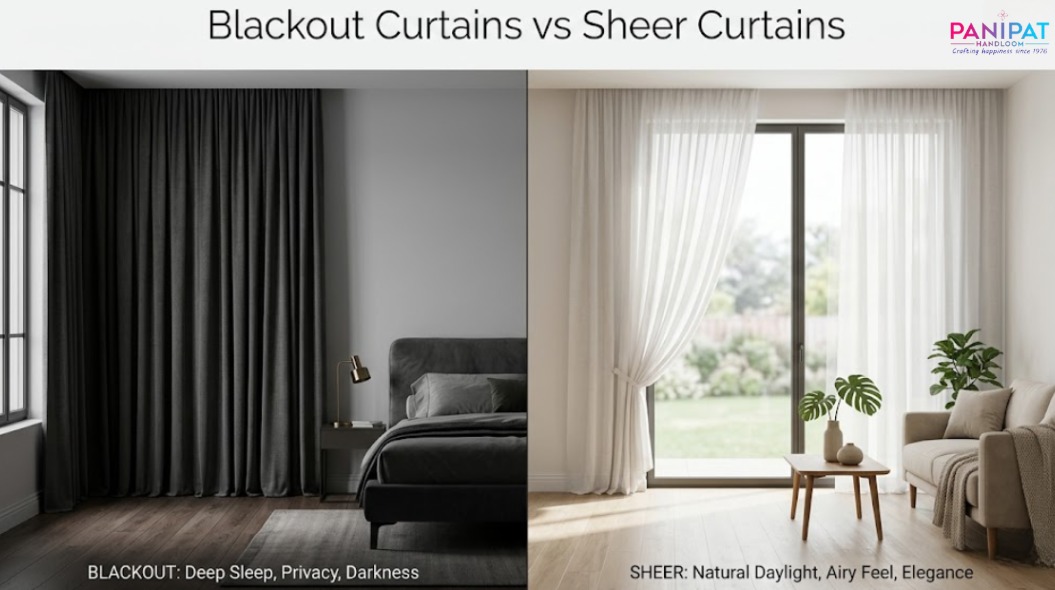
Blackout Curtains vs Sheer Curtains: Which Should You Choose
Choosing between blackout curtains vs sheer curtains sits at the heart of every window treatment decision for a modern Indian home. One blocks every ray of morning sun, the other lets a soft glow drift across the room at golden hour. Both serve real purposes, yet homeowners in Delhi NCR often struggle to work out which one fits where and whether they need one, the other, or both. The Panipat Handloom Window Treatment Team has handled thousands of installations across Gurugram and Dwarka, and the pattern is clear. The answer almost never lives at either extreme.
This guide walks through the real difference between blackout and sheer curtains, when each fabric wins, and the layered setup most premium homes end up choosing. Expect straightforward advice on blackout curtains sheer curtains styling, a look at how blackout curtains vs regular curtains actually perform, and practical rules for hanging both on the same window without the room feeling cluttered.
What Are Blackout Curtains?
Blackout curtains are densely woven panels, often constructed with two or three fabric layers or a thermal acrylic backing, designed to cut out almost all incoming light. They hold back 95 to 100 percent of daylight when installed correctly, which is why they anchor every premium bedroom setup. The Panipat Handloom Window Treatment Team recommends them anywhere sleep quality, projector image clarity, or infant rest is non-negotiable. Our Panipat blackout curtain fabric range uses a triple-weave polyester core that absorbs light rather than bouncing it around the room.
How blackout curtains are made matters more than most buyers realise. Lower-grade panels rely on a single dyed fabric and lose effectiveness within a year as the coating flakes. Quality blackout panels bond a light-blocking membrane between two woven surfaces, which also adds thermal insulation and sound dampening. That is the layer that lowers AC load in summer and keeps drafty winter glass from cooling the room. The complete window treatment solutions catalogue lists variants from matte velvet to satin-touch polyester, so the same function can arrive in completely different visual languages.
What Are Sheer Curtains?
Sheer curtains are lightweight, translucent panels that filter sunlight rather than block it. They soften glare, keep daytime privacy intact without darkening the room, and move beautifully in natural airflow. Sheer fabric reads luxurious when paired with good tailoring and full-width pleats. The Panipat sheer fabric catalogue covers voile, organza, linen-blend sheer, and embroidered variants, each giving a slightly different feel to the same window.
Most homeowners underestimate how much ambient warmth a sheer adds to living spaces. A single-layer sheer panel on a balcony door turns harsh afternoon light into a diffused wash across the floor, and the room feels larger. Our lightweight sheer fabric range is stocked in both neutral whites and tinted variants such as champagne and dove grey, which read richer than plain white without fighting the wall colour.
Blackout Curtains vs Sheer Curtains: Head-to-Head Comparison
The difference between blackout and sheer curtains becomes obvious once they hang side by side. One builds a sealed, quiet envelope around the room. The other opens the room up to the world outside while keeping it framed. The table below summarises how each fabric performs across the factors the Panipat Handloom Window Treatment Team tests during every consultation.
|
Feature |
Blackout Curtains |
Sheer Curtains |
|
Light Control |
Blocks 95 to 100 percent of light |
Filters natural light softly |
|
Privacy |
Full privacy day and night |
Daytime privacy only |
|
Fabric Weight |
Heavy, tightly woven, multi-layer |
Light, translucent, airy |
|
Insulation |
Blocks heat and cold |
Minimal insulation value |
|
Noise Reduction |
Dampens outside sound |
No significant sound effect |
|
Best Rooms |
Bedrooms, home theatres, nurseries |
Living rooms, balconies, dining areas |
|
Style Feel |
Dense, luxurious, structured |
Breezy, romantic, relaxed |
|
Energy Savings |
High, lowers AC load |
Low, mostly decorative |
The difference between blackout curtains and normal curtains also shows up here. Regular curtains sit in the middle, offering moderate light control without the coated membrane that defines true blackout. When a client tells us they want darkness but not total darkness, we usually steer them toward light-filtering panels in our customized curtains for your home range rather than mislabelling a regular panel as blackout.
Blackout Curtains vs Room Darkening Curtains
Room darkening curtains meaning is the most misunderstood term in window treatments. Room darkening curtains vs blackout is not a naming gimmick. The two are genuinely different products. Room darkening panels reduce incoming light by roughly 80 to 95 percent, leaving a soft ambient glow even at their densest. True blackout panels push past 99 percent, creating the kind of pitch-dark environment a light sleeper or home theatre demands.
Room darkening curtains vs blackout curtains matters most when the buyer has never seen either in person. A store demo with a bright showroom floor makes both look similar. The real test is a weekday morning with east-facing sun. A room darkening panel will give soft diffuse light. A blackout panel will feel like midnight. Clients upgrading from basic cotton drapes usually ask for the blackout upgrade after one installation visit, especially for master bedrooms. The Panipat curtain collection labels both categories clearly so there is no confusion at the point of order.
Blackout Curtains vs Regular Curtains
Blackout curtains vs regular curtains is a fair question because the two look identical on a catalogue page. The real gap is the construction. Regular curtains, even in heavy cottons or jacquards, lack the opaque interlining that stops light from passing through the weave. They will dim a room, not darken it. They will soften street noise, not absorb it. Our D'Decor curtain collection includes both styles, and the tag on each panel specifies whether a blackout interlining is included or must be added as a second layer.
The cost gap is smaller than most shoppers expect. A quality blackout upgrade adds roughly 20 to 35 percent to the price of a comparable decorative curtain. Given the performance lift on sleep, AC efficiency, and projector contrast, our team considers it one of the highest-return upgrades in any home fit-out. Homeowners shopping our premium linen fabric options often pair a linen face with a blackout lining, which keeps the natural fibre look without sacrificing performance.
Curtains vs Shades: Where Each Category Fits
Curtains vs shades is the parallel debate that runs alongside blackout versus sheer. Shades in all three forms (roller, zebra, roman) sit tight to the window frame, stack compactly, and give a cleaner architectural line. Curtains flow, drape, and soften hard walls. The two are not rivals. They solve different problems. The roller blinds alternative range works well on small utility windows where curtains would overwhelm the space, while our zebra blinds option layer light filtering and privacy into a single mechanism.
Plenty of homes use both on the same window: a functional roller blind at the glass, full-length curtains around the frame. This is the layout most interior designers reach for when a room has hard modernist architecture that needs softening without losing function.
Types of Curtains Sheer Blackout and Everything Between
Types of curtains sheer blackout ranges are wider than most first-time buyers realise. Between the two extremes sit light-filtering panels, thermal-lined semi-sheers, printed cotton drapes, and velvet dress curtains. Each has its place. Our team usually maps the full room, including window size, compass direction, and furniture palette, before committing to a fabric family.
For north-facing rooms that rarely see direct sun, a semi-sheer linen often does the whole job without a blackout backup. For south and west-facing rooms, a layered setup becomes essential by month three of summer. Our printed fabric designs and Panipat printed curtains collection hit the middle ground when the brief calls for pattern without losing light control.
How to Use Sheer Curtains with Blackout Curtains
How to use sheer curtains with blackout curtains is the single most common question our team fields. The layered setup, sometimes called curtains between sheer and blackout, is the premium hotel standard for a reason. During the day, the blackout panels pull aside and the sheer stays drawn, giving privacy plus soft light. At night, the blackout panels close over the sheer and the room goes dark. One window, two moods, zero compromise.
Blackout curtains and sheer curtains together solve three problems at once: light control, daytime privacy, and visual warmth. The sheer softens the blackout panel when it is pulled back, hiding the darker fabric against the wall and keeping the overall room palette light. Without the sheer, a bunched blackout panel reads heavy during the day. Running blackout and sheer curtains together is why luxury hotels almost universally specify the layered setup on every guest room window.
How to Hang Blackout Curtains and Sheer Curtains Together
How to hang blackout curtains and sheer curtains depends on the hardware. The cleanest answer is a double-track curtain system, where the sheer runs on the front track closest to the room and the blackout runs on the rear track closest to the glass. How to layer blackout curtains and sheer curtains this way keeps both fabrics moving independently, which is the whole point of the layered look. Our curtain rods and tracks catalogue lists both single and double rail options.
How to have blackout curtains and sheer curtains without a double rod is also possible, just less elegant. Some homeowners mount a slim rod inside the window recess for the sheer, then a heavier rod over the frame for the blackout. This works, but the two panels never meet cleanly when closed. How to hang blackout curtains and sheer curtains together on the same hardware is the cleaner route. For automated homes, our motorized curtain systems handle both layers with a single remote, which is worth the upgrade on large master bedroom windows.
Sheer curtains and blackout curtains on one rod is the budget option. Both panels thread through the same rod using separate rings, with the sheer behind and the blackout in front, or vice versa. It saves hardware cost, but the panels fight for stack space when open. The Panipat Handloom Window Treatment Team usually recommends it only for narrow windows where a double rod would feel overbuilt.
Do Sheer Curtains Go in Front or Behind Blackout Curtains
Do sheer curtains go in front or behind blackout curtains is a design call with a functional answer. The hotel standard, and our default recommendation, is sheer in front, blackout behind. This keeps the blackout tight to the glass where its insulating function matters, and shows the softer sheer fabric as the daytime visual layer.
Can you put sheer curtains over blackout curtains is the same question phrased differently, and yes, it works beautifully. The sheer diffuses light when the blackout is pulled back, and disappears as a background when the blackout is drawn. How to put sheer curtains over blackout curtains cleanly requires rings or hooks on a double track, not a single rod. How to add sheer curtains to blackout curtains in an existing installation is usually a simple hardware upgrade, meaning a second slim rail mounted in front of the existing blackout rod. Our self curtain fabric range pairs well with most existing blackout panels because the tonal range stays neutral.
Advantages and Disadvantages of Blackout Curtains and Sheer Curtains
Blackout curtains advantages are significant. They deliver total light control, strong thermal insulation, noise dampening, UV protection for furniture and wooden flooring, and full privacy. The black curtain benefits extend to energy savings, where an insulated blackout panel on a west-facing window can lower summer AC load by 10 to 20 percent in Delhi NCR conditions. Blackout curtains uses cover everything from shift-worker bedrooms to projector rooms to infant nurseries, which is why they have become a default spec on every premium residential project.
The disadvantages of benefits of blackout include a heavier visual weight and a tendency to make rooms feel smaller when drawn during the day. Sheer curtains bring the opposite tradeoffs (light, airy, visually expansive) but zero nighttime privacy and no real insulation. This is exactly why the layered combination exists. Used together, the advantages stack and the disadvantages cancel. Our luxurious silk fabric curtains are often specified as a decorative layer outside both functional panels when the client wants an ornamental flourish.
Room-Wise Recommendation: Where Each Setup Wins
Every room in a typical Delhi NCR home has its own window personality. The table below is the shortlist we use during initial client walkthroughs. It is not a rulebook, just a starting point that saves two or three meetings of back-and-forth.
|
Room |
Best Choice |
Setup Style |
Fabric Suggestion |
|
Master Bedroom |
Layered combination |
Double track, sheer in front |
Polyester blackout plus voile sheer |
|
Living Room |
Sheer-led layer |
Sheer front, blackout backup |
Linen blend with light filter lining |
|
Kids Room |
Blackout primary |
Single rod with tie-backs |
Thermal-coated blackout |
|
Home Theatre |
Blackout only |
Wall-to-wall coverage |
Triple-weave blackout velvet |
|
Dining Area |
Sheer only |
Ceiling-mounted sheer panels |
Cotton voile or organza |
|
Study Room |
Light filter plus blackout |
Double rod layered setup |
Linen sheer plus cotton blackout |
|
Balcony Door |
Sheer primary |
Floor-length sliding panels |
Polyester sheer with shimmer |
One pattern worth calling out: study rooms and home offices benefit enormously from the layered setup because lighting needs shift throughout the workday. Morning calls need soft diffuse light from the sheer, afternoon focus work needs full blackout to kill screen glare, and evening reads well with both layers partly drawn. No other room setup has this much variance, which is why the double-track solution pays for itself within a month of use.
Fabric and Style Choices Within Each Category
Blackout curtains arrive in polyester, cotton-polyester blend, velvet, and suede finishes. Polyester holds its shape longest and washes best, which is why it dominates rental-ready installations. Velvet brings a dense, luxurious feel for formal living and master bedrooms. The sheer side has almost as much variety, covering voile, organza, linen-blend sheer, and embroidered sheer. Embroidered sheer sits in a special category because it performs as a sheer but reads as a statement piece. Many clients choose one embroidered panel for a feature window and plain voile for the rest of the house.
Custom tailoring matters more than fabric grade in the final result. A well-cut budget blackout fabric will outperform a premium fabric cut badly. We measure every window three times before cutting: once during the estimate visit, once during pattern making, and once right before stitching, because sagging, bunching, or short drops all trace back to a single millimetre of measurement error.
Key Takeaways Before You Buy
Blackout curtains block 95 to 100 percent of light and excel in bedrooms, nurseries, and home theatres. Sheer curtains filter light, add daytime privacy, and visually expand a room. Used together on a double rod, they cover every scenario from bright afternoon reading to pitch-dark sleep. Room darkening curtains fall between blackout and regular panels but are not a substitute for true blackout. The cost premium on a proper blackout layer is modest compared to the sleep, energy, and privacy returns. Sheer in front, blackout behind, is the hotel standard layout for a reason.
Frequently Asked Questions
Q1. Is there a real difference between blackout and sheer curtains beyond how they look?
Yes, and it is significant. Blackout curtains use a coated or interlined construction that physically blocks light and reduces heat transfer, while sheer curtains are a single layer of translucent fabric designed to filter light and add ambient softness. They serve completely different functional roles, which is why most premium installations use both.
Q2. Can I hang sheer curtains and blackout curtains on one rod?
Yes, using separate rings or hooks on the same rod. It saves hardware cost and works well on narrow windows. For wider windows, a double-track system is the cleaner choice so each layer can move independently without fighting for stack space.
Q3. What does room darkening curtains meaning actually cover?
Room darkening curtains reduce incoming light by roughly 80 to 95 percent, leaving a soft ambient glow. They are not the same as blackout curtains, which push past 99 percent light block. If your bedroom faces east and you are a light sleeper, go with true blackout, not room darkening.
Q4. How do I add sheer curtains to an existing blackout setup?
Mount a second slim rod or track in front of the existing blackout rod. Thread the sheer through and let it hang slightly closer to the room. The layered look takes about twenty minutes to install once the hardware is in place, and it transforms how the window reads during the day.
Q5. Are blackout curtains worth the cost over regular curtains?
For bedrooms, nurseries, home theatres, and any west or south-facing room, yes. The price premium is usually 20 to 35 percent over a comparable decorative curtain, and the returns on sleep quality, AC efficiency, and furniture UV protection pay back quickly. For living rooms and dining areas, a sheer or semi-sheer often does the full job.
Q6. Do sheer curtains go in front or behind blackout curtains in a layered setup?
The hotel standard is sheer in front, blackout behind. The blackout sits tight to the glass where its insulating function matters most, and the sheer becomes the daytime visual layer. This is also the configuration most interior designers specify, because the sheer softens the blackout panel when it is pulled back during the day.
Q7. How are blackout curtains made to block so much light?
Quality blackout curtains bond a light-blocking membrane, usually acrylic foam or tightly woven polyester, between two decorative fabric faces. This triple-layer construction absorbs light rather than reflecting it, which is why they also insulate against heat and dampen sound. Lower-grade single-layer panels use a surface coating that degrades within a year.
The Final Word
Blackout curtains vs sheer curtains is rarely an either-or decision in a well-designed home. The layered setup, with blackout for function and sheer for daytime softness, is the premium standard because it delivers both. The Panipat Handloom Window Treatment Team fits this combination across master bedrooms, nurseries, and home theatres in Delhi NCR every week, and the feedback from clients is consistent. Once the layered setup is in place, no one goes back to a single-curtain window. Start with room priorities, match fabric weight to function, and browse the Panipat curtain collection or reach out to the team for a site visit in Gurugram or Dwarka.