

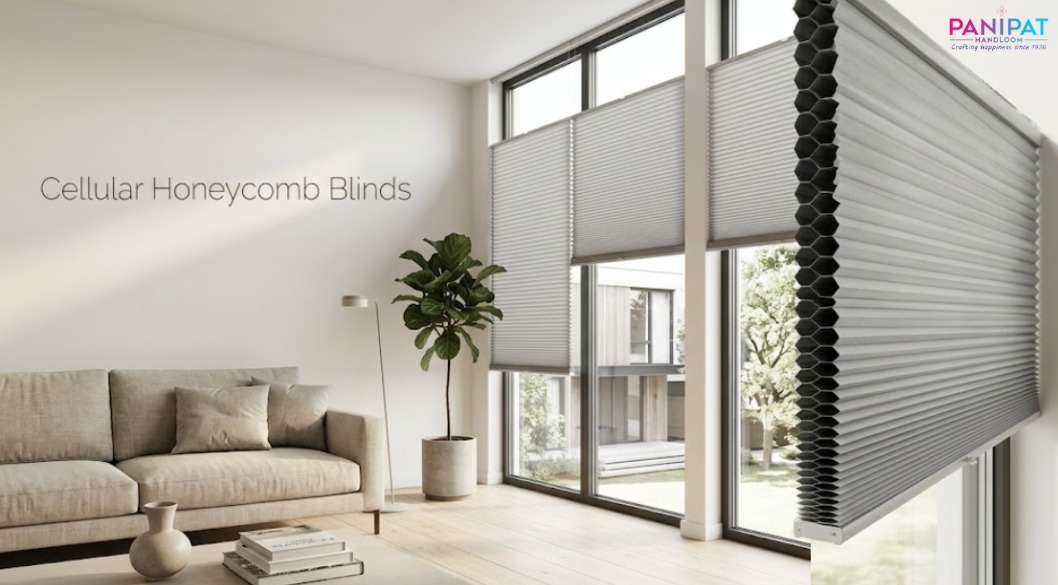
Cellular Honeycomb Blinds: Best Energy-Saving Window Solution
Cellular honeycomb blinds are the most technically advanced window blind available for residential use — and the only blind type specifically engineered for energy efficiency. In a country where air conditioning accounts for 40–60% of household electricity consumption in peak summer months, a window treatment that meaningfully reduces heat gain through glass is not just a comfort upgrade but a measurable financial investment.
This guide explains exactly how cellular honeycomb blinds work, why they are the best energy-saving blind for Indian homes, what they cost, and where to use them for maximum benefit.
What Are Cellular Honeycomb Blinds?
Cellular honeycomb blinds are made from a pleated fabric material that forms a series of air pockets (cells) between two bonded fabric layers. When viewed from the side, the cross-section of the fabric looks like a honeycomb — hexagonal cells stacked side by side. These air pockets act as a thermal barrier between the window glass and the room interior, similar to advanced solutions like Garware Suncontrol Window Film and Cosmo Sunshield Solar Film.
When the blind is closed, the trapped air in the cells resists heat transfer in both directions — keeping heat out in summer and warmth in during winter. This is the same principle used in double-glazed windows, but applied to the blind fabric itself.
Single-Cell vs Double-Cell vs Triple-Cell
|
Type |
Construction |
Insulation Value |
Best For |
Price |
|---|---|---|---|---|
|
Single-Cell |
One layer of cells |
Basic insulation |
Mild climates, moderate savings |
Rs. 140–200/sq.ft |
|
Double-Cell |
Two layers of cells |
Good insulation |
Delhi summers, AC cost reduction |
Rs. 200–280/sq.ft |
|
Triple-Cell |
Three layers of cells |
Excellent insulation |
Maximum energy efficiency |
Rs. 280–380/sq.ft |
For Delhi's climate — where peak summer temperatures reach 45–48 degrees Celsius combining blinds with motorized systems and customized blinds can further enhance comfort and efficiency. Triple-cell blinds are ideal for rooms with large west-facing windows that receive direct afternoon sun.
Energy Savings: What the Numbers Say
According to research from the U.S. Department of Energy (referenced in Indian energy efficiency studies),cellular honeycomb blinds can reduce heat gain through windows by up to 40%, similar to high-performance films like Cosmo Sunshield Solar Film. India's Bureau of Energy Efficiency (BEE) estimates that effective window treatments in Indian homes can reduce air conditioning energy consumption by 15–25% over a peak summer season.
For a typical Delhi apartment running 3–4 air conditioners for 8–10 hours per day in May–June–July, this translates to a potential monthly electricity saving of Rs. 800–2,000 depending on the AC's energy rating and the room's sun exposure. Over a 5-year period, these savings can fully recover the cost of the honeycomb blind installation.
Light Control Options
Unlike roller blinds such as Alkemi Customized Roller Blind and Roman window blinds, where light control is determined entirely by the fabric opacity, cellular honeycomb blinds are available in three light control variants:
- Sheer / Light Filtering: Diffuses light gently while maintaining a sense of connection to the outside. Good for living rooms and offices where soft ambient light is preferred.
- Room Darkening: Reduces light by 80–90% while maintaining the thermal benefits. Suitable for bedrooms where near-darkness is needed but absolute blackout is not critical.
- Blackout: Combines the honeycomb cell structure with a blackout lining on the outer layer. Provides both maximum energy efficiency and complete light elimination — the best choice for Indian bedrooms.
Additional Benefits
- Acoustic insulation: The air cells in honeycomb blinds absorb sound as well as heat. Studies show a reduction of 5–8 decibels at the window surface — meaningful noise reduction for rooms facing busy Delhi streets or highways.
- Cordless operation: Most cellular honeycomb blinds use a cordless lift mechanism — simply push up or pull down the bottom rail. This makes them inherently child-safe without the need for motorisation.
- Condensation reduction: By maintaining a warmer surface temperature on the room-facing side of the window, honeycomb blinds reduce window condensation — a common problem in air-conditioned Indian rooms during monsoon season.
Pricing — Delhi & Gurugram 2026
|
Product |
Economy |
Mid-Range |
Premium |
|---|---|---|---|
|
Single-Cell Honeycomb |
Rs. 140–170/sq.ft |
Rs. 175–210/sq.ft |
Rs. 215–260/sq.ft |
|
Double-Cell Honeycomb |
Rs. 200–240/sq.ft |
Rs. 245–290/sq.ft |
Rs. 295–360/sq.ft |
|
Triple-Cell Honeycomb |
Rs. 280–320/sq.ft |
Rs. 325–370/sq.ft |
Rs. 375–440/sq.ft |
|
Motorised Add-on |
Rs. 3,500–5,500/blind |
Rs. 5,500–7,500/blind |
Rs. 7,500–10,000/blind |
Frequently Asked Questions
Q1. Are cellular honeycomb blinds worth the extra cost over roller blinds?
For rooms where energy efficiency is a priority — west-facing rooms, south-facing living rooms, and any room with large glass windows in a Delhi climate — yes. The energy savings over 3–5 years can offset the higher purchase cost of honeycomb blinds compared to roller blinds. For rooms with small windows or limited sun exposure, the energy benefits are smaller and a quality dimout roller blind may be the more cost-effective choice.
Q2. Can honeycomb blinds be cleaned easily?
Yes, with care. Use a soft brush vacuum attachment to remove dust from the cells. For spot cleaning, dab gently with a clean damp cloth — avoid rubbing which can distort the cell structure. Do not submerge honeycomb blinds in water as the bonded cell layers can separate. Most honeycomb fabrics are treated with an anti-dust coating from the manufacturer, similar to premium materials like Leatherette fabric.
Q3. Do cellular honeycomb blinds work in reverse — retaining heat in winter?
Yes. The same air-cell thermal barrier that keeps summer heat out also retains interior warmth in Delhi's winter months (December–February). For rooms that feel cold and draughty in winter — particularly rooms with large north-facing windows — closed honeycomb blinds can meaningfully reduce heat loss and improve comfort without additional heating cost.
RELATED READING
- Blackout Blinds for Bedroom: Top Options to Block 100% Light
- How to Choose the Right Blinds for Every Room in Your Home
- Motorized Blinds for Smart Homes: Complete Guide & Price Range
- Double Roller Blinds: Combine Light Control + Blackout in One
CONTACT THE PANIPAT HANDLOOM EMPORIUM
New Delhi: N-14, South Extension Part 1, New Delhi – 110049
Gurugram: Shop No. 3, Dharam Plaza, Brahma City, Sector-62, Gurugram – 122101
Phone: +91-9899073000 / +91-9999999009
Email: team@thepanipathandloom.com
Website: thepanipathandloom.com