

DGU Blinds: The Ultimate Guide to Double Glazed Window Blinds
Double Glazed Units (DGUs) — also called double-pane or IGU (Insulated Glass Unit) windows — are increasingly common in premium Indian homes, villas, and commercial offices. They offer superior thermal insulation, noise reduction, and condensation control. But they also create a specific window treatment challenge: standard blinds cannot be fitted inside the sealed glass unit, and the exterior surfaces of DGU windows require specialised products.
This guide explains everything you need to know about DGU blinds — the types available, how they are installed, what they cost, and how to choose the right one for your double-glazed windows in India.
What Makes DGU Windows Different?
A standard single-pane window has one layer of glass. A DGU window has two parallel glass panes separated by a sealed air or gas gap (typically 12–16 mm) filled with argon or dry air. This gap provides the insulation. The sealed unit cannot be opened — so a blind cannot be placed between the panes the way it could in older sash or casement windows.
This means all blinds for DGU windows, including options like Roman window blinds, must be installed either on the room-facing surface of the inner pane (inside-mounted) or on the wall/frame around the window (outside-mounted). The challenge is that DGU window frames are often slim UPVC or aluminium profiles with minimal recess depth, limiting inside-mount options.
Types of DGU Blinds
Standard Roller Blinds — Inside or Outside Mounted
The most common DGU blind solution. A roller blind is mounted on the wall or frame above the DGU window — outside the glass unit entirely. This works well for most standard DGU windows and allows the full range of fabrics (blackout, dimout, solar, sheer). The only limitation is that the slim UPVC frame of many DGU windows may not provide enough depth for an inside-mount bracket — in which casean outside-mount on the surrounding wall is used, especially on modern surfaces like Wpc pannels or PU Stone vener.
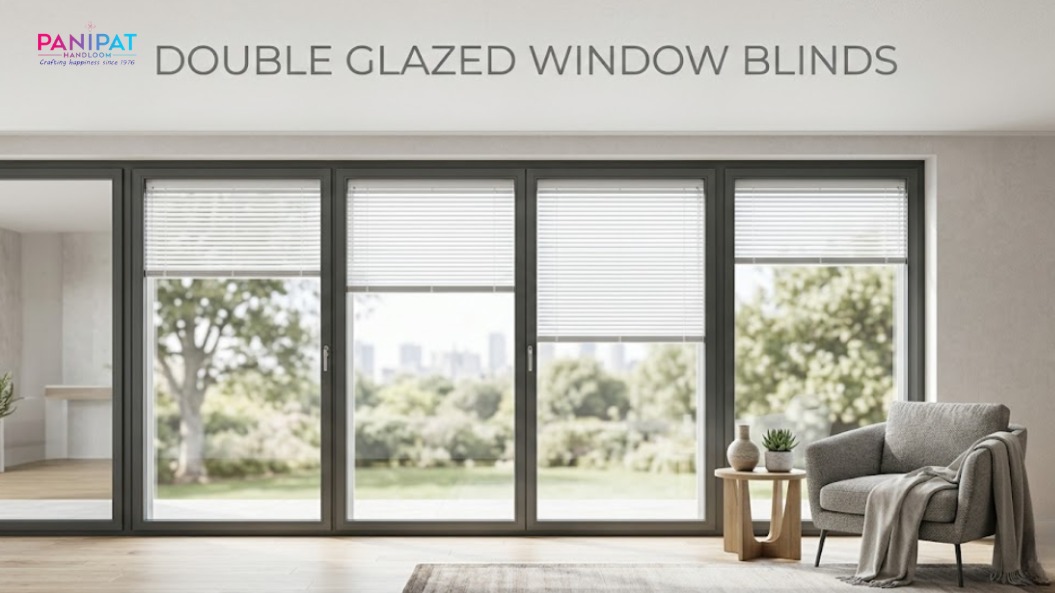
Integral / Between-Glass Blinds
A specialised product where a venetian blind or pleated blind is sealed inside the DGU unit itself — between the two panes of glass — at the time of manufacture.The blind is operated via a magnetic or electronic mechanism on the exterior glass surface, including motorized control options in premium systems. These are hermetically sealed and completely dust-free. Most commonly used in commercial office partitions and premium residential projects. Cannot be retrofitted to existing DGU units — must be specified at window manufacturing stage.
Cassette Roller Blinds for UPVC Frames
A roller blind with a slim cassette housing designed to fit within the narrow recess of a UPVC DGU window frame. The cassette protects the rolled fabric and provides a clean finish that integrates visually with the window frame. Available from The Panipat Handloom in widths from 40 cm to 300 cm.
Comparison: Standard vs Integral DGU Blinds
|
Feature |
Standard Roller Blind |
Integral Between-Glass Blind |
|---|---|---|
|
Installation timing |
Anytime — retrofit friendly |
Factory-fitted at window manufacture only |
|
Dust accumulation |
Normal — requires cleaning |
None — sealed unit, dust-free forever |
|
Fabric options |
Full range — 200+ choices |
Limited — venetian or pleated only |
|
Price range |
Rs. 65–200 per sq.ft |
Rs. 8,000–25,000 per window unit |
|
Maintenance |
Standard blind maintenance |
Zero maintenance — sealed unit |
|
Retrofit possible |
Yes |
No — new windows only |
|
Best for |
All existing DGU windows |
New premium construction projects |
Key Considerations for DGU Blind Installation
- Frame depth: Measure the recess depth of your UPVC or aluminium frame carefully. A minimum of 35–40 mm depth is needed for most inside-mount cassette rollers. If depth is less than 35 mm, an outside-mount installation on the surrounding wall is the correct approach.
- Frame material: UPVC frames require specific brackets that grip the frame without cracking the plastic. Always use UPVC-compatible brackets — standard wall brackets can crack UPVC under load.
- Condensation risk: If a blind is installed very close to the DGU glass surface, it can reduce airflow around the window and increase condensation on the inner glass surface. A minimum 25 mm air gap between the blind fabric and the glass surface is recommended.
- Weight: Heavy blackout fabrics on wide DGU windows can place stress on slim UPVC frames. For windows wider than 180 cm, consider splitting into two individual blinds rather than one wide blind.
Pricing — Delhi & Gurugram 2026
|
Product |
Price Range |
Notes |
|---|---|---|
|
Standard Roller Blind for DGU |
Rs. 65–180 per sq.ft |
Same as standard roller — frame bracket may vary |
|
Slim Cassette Roller (UPVC frame) |
Rs. 90–160 per sq.ft |
Cassette housing fits UPVC recess |
|
Between-Glass Integral Blind |
Rs. 8,000–25,000 per window |
Factory-fitted only; includes blind + modified DGU |
|
UPVC-compatible brackets (pair) |
Rs. 150–400 |
Specific clips for UPVC frames |
Frequently Asked Questions
Q1. Can I install a standard blind on a DGU window?
Yes. Most DGU windows can accommodate a standard roller blind mounted on the surrounding wall (outside-mount) or on the UPVC frame itself (inside-mount, if sufficient recess depth exists). The blind operates identically to one fitted on a standard single-pane window. The only requirement is to use UPVC-compatible brackets if mounting on the frame, and to ensure a 25 mm air gap between the fabric and the glass.
Q2. Will a blind affect the thermal performance of my DGU window?
A roller blind installed on the room side of a DGU window adds an additional layer of thermal insulation — particularly when using a blackout or dimout fabric with a foam backing. This actually improves the overall thermal performance of the window system, similar to solutions like Garware Sun Control Window Film or Cosmo Sunshield Solar Film. However, the improvement is marginal compared to the DGU unit itself, which does the heavy lifting. The blind is most useful for controlling solar gain through the glass rather than cold-weather insulation.
Q3. Are between-glass blinds available in India?
Yes, but they are a premium product that must be specified when ordering your DGU windows from the window manufacturer. Between-glass blinds are not a standard off-the-shelf product in India — they require the window manufacturer to incorporate the blind mechanism and magnetic control system into the sealed glass unit during production. They are most commonly used in commercial office glazing and premium residential projects. Contact The Panipat Handloom for referrals to window manufacturers who offer this option.
RELATED READING
- Sky Light Blinds: How to Cover Roof Windows Perfectly
- Roller Blinds vs Zebra Blinds: Which Is Better for Indian Homes?
- Motorized Blinds for Smart Homes: Complete Guide & Price Range
CONTACT THE PANIPAT HANDLOOM EMPORIUM
New Delhi: N-14, South Extension Part 1, New Delhi – 110049
Gurugram: Shop No. 3, Dharam Plaza, Brahma City, Sector-62, Gurugram – 122101
Phone: +91-9899073000 / +91-9999999009
Email: team@thepanipathandloom.com
Website: thepanipathandloom.com