

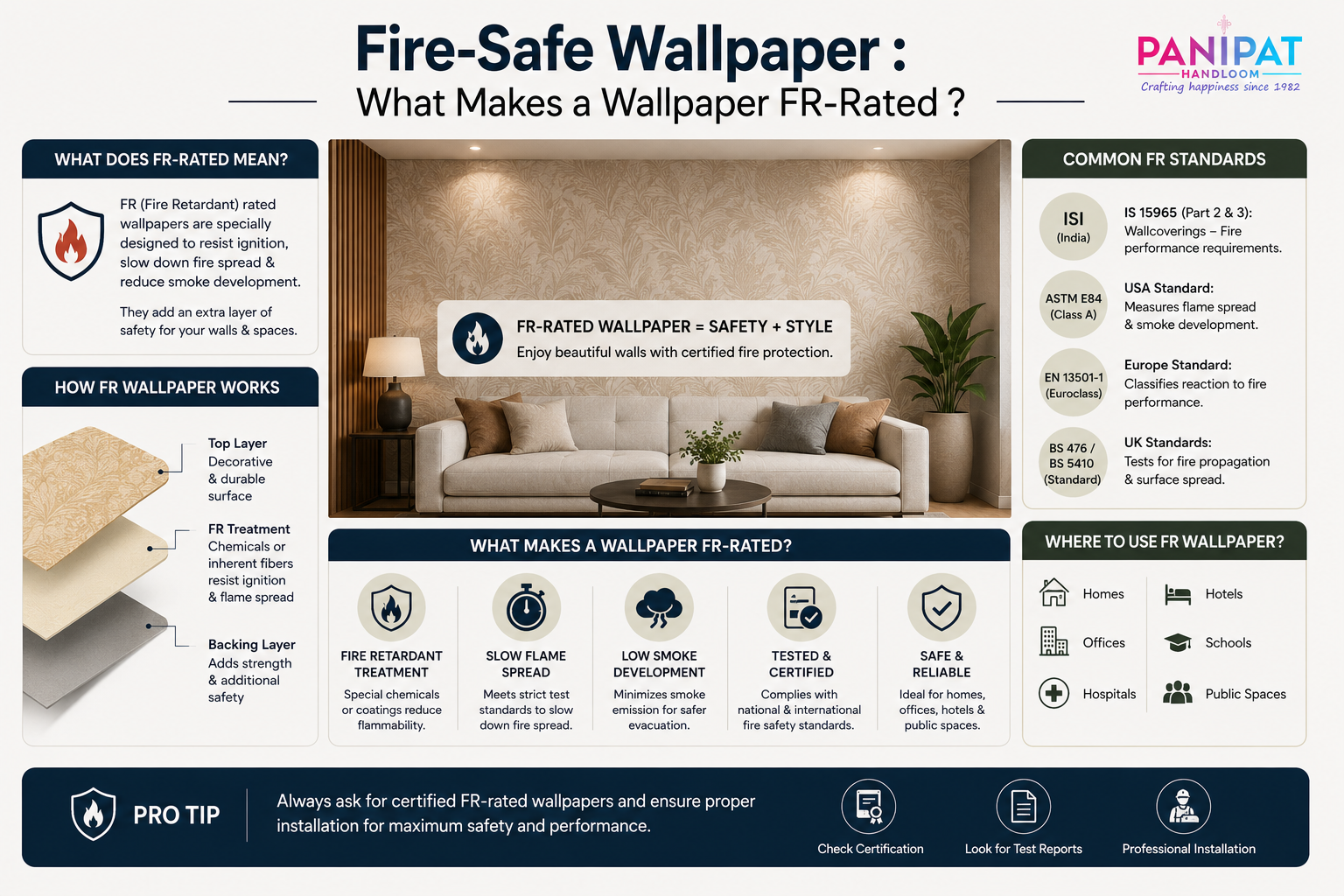
Most clients picking wallpaper for the first time focus entirely on pattern, colour and brand. Fire safety rarely makes the shortlist. It should. Standard paper-based wallpapers are highly combustible and act as a wick for flame spread once a fire starts. FR-rated wallpapers can buy precious minutes in an emergency by resisting ignition and self-extinguishing when the flame source is removed. For Indian commercial spaces this is now a legal requirement under NBC 2016. For homes it's an upgrade worth understanding.
The Panipat Handloom Wallpaper Team works across the full wallpaper range from luxury designer brands to economy lines for Delhi and Gurugram homes. This guide breaks down what FR-rated actually means, the standards behind the label and how to verify a wallpaper's fire class before installing it in a home, hotel, hospital or office.
Why Fire Safety in Wallpaper Matters
Wallpaper covers large continuous wall surface areas. In a fire, untreated paper-based wallpaper spreads flame at roughly 25 to 40 cm per second once ignited. Add a flammable adhesive layer behind it and the burn rate increases further. The smoke from burning standard wallpaper carries enough toxicity to incapacitate occupants within minutes, often before the actual fire reaches them.
This is why fire-rated wall finishes are mandated in hospitals, schools, hotels, offices and assembly buildings under the National Building Code of India 2016 and most state fire service acts. For high-traffic residential common areas like corridors, lift lobbies and escape routes, the requirement extends to mid-rise buildings as well.
What "FR-Rated" Actually Means
FR stands for fire retardant. An FR-rated wallpaper has been engineered or treated to resist ignition, slow flame spread, reduce smoke generation and self-extinguish once the heat source is removed. It does not mean fireproof. No wallpaper is. The right way to read an FR rating is as a measure of how much time the material buys you before flame and smoke fill a space.
The label "FR" alone means almost nothing without a certification. The actual safety profile is determined by laboratory testing under one of these standards:
- EN 13501-1 (European). Classes from A1 to F. B-s1, d0 is the typical FR wallpaper certification.
- ASTM E84 / NFPA 255 (American). Classes A, B, C based on Flame Spread Index and Smoke Developed Index. Class A is the safest (FSI 0-25, SDI under 450).
- DIN 4102-1 (German). B1 rating commonly applied to imported European wallpapers.
- NF P92-503 (French). M1 is highly flame retardant.
- IS 1642 (Indian). Adopted from international tests, applied via BIS testing.
For any commercial or compliance-sensitive project, ask for the test certificate showing the actual class achieved, not just "FR-rated" on the brochure.
The Three Things That Make a Wallpaper Fire Safe
A wallpaper's fire performance comes down to three factors working together.
1. Base Material
The material the wallpaper is printed on matters most. Standard paper substrates burn fast. Vinyl-coated paper performs significantly better. Non-woven backing (a blend of cellulose and polyester fibres) is harder to ignite. Glass fibre wallpapers used in commercial and hospitality settings are essentially non-combustible and can achieve Class A under ASTM E84 or A2 under EN 13501-1.
2. Flame Retardant Treatment
Wallpapers can be treated with FR additives during manufacture or as a surface coating. Common chemistry includes phosphate compounds, halogenated flame retardants and aluminium hydroxide. These don't change how the wallpaper looks but they raise the ignition temperature significantly. A properly FR-treated paper wallpaper can climb from Class D (untreated) to Class B-s1, d0 (treated). The treatment must be permanent. Surface sprays that wash off after one cleaning don't count as FR certification.
3. Adhesive and Backing
The glue layer between wallpaper and wall affects fire performance more than most people realise. Standard wallpaper adhesives are flammable and can transmit flame behind the paper face. FR wallpaper paste is a polymer-based adhesive that resists flame spread and helps the overall wall system maintain its rating. For commercial projects the paste should match the wallpaper's fire class.
Wallpaper Fire Classes Explained
|
Class (EN 13501-1) |
ASTM E84 Equivalent |
What It Means |
Where Used |
|---|---|---|---|
|
A1 |
Non-combustible |
Cannot burn under any test |
Special applications |
|
A2 |
Class A (limited) |
Limited combustibility, minimal smoke |
Hospitals, escape routes |
|
B-s1, d0 |
Class A or B |
Self-extinguishing, low smoke, no droplets |
Hotels, offices, residential FR |
|
B-s3, d2 |
Class B |
Burns slowly with heavy smoke |
Avoid in occupied buildings |
|
C-s1, d0 |
Class B or C |
Limited fire resistance |
Low-risk residential only |
|
D / E / F |
Class C or untested |
Standard untreated wallpaper |
Not for compliance projects |
B-s1, d0 is the gold standard for FR-rated decorative wallpapers in commercial and high-end residential use. Most imported designer wallpapers from European manufacturers (luxury brands like Cole & Son, Morris & Co, 1838 Wallcoverings and GP & J Baker) carry European fire test certificates with B-s1, d0 or higher on their commercial-grade rolls. Always request the specific roll certification before installation.
Types of Wallpaper by Fire Performance
Glass fibre wallpaper. Highest fire resistance. Often Class A or B-s1, d0. Used in hospitals, kitchens and high-risk areas.
Vinyl wallpaper (fabric-backed commercial). Strong fire resistance, typically B-s1, d0. Used in hotels and offices. Vinyl face is also washable.
Non-woven wallpaper (FR treated). Modern European standard. Achieves B-s1, d0 when properly treated. Most luxury designer wallpapers fall in this category.
Paper-based wallpaper. Lowest fire resistance unless treated. Standard versions are Class D or worse. FR-treated paper can reach C-s1, d0 but rarely better.
Self-adhesive wallpaper. Variable. Quality depends entirely on the manufacturer. Always check the test certificate. The self-adhesive wallpaper range should be matched with verified fire certification for any compliance-relevant project.
For projects across the designer wallpaper collection or economy wallpapers range, our team can pull the original manufacturer certification documents on request.
When You Need FR-Rated Wallpaper in India
Mandatory for compliance:
- Hospitals, schools, hotels (3-star and above)
- Offices and commercial buildings
- Mall corridors and lift lobbies
- Restaurants and assembly halls
- Escape routes in any building above 15 m
Strongly recommended:
- Kitchens and dining areas in any home
- High-rise apartment common areas
- Kids' bedrooms
- Home offices with multiple electrical devices
Personal choice:
- Private bedroom and living room interiors in low-rise homes
For architects and PMC clients handling these specifications across Delhi NCR, the architects and designers section covers the project-level engagement model where fire test documentation accompanies the wallpaper supply.
How to Verify FR-Rated Wallpaper Before Buying
- Ask for the original test certificate. Manufacturer-issued. Should name the specific wallpaper SKU, the test standard (EN 13501-1, ASTM E84 etc.) and the class achieved.
- Check the certificate's date. Fire test certificates typically remain valid for 3 to 5 years from issue. Anything older should be re-tested or treated cautiously.
- Match the paste to the paper. Use FR-rated wallpaper paste for any installation where the paper is FR. Mismatched paste compromises the system rating.
- Get it in writing on the quote. The class achieved should be stated on the purchase order so it's auditable later.
- Verify the lab. Reputable European labs include MPA Stuttgart, Warrington Fire and SP Sweden. US labs include UL and Intertek. Indian testing happens through BIS-recognised labs.
Common Mistakes
Assuming all imported wallpaper is FR-rated. Many European wallpapers carry FR certification on their commercial rolls but not on residential variants. Always check the specific SKU.
Trusting "fire safe" without a class. "Fire safe" is marketing language. Without a fire class (A1, A2, B-s1 d0 etc.) it means nothing.
Skipping the paste check. FR wallpaper installed with regular paste loses much of its rating advantage.
Ignoring smoke ratings. A wallpaper that's class B but s3 (heavy smoke) is dangerous in occupied spaces despite the B rating.
Key Takeaways
FR-rated wallpaper resists ignition, slows flame spread and reduces smoke generation. It is not fireproof but it buys critical time in an emergency. The certification matters more than the label. EN 13501-1 B-s1, d0 is the typical FR rating for decorative wallpapers. Glass fibre and vinyl wallpapers perform best on fire. Paper-based wallpapers need FR treatment to reach safe ratings. NBC 2016 makes FR wallpaper effectively mandatory for commercial buildings, hospitals, schools and hotels in India. Always demand the test certificate before installing wallpaper in any compliance-sensitive project.
The Final Word
Fire-safe wallpaper isn't about replacing decoration with industrial-grade material. Luxury designer wallpapers from European houses are visually rich and achieve B-s1, d0 fire ratings as standard. The trick is verification. Ask for the certificate, match the paste to the paper and keep the documentation auditable. That's the whole game.
The Panipat Handloom Wallpaper Team can pull manufacturer fire certification documents for any wallpaper across our range. Walk in to our N-14 South Extension Part 1 store in New Delhi or the Dharam Plaza store in Sector 62 Gurugram. Browse the full wallpaper collection before the consultation.
Frequently Asked Questions
Q: What does FR-rated wallpaper actually mean?
FR stands for fire retardant. An FR-rated wallpaper has been engineered or treated to resist ignition, slow flame spread and reduce smoke. The actual safety level is set by the fire class achieved under testing, commonly EN 13501-1 B-s1, d0 for decorative wallpapers. FR-rated does not mean fireproof.
Q: Are all designer wallpapers FR-rated?
No. Many European designer wallpapers carry FR certification on their contract or commercial grade rolls but not always on residential rolls. Always ask the seller for the specific SKU's fire test certificate. Some collections have both versions and the difference matters for compliance-sensitive buildings.
Q: What is the best fire class for wallpaper in Indian homes?
For commercial buildings, hospitals, schools and hotels in India, EN 13501-1 Class B-s1, d0 is the standard FR wallpaper certification. For private homes the law is lighter but the same B-s1, d0 rating is recommended for kitchens, kids' rooms and high-rise common areas.
Q: Does FR-rated wallpaper cost more?
Yes, typically 15 to 35 percent more than non-FR equivalents at the same design tier. The premium covers fire retardant treatment, certified testing and quality control. Luxury European wallpapers often include FR certification in the base price.
Q: How do I check if a wallpaper is genuinely FR-rated?
Ask the seller for the original fire test certificate from the manufacturer. The certificate must list the wallpaper SKU, the test standard (EN 13501-1, ASTM E84 or equivalent), the class achieved and the issuing laboratory. Brochure claims of "fire safe" without a certificate should not be accepted.