

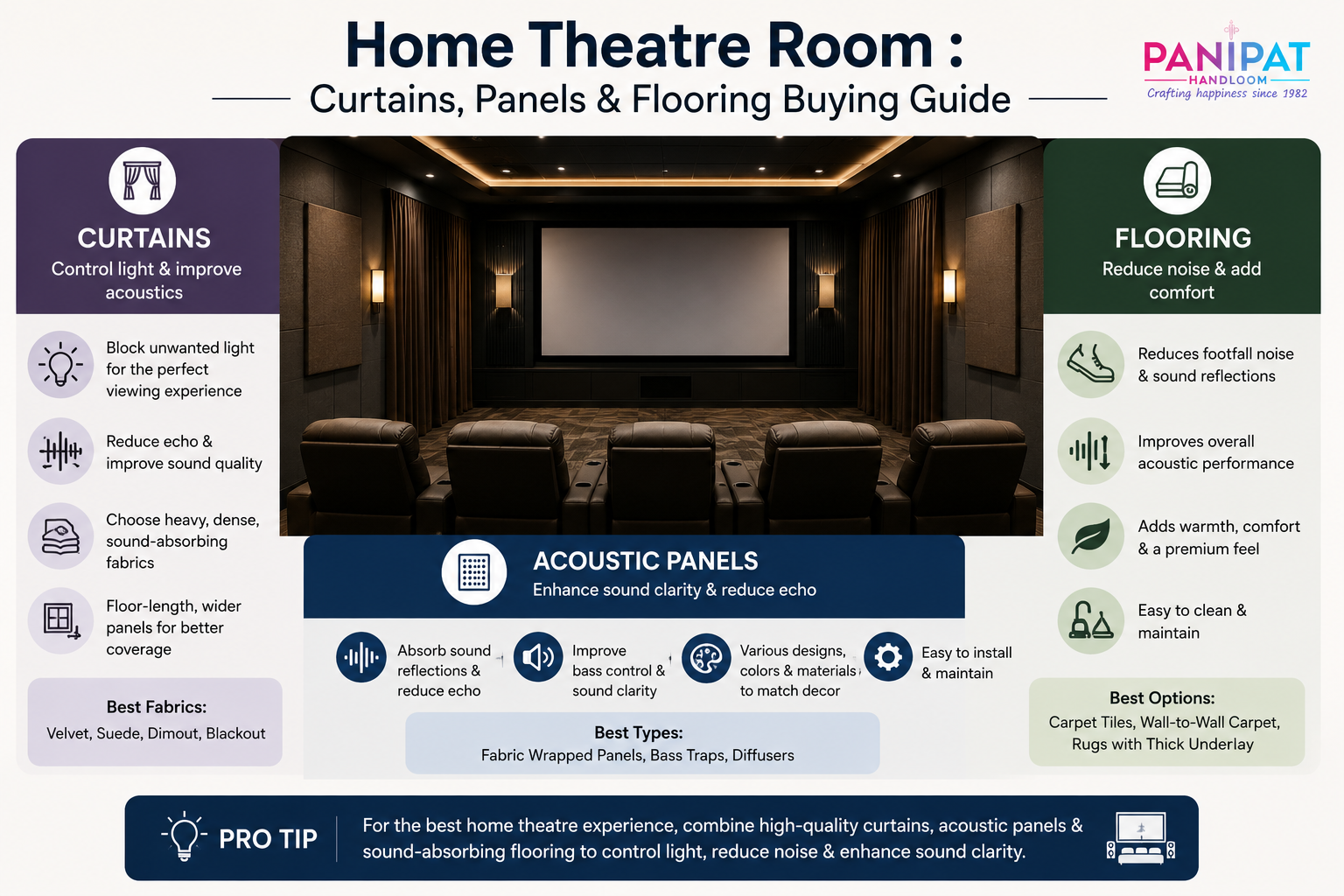
Home Theatre Room: Curtains, Panels & Flooring Buying Guide
A great home theatre room isn't about the projector or the speakers. Those matter but the room itself decides whether your equipment sounds like a cinema or sounds like a TV in a hallway. Three product categories do the heavy lifting. Curtains, wall panels and flooring. Get these right and even mid-range audio gear sounds premium. Get them wrong and even Rs 5 lakh worth of speakers will sound flat.
The Panipat Handloom Home Theatre Team has specified dozens of home theatre rooms across villas in Gurugram and apartments in South Delhi. The buying decisions follow the same pattern every time. This guide breaks down what to pick in each of the three big categories, what it costs in India and the spec that actually delivers cinema sound at home.
Why Home Theatre Acoustics Need a System
Sound inside a closed room behaves like light bouncing off mirrors. Without absorbent surfaces, every wall, floor and ceiling reflects sound back into the room. The result is echo, harsh dialogue and muddy bass. The fix is layered absorption across curtains, panels and floor coverings, with each layer handling different frequencies.
The goal isn't a "dead" room. The goal is balanced absorption that lets speakers sound the way they were designed to sound. For most Indian home theatre rooms (200 to 350 sq ft typical), 30 to 50 percent total surface absorption hits the sweet spot.
Curtains for a Home Theatre Room
Home theatre curtains do three jobs. Block light. Absorb sound. Cover acoustically reflective glass windows.
Fabric to pick. Heavy velvet at 350 GSM and above is the standard for a reason. The dense pile absorbs mid and high frequency reflections better than almost any other curtain fabric. Dark colours like deep red, dark grey, navy and black absorb stray light from the screen and prevent reflections that wash out picture contrast. The Panipat velvet range covers the GSM bands needed for home theatre work, in dark cinema-appropriate shades.
Layering with blackout. A velvet front layer with a blackout liner behind kills daytime light leak completely and adds 25 to 40 percent more sound absorption. The Panipat blackout fabric range is built for this layered install.
Coverage strategy. Don't just cover the window. Run curtains across the entire front wall (where the screen sits) and the entire rear wall. The wall becomes acoustically softer. This is how commercial cinemas do it.
Motorisation. With the lights dimmed and screen on, manual curtains become annoying fast. A motorised track lets you close everything from the recliner. The motorisation range handles standard residential curtain weights including 450 GSM velvet without strain. Pair with our customised curtains service for exact wall-to-wall sizing.
Acoustic Panels for a Home Theatre Room
Curtains handle perimeter walls. Acoustic panels handle the side walls and back wall reflection points. This is where studio-grade clarity comes from.
Where to place panels. The two highest priority spots are the first reflection points on each side wall. Sit in your viewing position and have someone slide a mirror along each side wall. Wherever you see a speaker in the mirror, that's where the panel goes. Two panels per side, 4 ft x 2 ft each, handles 80 percent of side reflections.
Panel type. Fabric wrapped panels with a mineral wool or polyester fibre core in the 25 mm to 50 mm thickness range. NRC ratings of 0.85 plus are easy to find in this format. The Accosting Panel range is the workhorse here. For installations that combine acoustics with visual character, the designer wall panelling collection has options that do both jobs at once.
Don't overdo it. A common mistake is covering every wall in acoustic panels. The room ends up sounding dead and unnatural. Target 30 to 40 percent of total wall surface area, distributed across multiple walls rather than concentrated on one wall.
Foam tiles for budget builds. When budget is tight, the foam tiles for wall range covers the high frequency absorption job. Foam doesn't match fabric panels on mid range performance or aesthetics. Use it on rear walls or behind built-in cabinets where the look doesn't matter.
Flooring for a Home Theatre Room
Hard floors are the enemy of home theatre sound. Tile, marble and bare concrete reflect sound waves straight back up into the room, creating boomy bass and harsh dialogue. The fix is full carpet or full underlay coverage.
Wall-to-wall carpet. The gold standard. A 6 mm to 10 mm carpet over a 4 mm to 6 mm underlay absorbs floor reflections and dampens footfall from above or below. The wall to wall carpet range covers commercial grade options built for decade-long use.
Carpet tiles. A flexible alternative that allows pattern variation and easier replacement of damaged sections. Good for home theatres that double as occasional family rooms. Browse the carpet tile collection for grade options.
Underlay matters. A premium carpet over a cheap underlay underperforms a mid-grade carpet over a thick underlay. Spend the budget on underlay first.
What to avoid. Hardwood, ceramic tile, polished marble and vinyl planks without underlay are all reflective. If the home theatre sits over an existing hard floor that can't be changed, lay a heavy area rug covering at least 70 percent of the floor area. For non-theatre rooms in the same home, the engineered wooden flooring range works beautifully but it doesn't belong in a serious home theatre.
A Real Home Theatre Spec for Indian Homes
Here's what a properly specified 250 sq ft home theatre room in Gurugram or Delhi typically looks like.
|
Element |
Specification |
Coverage |
|---|---|---|
|
Front wall curtain |
450 GSM velvet plus blackout liner, motorised |
Full wall, ceiling to floor |
|
Rear wall curtain |
350 GSM velvet, manual or motorised |
Full wall, ceiling to floor |
|
Side wall panels |
Fabric wrapped acoustic panels (40 mm) |
30 to 40 percent of each side wall |
|
Door treatment |
Acoustic seal strip plus heavy fabric overlay |
Around entire door frame |
|
Flooring |
Wall-to-wall carpet over 6 mm underlay |
100 percent of floor |
|
Ceiling |
Optional acoustic clouds (4 panels) or coffer |
Centre of ceiling above seating |
This setup delivers genuine commercial-cinema sound quality with mid-grade speakers. Adding premium gear on top of this spec elevates further. Adding premium gear on top of a bare-walled room with marble floors does almost nothing.
Home Theatre Budget Breakdown
|
Tier |
Total Investment (250 sq ft room) |
What You Get |
|---|---|---|
|
Entry |
Rs 1.2 lakh to Rs 2 lakh |
Basic velvet curtains, foam tiles, carpet rolls |
|
Mid |
Rs 2.5 lakh to Rs 4 lakh |
Premium velvet plus blackout, fabric panels, wall-to-wall carpet, motorisation |
|
Premium |
Rs 5 lakh to Rs 9 lakh |
Designer panels, custom velvet, motorised tracks, ceiling treatment, full acoustic seal |
Prices cover materials, fabric, panels, carpet and installation. Audio video equipment, seating, projector and lighting are separate. For category-level browsing while planning, the wall decor shop category and flooring shop category cover all the panel and carpet options at every tier.
Common Mistakes
Treating the home theatre like a regular bedroom. Standard sheer curtains and a tiled floor look fine but acoustically the room sounds like an empty cafeteria.
Buying expensive speakers without treating the room. Rs 4 lakh of speakers in an untreated room sound worse than Rs 1 lakh of speakers in a treated room. Spend the first Rs 2 lakh on room treatment then upgrade gear.
Skipping the rear wall. Most installs focus on side walls and ignore the wall behind the listening position. Rear wall reflections cause the biggest dialogue clarity issues.
Overdoing absorption. Covering every surface in fabric and panels makes the room sound flat and unnatural. Aim for balanced not maximum absorption.
Key Takeaways
A home theatre room is a system not a product. Velvet curtains with blackout liner handle perimeter walls. Fabric wrapped acoustic panels handle reflection points on side and rear walls. Wall to wall carpet over thick underlay handles the floor. Target 30 to 50 percent total surface absorption, balanced across walls. Hard floors and bare walls undo expensive audio equipment. Budget Rs 2.5 to 4 lakh for a properly treated mid-tier 250 sq ft home theatre across Delhi NCR.
The Final Word
A home theatre room earns its premium label through the surfaces, not the gadgets. The curtains, panels and flooring you pick decide what the speakers actually sound like inside the room. Pick velvet over polyester, layer blackout behind the front curtain, treat the side wall reflection points and lay proper carpet on the floor. That's the spec across Delhi and Gurugram installations that consistently deliver cinema-grade results.
The Panipat Handloom Home Theatre Team handles measurement, fabric and panel matching, carpet specification, motorisation planning and installation in a single engagement. Walk in to our N-14 South Extension Part 1 store in New Delhi or the Dharam Plaza store in Sector 62 Gurugram for a site visit and full room spec.
Frequently Asked Questions
Q: What is the best curtain fabric for a home theatre room?
Heavy velvet at 350 GSM or above is the best curtain fabric for home theatres because it absorbs mid and high frequency reflections and blocks stray light from the screen. Layer a blackout liner behind the velvet for full daytime light control and additional sound absorption. Dark cinema-appropriate shades like deep red, navy, dark grey and black work best.
Q: How many acoustic panels do I need for a home theatre?
For a typical 250 sq ft home theatre, four to six fabric wrapped panels of 4 ft x 2 ft size cover the primary side wall reflection points and one back wall reflection zone. That works out to 30 to 40 percent of total wall surface area, which is the optimal balance between absorption and natural sound.
Q: Is wood flooring okay for a home theatre?
Wood flooring is not ideal for a dedicated home theatre because it reflects sound waves and creates echo. If wood flooring is already installed, cover at least 70 percent of the floor area with a heavy area rug over an underlay. For new home theatre builds, wall-to-wall carpet over 6 mm underlay is the recommended specification.
Q: How much does a home theatre room setup cost in Delhi NCR?
A properly treated home theatre room in Delhi NCR ranges from Rs 1.2 lakh entry tier to Rs 9 lakh premium for material, fabric, panels, carpet and installation in a typical 250 sq ft space. Audio video equipment, seating and projector are additional. Mid-tier setups at Rs 2.5 to 4 lakh deliver excellent acoustic results.
Q: Can a small bedroom be converted into a home theatre?
Yes. A 150 to 200 sq ft bedroom converts into an effective home theatre with the same three-layer treatment: velvet curtains with blackout, acoustic panels on side walls and wall-to-wall carpet. The smaller volume actually helps with bass control. The main challenge is fitting projector throw distance and seating, which a site visit can plan around.