

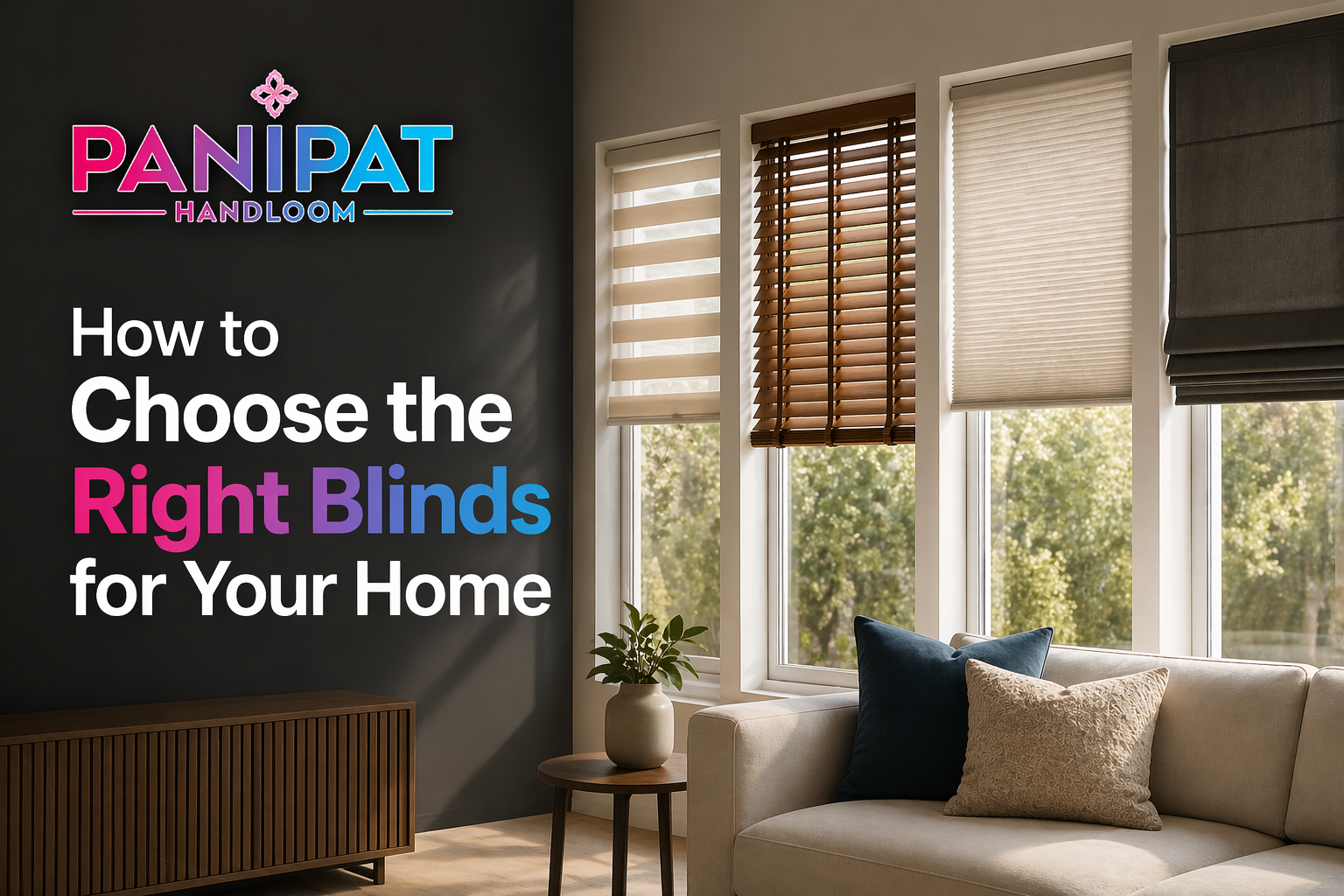
How to Choose the Right Blinds for Your Home
Learning how to choose the right blinds for your home is less about picking a trendy style and more about matching fabric, mechanism, and mood to the way each room actually gets used. A blind that looks perfect in a showroom can flood a bedroom with morning light, overheat a west-facing kitchen, or feel visually heavy in a small living room. The Panipat Handloom Window Treatment Team has fitted every category on this list across hundreds of Delhi NCR homes, and the decisions that hold up over years always come down to the same handful of practical checks.
This guide walks through how to choose right blinds by function, room, colour, size, and finish. It also covers curtains side by side, because most well-designed homes use both. Expect straightforward advice on how to select blinds for windows of different shapes, how to pick the right blind size without guesswork, and how to coordinate the blinds you pick with the curtains already planned for each space.
How to Choose the Right Blinds for Your Home: The Five-Factor Framework
How to choose the best blinds for any room comes down to five factors the team evaluates on every site visit: light control, privacy, room function, style direction, and budget. Getting even one of these wrong is what forces a re-installation two years later. Light control drives whether you need blackout, dim-out, or sheer. Privacy dictates whether day-night dual function matters. Room function narrows the mechanism (cord, motorised, cordless for child safety). Style direction tightens the finish. Budget sets the fabric grade.
Once those five boxes are filled, narrowing down how to find the right blinds becomes mechanical. Our complete window treatment catalogue is organised exactly this way, which is why most clients finalise their shortlist in a single consultation rather than bouncing between categories for weeks.
Blind Types at a Glance
Before any colour or size conversation, you need to know which blind category suits which space. The table below is the snapshot our team uses during the first client walkthrough.
|
Blind Type |
Best Use |
Light Control |
Style Feel |
|
Roller Blinds |
Offices, kitchens, small windows |
Medium to full |
Clean, minimal, modern |
|
Zebra Blinds |
Living rooms, balconies |
Adjustable sheer to solid |
Contemporary, layered |
|
Venetian Blinds |
Studies, home offices |
Fine-tuned slat control |
Classic, structured |
|
Vertical Blinds |
Large windows, sliding doors |
Full sweep coverage |
Tall, streamlined |
|
Roman Blinds |
Bedrooms, formal spaces |
Medium fold-based control |
Soft, luxurious, fabric-rich |
|
Wooden Blinds |
Living rooms, studies |
Strong slat tilt control |
Warm, natural, traditional |
|
Cellular Blinds |
Bedrooms, AC-heavy rooms |
Full with thermal seal |
Soft honeycomb texture |
Once a category is locked, the rest of the decisions follow quickly. For example, roller blinds for any room dominate kitchens and small bathrooms because they wipe clean and stack tight. zebra blinds with dual bands win living rooms because the same panel flips between sheer filter and full privacy. For bedrooms needing full darkness, cellular honeycomb window blinds add thermal insulation on top of light control.
How to Choose the Right Size Blinds: Measurement Rules
How to choose the right size blinds is the step most homeowners rush and regret. The rule is simple: inside-mount blinds sit flush inside the window recess and need exact recess measurements minus 3 mm on width for smooth operation. Outside-mount blinds cover the frame and need the full frame width plus 5 cm overlap on each side for proper light seal. How to find the right size blinds for any given window therefore starts with deciding mount type before pulling out the measuring tape.
How to choose blinds size also depends on the ceiling height. For rooms above 10 feet, extending the blind 8 to 12 inches above the window frame creates the illusion of taller windows. How to pick the right blind size for a low-ceiling room is the opposite: stay tight to the frame so nothing visually presses down on the room. How to find the right size window blinds for odd-shaped windows (bay, arched, corner) almost always requires custom manufacturing, which is why our customized blinds solution exists as a separate category. The Panipat Handloom Window Treatment Team measures twice at three positions before cutting, and this is the single biggest reason installations sit flush rather than bowing open at the edges.
How to Pick the Right Blind Box for Clean Finishing
How to pick the right blind box is the finishing detail that separates a retail install from a designer install. The blind box is the recessed housing above the window that hides the blind roll when fully raised. A good box is 15 cm deep and 12 cm tall, which fits every blind type including the thicker cellular and roman rolls. How to find the right size window blinds also loops back here, because a box that is too shallow forces the blind roll to protrude visibly when lifted.
For new construction and major renovations, specify the box during civil work, not after. Retrofitting a box into a finished room means false ceiling work and plaster patching. For existing homes without boxes, a wooden pelmet delivers a similar clean look at the top of the window. The wooden pelmet range we supply covers standard window widths and can be stained to match existing woodwork.
How to Choose the Right Colour Blinds and the Right Color Blinds
How to choose the right colour blinds trips up more buyers than any other decision. The usual mistake is matching blinds to wall paint. The better rule is matching blinds to the ceiling tone or to the window frame, because both stay visible when the blind is down. Light blinds on a dark-framed window look great in a catalogue and cluttered in a real room. How to choose the right color blinds improves the moment you stop treating the blind as a standalone element and start treating it as part of the window envelope.
How to choose the right colour blinds also depends on room size. Dark blinds in a small room absorb light and compress the space. Light blinds in a large room can feel washed out without enough warm accents. A mid-tone neutral (dove grey, warm beige, soft taupe) works in the widest range of rooms and forgives most existing wall colours. For statement rooms, a deep charcoal or forest green blind paired with vertical window blinds in rich tones can anchor the whole scheme.
How to Select Blinds for Windows of Every Shape
How to select blinds for windows changes with window geometry. Standard rectangular windows accept any blind category. Tall narrow windows look best with vertical blinds or floor-length roller blinds that emphasise the height. Wide low windows benefit from horizontal venetians or roman blinds that fold in bands. Bay windows need separate blinds on each panel with a colour-matched finish at the joins.
Skylight windows, sloped glazing, and double-height atriums each have their own hardware solution. Our specialist sky light blinds category handles these edge cases with motorised tracks that are non-negotiable on anything out of arm's reach.
How to Choose the Right Curtains for Your Home
How to choose the right curtains for your home runs on a different logic than blinds. Curtains carry more visual weight, softer texture, and a stronger emotional feel. How to choose the right curtains starts with fabric: linen for relaxed warmth, cotton for everyday durability, silk for luxury, polyester for practicality. How to choose best curtains in each category depends on fall, pleat style, and lining weight. A beautifully woven fabric hung without lining will sag within a year, while the same fabric with a cotton interlining holds its shape for a decade.
How to choose curtains for your room also depends on how the room is used daily. Formal rooms accept longer pools of fabric on the floor; high-traffic rooms need exact floor-clearance to avoid dust. The D'Decor curtain collection we stock covers most Indian living contexts, and the premium linen fabric range is the single most requested fabric for living rooms in Gurugram and Dwarka homes.
How to Choose the Right Curtains for Bedroom and Curtain for Bedroom Selection
How to choose the right curtains for bedroom is a function-first decision. Bedroom curtains must block enough light for proper sleep, dampen outside sound, and coordinate with the headboard and bedding palette. How to choose curtain for bedroom setups therefore starts with blackout or dim-out lining, then moves to colour. Darker mid-tones work best because they forgive wrinkles and hold their colour longer against afternoon sun.
How to select curtain for bedroom windows in smaller rooms needs a lighter touch than in master suites. Tight rod-pocket curtains in a soft fabric feel less oppressive in a 12x12 room than heavy pinch pleats. How to select curtains for bedroom windows in a master with a king bed can go in the opposite direction: full-length pinch pleats in a mid-weight cotton or linen blend, hung ceiling to floor. The Panipat blackout curtain fabric is the base layer most clients pair with a decorative outer drape.
How to Choose Right Curtains for Living Room and Curtains for Living Room
How to choose right curtains for living room is where most homeowners either overshoot into theatrical drapes or undershoot into flat panels that look rental-grade. The sweet spot is full-length pleated curtains with a sheer layer behind them. How to choose curtains for living room therefore usually ends up as a two-layer decision: a sheer for daytime softness, an outer curtain for evening privacy and visual anchoring.
How to select curtains for living room differs from bedroom selection because the living room is seen from more angles. Pleats need to read crisp when viewed from across the room, and the pooling at the floor should be consistent across all panels. How to select curtains for a room with a main seating zone also means the curtain should frame the view, not crowd the sofa. Our customised curtain service handles the full cut-and-stitch for non-standard window widths.
How to Select Curtains for Home and How to Select Curtains for Windows
How to select curtains for home projects starts with a palette plan. Walking into each room and picking curtains independently is how most homes end up looking disjointed. How to select curtains for home success comes from a three-colour plan: one dominant neutral across main rooms, one secondary accent, one texture variation for the family room. How to select curtains for windows then becomes a matter of applying the plan to each window type.
How to select curtains for room by room becomes faster once that palette is locked. Most clients finalise the plan in under a week with a proper colour chart in hand. How to select curtains for living room, bedroom, and study then becomes incremental. Our Panipat curtain collection is organised by colour family exactly for this workflow, and printed fabric options we supply add variation without breaking the palette.
How to Choose the Right Curtain Colour and Select Curtains Color
How to choose the right curtain colour follows three proven rules the Panipat Handloom Window Treatment Team shares on every consultation. First, pick a tone 2 to 3 shades deeper than the wall for visual grounding. Matching curtain colour to wall paint flattens the window and makes the room feel smaller. Second, check the fabric swatch under all three lighting conditions the room experiences: morning daylight, afternoon daylight, and evening lamp light. Colours shift dramatically across these three, and a swatch that looks perfect at 3 pm can read completely wrong at 9 pm.
How to select curtains color for a full home uses the same logic. How to select curtain color for living room usually lands on warm earth tones, because most living rooms combine natural light with lamp light and warm tones unify both. How to select curtain color for bedroom typically goes cooler or deeper, because the bedroom palette is often calmer. silk fabric curtains in muted shades suit formal living rooms, while softer pure cotton fabric curtains flatter bedrooms and breakfast nooks.
How to Select Curtain Size and Determine Best Curtain Length
How to select curtain size starts with window measurement plus a planned extension on each side. Standard practice is window width plus 20 cm total extension for a stacked-open look, or window width plus 40 cm for a fuller stack that fully clears the glass when open. Height measurement runs from the rod position to the desired drop: floor-kissing, half-inch gap, or pooling by 5 cm.
How to determine best curtain length depends on the room's formality. Formal living and dining rooms can pool. Bedrooms and kids rooms should sit at a half-inch gap for easier cleaning. Family rooms and studies work best with floor-kissing drops. How to select curtain size correctly also factors in the fabric: heavier fabrics like velvet and suede hang straight and forgive small measurement errors, while sheers show every millimetre of inconsistency and need exact cutting. Our suede fabric range for heavy drapes is popular for formal rooms, while Panipat sheer fabric panels handle the lighter daytime layer.
Room-Wise Recommendation Chart for Blinds and Curtains
The table below pulls everything together into a practical reference. It is not a rulebook, just the default combinations our team reaches for when a client has not specified a preference. Treat it as a starting point and adjust based on personal style.
|
Room |
Recommended Blind |
Recommended Curtain |
Colour Direction |
|
Master Bedroom |
Blackout roller or cellular |
Blackout-lined drapes |
Deep neutrals, charcoal |
|
Living Room |
Zebra or wooden |
Linen sheer + cotton |
Warm beige, ivory, olive |
|
Kids Room |
Cordless roller |
Printed cotton panels |
Soft pastels |
|
Kitchen |
Wipe-clean PVC roller |
Short cafe curtain |
Crisp whites, light grey |
|
Study |
Venetian or wooden |
Structured drapes |
Earthy browns, navy |
|
Balcony Door |
Vertical blind |
Floor-length sheer |
Light neutrals |
|
Dining Area |
Roman blind |
Voile sheer panels |
Champagne, dove grey |
One pattern worth noting: the highest-satisfaction installs almost always pair a functional blind against the glass with a decorative curtain over the frame. This layered setup is the professional standard and the reason premium hotels run blinds plus curtains on every guest room window.
Budget Planning for Blinds and Curtains
Blinds and curtains planning almost always hits a budget ceiling before aesthetics drive the decision. The best cost-saving strategy is spending well on the rooms that see the most visual traffic (living room, master bedroom) and scaling back on secondary spaces. A budget split of 60 percent on primary rooms and 40 percent across everything else is the ratio most interior designers use.
Within each category, the Panipat Handloom Window Treatment Team recommends spending more on mechanism and lining than on surface fabric. A mid-grade fabric on excellent hardware with proper blackout lining outperforms a luxury fabric on weak mechanisms. motorised window treatment upgrades are the single highest-return upgrade on large windows and sliding balcony doors, because manual operation on wide panels becomes tedious within weeks.
Key Takeaways Before You Buy
Start blind selection with the five-factor framework: light control, privacy, function, style, budget. Match blinds to window frame tone, not wall paint. Measure recess and frame separately before deciding inside or outside mount. For curtains, fabric grade and lining matter more than colour. Plan a three-colour palette across the home before picking individual room curtains. Deeper curtain colours 2 to 3 shades darker than the wall anchor the room visually. Check every fabric swatch under morning, afternoon, and evening light. For window blinds, always plan the blind box or pelmet during civil work, not after. Motorised hardware on wide windows pays for itself in usability within the first month.
Frequently Asked Questions
Q1. How to choose the best blinds for a first-time buyer?
Walk through the five-factor framework one room at a time: light control needed, privacy level, how the room is used, style direction, and budget. For a first install, roller blinds in the kitchen, zebra blinds in the living room, and cellular blinds in the bedroom is the default combination that works for most Delhi NCR homes.
Q2. How to pick the right blind size without a professional measurement?
Measure the window recess or frame three times at top, middle, and bottom positions. Use the smallest measurement for inside-mount blinds (minus 3 mm clearance) and the largest for outside-mount (plus 5 cm overlap each side). For custom shapes, a professional site visit remains the safest route.
Q3. How to find the right colour blinds for a room with existing furniture?
Match the blind to the window frame colour or to the ceiling tone, not to the wall paint or the sofa. This keeps the blind visually integrated with the architecture and prevents it from clashing if furniture changes later. Mid-tone neutrals like dove grey and warm beige forgive the widest range of existing palettes.
Q4. How to determine best curtain length for a standard bedroom window?
For a standard bedroom, the half-inch floor gap is the most practical drop. It keeps the curtain off the dust line and makes washing easier. Pooling looks elegant in formal rooms but collects dust fast in bedrooms. Always measure from the rod position, not the window top, because curtain rods usually sit 8 to 12 inches above the window frame.
Q5. How to select curtains for living room with very tall windows?
Go full-length ceiling to floor, even if the window itself is shorter. Tall drapes visually unify the wall and make the room feel larger. Pair a linen or cotton outer curtain with a voile sheer behind it for the layered look. Avoid short cafe-style curtains in living rooms with tall ceilings because they fragment the wall visually.
Q6. How to choose the right curtain colour that will not date quickly?
Stay in the neutral to mid-tone range: dove grey, warm beige, soft taupe, muted olive. These colours survive interior trend cycles and pair easily with evolving furniture palettes. Statement colours like ruby red or emerald are beautiful for feature rooms but tend to feel dated within three to five years.
Q7. How to select curtain size for a non-standard window?
Measure the window, add 20 cm total width extension for a standard stack or 40 cm for a full stack, then add the desired drop from rod position to floor. For non-standard widths, custom tailoring is the only way to get a clean hang. Off-the-shelf panels stretched across wide windows never pleat properly.
The Final Word
How to choose the right blinds for your home is a series of small correct decisions, not a single grand choice. Mount type, measurement, colour direction, and mechanism each compound into the final result. The same applies to curtains, where fabric grade, lining, pleat style, and length dictate whether the window reads designer or rental. Treat the blinds and curtains plan as one integrated brief rather than two separate shopping trips, and the whole home pulls together faster and at better value. For a proper walkthrough of the full window treatment catalogue or a site visit in Delhi NCR, reach out to the team and a consultation can be arranged within the week.