

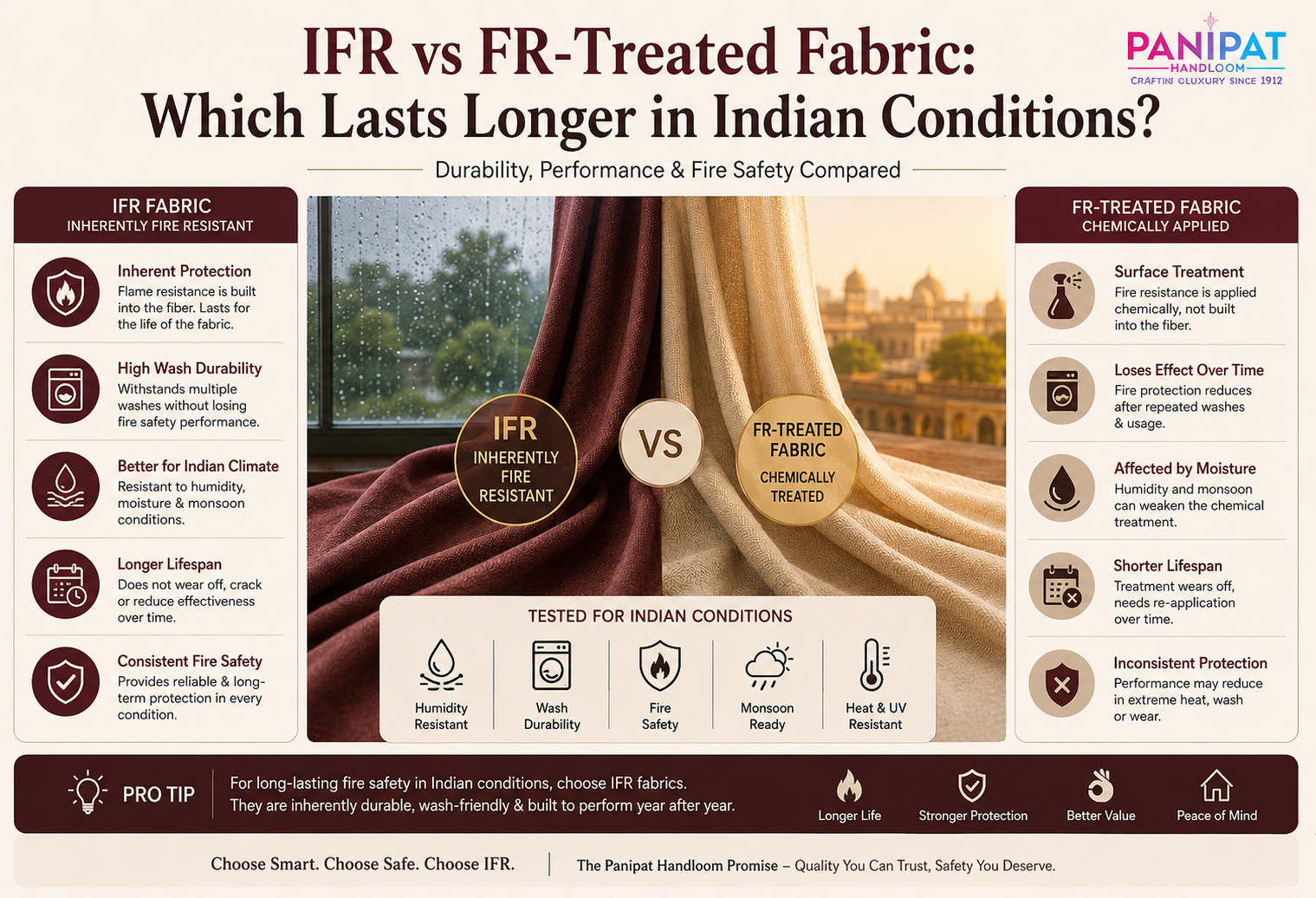
Anyone specifying curtains, drapes or upholstery for a hotel, theatre, hospital or office in India hits this question early. Should the fabric be IFR (inherently fire retardant) or FR-treated? On paper both meet the same fire safety standards. In practice they behave very differently over the years, especially under Indian conditions where humidity, dust and cleaning frequency all affect fabric performance.
The Panipat Handloom Contract Fabric Team supplies both IFR and FR-treated fabrics across hospitality, healthcare and commercial projects in Delhi NCR. This guide breaks down what each term means, how they perform over time, what they cost in India and which one earns its place in long-life installations.
What IFR Fabric Actually Is
IFR stands for Inherently Fire Retardant. The fire resistance is built into the fibre itself at the molecular level during manufacture. The polymer is chemically modified so that combustion is suppressed regardless of how the fibre is later woven, dyed or finished.
Common IFR fibres include modacrylic, aramid (firefighter-grade), specially modified polyester (FR polyester) and glass fibre. For curtain and upholstery use, IFR polyester is the dominant choice because it offers the visual range of standard polyester with permanent fire resistance. IFR fabric cannot lose its fire resistance through washing, dry cleaning, humidity exposure or normal wear. The flame retardancy lasts as long as the fabric itself.
What FR-Treated Fabric Actually Is
FR-treated fabric starts as standard cotton, linen, polyester or a blend and is dipped, sprayed or impregnated with flame retardant chemicals after weaving. The chemicals bond to the fibres at the surface level, raising the ignition temperature and slowing flame spread.
The catch is that the treatment is not permanent. Most FR chemicals are water-soluble or react to humidity. They wash out over time. International standards under NFPA 701 certify FR-treated drapery fabrics for only one year before recommended retesting and likely retreatment. A variant called DFR (Durably Flame Retardant) uses non-water-soluble chemistry and can survive up to 25 washes before requiring retreatment. DFR sits between standard FR-treated and true IFR in both cost and durability.
The Real Difference: Lifetime Performance
Day one, both IFR and FR-treated fabrics meet the same fire safety certification. A new IFR curtain and a freshly treated FR curtain are equally fire safe when first hung. The difference emerges over months and years.
|
Performance Factor |
IFR Fabric |
FR-Treated Fabric |
|---|---|---|
|
Day one fire rating |
Equal to FR |
Equal to IFR |
|
After 1 year hanging |
Same as day one |
Often degraded, retest required |
|
Effect of washing |
None |
Treatment washes out |
|
Effect of dry cleaning |
None |
Most solvents strip treatment |
|
Effect of humidity |
None |
Gradual loss across monsoon seasons |
|
Retreatment frequency |
Never needed |
Every 1 to 3 years typically |
|
Lifetime cost |
Higher upfront, no retreatment |
Lower upfront, recurring retreatment |
|
Best lifespan |
10 to 15 years with full fire safety |
1 to 3 years before retreatment |
For long-life commercial installations IFR wins on total cost of ownership despite the higher upfront price. For short-term or temporary use FR-treated is fine.
How Indian Conditions Affect Each
Indian conditions stress FR-treated fabrics in three specific ways.
Monsoon humidity. From June to September across most of north and central India, indoor humidity stays above 70 percent for weeks. Water-soluble FR chemicals slowly migrate within the fabric and lose effectiveness. A FR-treated curtain installed in March may need retesting by November after one full monsoon cycle.
Urban dust and pollution. Delhi NCR's particulate load means commercial curtains get cleaned more frequently than equivalent installations in cleaner climates. Each cleaning round either strips FR treatment (water washing) or degrades it (dry cleaning solvents). FR-treated fabrics in Delhi hotels typically need retreatment every 12 to 18 months.
Summer heat. Extended exposure to 40°C plus temperatures combined with direct sunlight breaks down some FR chemical bonds. The fabric may still look fine but fail a fire test after 18 to 24 months.
IFR fabrics handle all three Indian stressors with no measurable drop in fire performance. This is why hospitality groups and hospital chains across India have moved heavily toward IFR specifications over the past five years despite the higher upfront cost.
Pricing in India
IFR polyester drapery fabric in India typically retails between Rs 320 and Rs 850 per metre depending on weight, weave and brand. FR-treated equivalents start at Rs 180 to Rs 250 per metre plus a treatment surcharge of Rs 60 to Rs 120 per metre. Retreatment over time runs Rs 40 to Rs 90 per metre, repeated every 1 to 3 years. Over a 10-year hospitality contract, FR-treated fabric usually costs 30 to 50 percent more than IFR in total ownership terms despite the lower entry price.
For project-level fabric specifications across Delhi NCR, the customised curtains service and Panipat polyester curtains range cover both IFR and FR options with documented certifications. The D'Decor curtain collection and Vaya Luxury Brands range carry imported IFR options at the premium tier.
Which to Pick by Application
Hotels (3-star and above), hospitals, theatres and assembly buildings. IFR. Long service life, frequent cleaning, mandatory fire compliance. The cost premium is small relative to total project budget and the recurring retreatment cycle disappears.
Corporate offices and meeting rooms. Either works. FR-treated is fine if the cleaning routine is light and retest protocols are documented. IFR is simpler.
Restaurants and cafés. Mixed. Backdrop fabrics IFR. Decorative drapes can be FR-treated and replaced more frequently as designs change.
Event venues and temporary installs. FR-treated. The fabric won't see enough service time to justify IFR's upfront premium.
Residential. Either is acceptable. Most Indian homes are not legally bound to FR specifications but premium homes increasingly specify IFR for media rooms, home theatres and home offices.
For architects and PMC clients handling these specifications across Delhi NCR, the architects and designers section covers the project-level engagement model with full test documentation supplied with the fabric.
Common Mistakes
Assuming "FR" alone is enough. Without specifying IFR or DFR, the default supply is often a standard FR treatment certified for only 12 months. Always specify the durability class in writing.
Skipping the retest protocol. FR-treated fabrics need annual or biennial fire testing. Many buyers install FR-treated drapes and forget. By year three the fire compliance has lapsed.
Choosing FR-treated for high-humidity zones. Coastal cities like Mumbai, Chennai and Kolkata plus northern Delhi NCR monsoons both accelerate FR breakdown. IFR or DFR makes more sense in these zones.
Ignoring smoke ratings. Both IFR and FR-treated come in variants with different smoke ratings. Specify the smoke class (s1, d0 or equivalent) for any enclosed space.
Key Takeaways
IFR fabric has fire resistance built into the fibre itself and lasts the lifetime of the fabric. FR-treated fabric is standard fabric chemically treated after weaving and loses its rating over time through washing, humidity and cleaning. Day one fire ratings are equal but lifetime performance differs sharply. Indian monsoon humidity, urban dust and summer heat all accelerate FR-treated fabric breakdown. IFR costs more upfront but delivers lower total cost of ownership over 5 plus years. Hotels, hospitals and theatres should specify IFR. Event venues and temporary installs can use FR-treated. Always specify the durability class in writing on the purchase order.
The Final Word
The IFR versus FR-treated decision isn't really about which is more fire resistant. It's about how long that resistance stays intact in real-world Indian conditions. For installations expected to last more than 2 to 3 years and exposed to normal cleaning, humidity and heat cycles, IFR pays for itself within the second cycle of avoided retreatment. For short-life or temporary applications, FR-treated remains the practical choice.
The Panipat Handloom Contract Fabric Team supplies both IFR and FR-treated fabrics with full certification documentation. Walk in to our N-14 South Extension Part 1 store in New Delhi or the Dharam Plaza store in Sector 62 Gurugram for a project consultation.
Frequently Asked Questions
Q: What is the main difference between IFR and FR-treated fabric?
IFR (Inherently Fire Retardant) fabric has fire resistance built into the fibre at the molecular level during manufacture. FR-treated fabric is standard fabric that has been chemically treated with flame retardants after weaving. IFR is permanent and lasts the lifetime of the fabric. FR treatment can wash out, break down with humidity and typically requires retesting every 1 to 3 years.
Q: Which lasts longer in Indian conditions?
IFR lasts significantly longer. Monsoon humidity, urban dust requiring frequent cleaning and summer heat all degrade FR treatment chemistry. A typical FR-treated curtain in Delhi NCR needs retesting and possible retreatment every 12 to 18 months. IFR fabric maintains its full fire rating for 10 plus years without intervention.
Q: How much more does IFR fabric cost than FR-treated in India?
IFR fabric typically costs 35 to 60 percent more per metre upfront than equivalent FR-treated fabric. Over a 10-year service life however, the recurring retreatment cost on FR-treated typically makes IFR cheaper in total ownership terms. For long-life commercial installations the IFR premium pays back within 2 to 3 cleaning cycles.
Q: Can FR-treated fabric be washed at home?
No. Standard FR chemical treatments are water-soluble. Washing FR-treated fabric in a regular washing machine will strip most of the flame retardant. Only IFR fabric can be washed without affecting fire performance. DFR variants can survive up to 25 washes.
Q: Do Indian regulations require IFR specifically?
Indian fire safety regulations under NBC 2016 and most state fire service acts require certified flame retardant fabrics for commercial buildings, hotels, hospitals and schools but do not specify IFR over FR-treated. The choice is left to the project specifier. Most experienced specifiers choose IFR for high-traffic permanent installations because it avoids the annual retest and retreatment cycle.
Contact for site visit and quote:
- Delhi store: N-14, South Extension Part 1, New Delhi-110049
- Gurugram store: Shop No 3, Plot No 101A, First Floor, Left Side, Dharam Plaza, Brahma City, Sector-62, Gurugram, Haryana-122101
- Phone: +91-9899073000, +91-9999999009