

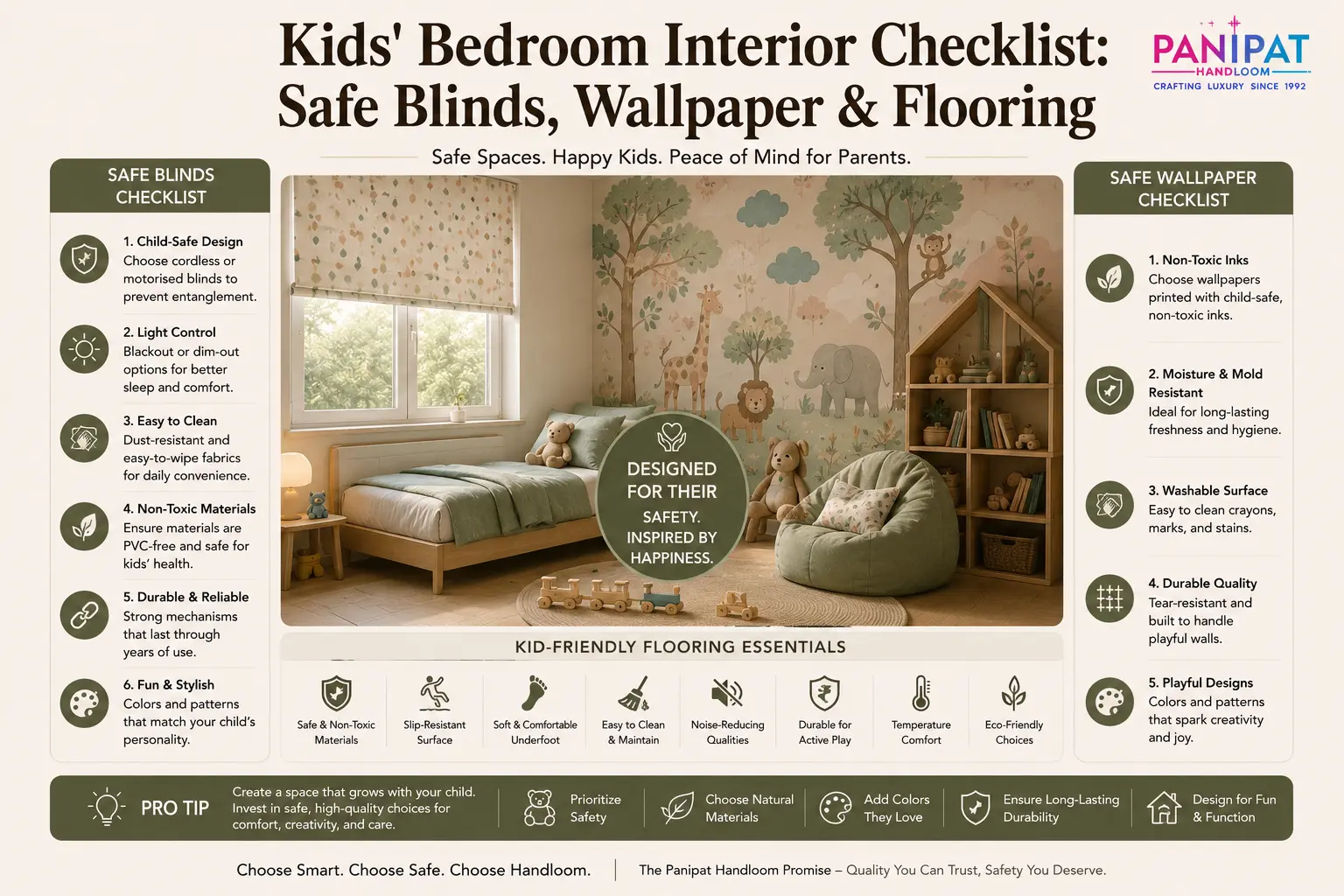
Designing a kids' bedroom is the one project where safety and aesthetics have to coexist from the first decision. A beautiful room with the wrong window treatment, a chemically loaded wallpaper or a hard slippery floor is not a safe room. The good news is that child-safe options now exist across every category, and most look great. This checklist covers what every parent in Delhi or Gurugram should specify across blinds, wallpaper, flooring, lighting and air quality before signing off on a kids' bedroom.
The Panipat Handloom Kids Bedroom Team helps parents specify rooms for children aged 2 to 12 across apartments and villas in Delhi NCR. The most common gap we see is parents focusing on theme and colour first then discovering safety problems too late. This guide flips that. Safety comes first, then everything else.
Safety First: The Non-Negotiables
Three rules that override everything else.
No corded blinds in a kids' bedroom. Corded window blinds are among the top five hidden hazards in homes per the US Consumer Product Safety Commission. Cords pose a real strangulation risk for toddlers and young children. Always specify cordless or motorised options for a kids' room.
Beds and climbable furniture away from windows. A child who can climb on a bed near a window can reach the window itself, the cords if any exist and potentially the window frame. Keep beds, cribs and storage units on walls without windows.
Low VOC and washable materials throughout. Kids spend more time on the floor and closer to surfaces than adults. Paints, wallpapers and flooring with low volatile organic compounds (VOC) protect indoor air quality. Washable materials let you clean up spills and crayon marks without throwing out the whole finish.
Everything else flows from these three.
The Kids' Bedroom Blinds & Window Treatment Checklist
Choose cordless or motorised blinds. No exceptions for a kids' room. The motorised window treatment range and motorised roman blinds are the safest because they have no operating cords at all. The cellular window blinds range offers cordless cellular shades which are a popular kids' room choice.
Add blackout backing for nap times. Indian summer light starts at 5 am and disturbs sleep schedules. The Panipat blackout fabric range can be layered behind a decorative front curtain or used as a standalone blackout shade.
Pick durable, easy to clean fabrics. Kids touch curtains, wipe hands, throw food. Cotton, polyester and roller-blind PVC all clean easily. The Panipat cotton fabric range handles repeated washing well. Avoid silk and delicate linens which stain easily.
Use solid colours or simple patterns. Bold cartoon-character prints date fast as kids grow. Solid bright colours or simple geometric patterns last longer through age changes.
Floor-length curtains only when blinds are not feasible. If curtains are used instead of blinds, floor-length on a wall-mounted track keeps the fabric out of toddler reach.
Skip: Corded venetian blinds. Roman blinds with exposed cords. Heavy looped tassels at toddler height. Long curtain ties that can wrap around small necks.
The Kids' Bedroom Wallpaper Checklist
Choose washable or wipeable wallpaper. Vinyl-coated and non-woven wallpapers wipe clean with a damp cloth. Standard paper wallpapers stain permanently. Ask specifically for a washable rating before buying.
Pick low VOC or non-toxic certifications. Indoor air quality matters most in the room where a child sleeps. The designer wallpaper range and customise wallpapers service cover non-toxic options suitable for kids' rooms.
Consider self-adhesive (peel and stick) for the playful wall. Kids' tastes change every two to three years. The self-adhesive wallpaper range lets you swap a feature wall without major work. Useful for the dinosaur phase that ends, the unicorn phase that follows and the space phase after that.
One feature wall maximum. Wallpaper on all four walls overwhelms a small Indian bedroom. Pick the wall behind the bed or facing the bed and keep the other three painted in a calm complementary tone.
Test colours in your actual light. Indian afternoon light is very different from showroom or photograph light. Always tape a sample on the wall and check it at different times of day.
Skip: Heavy metallic or glitter finishes (peel off in pieces). Wallpapers with strong chemical smell out of the roll (high VOC). Very busy patterns floor to ceiling (visual overload affects sleep).
The Kids' Bedroom Flooring Checklist
Pick a soft or cushioned floor. Hard tile and polished marble are unforgiving when kids fall. Wall-to-wall carpet, area rugs over wood or engineered wood with rugs all soften the landing. The wall-to-wall carpet range covers wool and synthetic options sized for kids' bedrooms.
Choose machine washable or easy-clean. The carpet tile range lets you replace individual tiles when one is damaged. The rugs and flooring section covers machine-washable rug options that lay over existing flooring.
Engineered wood beats laminate for kids' rooms. Real wood is warmer to sit on and free of the printed-laminate look. The engineered wooden flooring range handles spills better than solid hardwood and is forgiving on small falls when paired with an area rug. The bamboo flooring range is also worth considering for its natural warmth.
Use anti-slip backing on every loose rug. Loose rugs that slide cause falls. Either anti-slip mat backing or rug grippers underneath, every time.
Pick neutral or single-tone base flooring. The floor lives longer than any theme. Save the bright colour for cushions, curtains and wall art, not the floor itself.
Skip: High-gloss tile (slippery when wet). Loose woven mats without backing. Brittle laminate strips that splinter when furniture drags. Dark grout in light tiles (shows every spill).
Lighting and Air Quality Notes
A few small details that often get missed but matter.
Use warm white bulbs (2700K to 3000K), not cool white. Warm white in the evening supports natural sleep. Cool white delays melatonin and disturbs sleep schedules. A bedside dimmer is worth the small extra cost.
Add a soft night light. Plug-in LED night lights that switch on automatically prevent stumbles during night walks to the bathroom.
Ventilate the room well after any wallpaper, paint or flooring work. New materials off-gas for the first seven to fourteen days. Keep windows open and the room unoccupied during this period before moving the child back in.
Run an air purifier in Delhi NCR winter months. Particulate matter peaks November through January. A small HEPA purifier in a kids' bedroom is worth more than most decorative upgrades.
The Indian Climate Factor
Indian conditions add three layers that international guides miss.
Dust and pollution. Daily dust settles on horizontal surfaces. Kids' rooms benefit from minimal open shelving and easy-clean fabrics that handle repeated washing.
Monsoon humidity. Wallpaper and engineered wood handle Indian monsoon better than solid hardwood. Confirm humidity tolerances on any flooring before installation.
Summer heat. Kids' bedrooms facing south or west need blackout-backed blinds to keep afternoon sun out. Heat-blocking films on glass plus the blackout layer cut room temperature meaningfully.
Common Mistakes Parents Make
Picking the theme first. Spider-Man or fairy princess wallpaper that the child loves at age four is hated by age seven. Pick safe and durable first. Add theme through swappable elements (cushions, bedsheets, art prints) that change cheaply.
Choosing corded blinds because they look better. They look fine, but they are dangerous. Cordless and motorised options now match corded ones aesthetically. There is no reason to compromise here.
Forgetting storage will outgrow the child. A toddler's storage needs differ from a ten-year-old's. Modular storage with adjustable shelves lasts longer than fixed cabinetry built for a specific age.
Skipping the wall-anchor check. Any tall storage unit in a kids' room must be wall-anchored to prevent tipping. Indian apartments often skip this. Don't.
Buying everything bright and bold. A child's bedroom is primarily for sleep. Bright everywhere over-stimulates. Save bright for accents. Keep walls, blinds and floor mostly neutral.
Key Takeaways
A safe kids' bedroom starts with three non-negotiables: no corded blinds, beds away from windows, low VOC and washable materials throughout. For blinds, choose cordless cellular shades or motorised options with a blackout backing for nap times. For wallpaper, pick washable or wipeable types, ideally on one feature wall only, with self-adhesive options for changing themes. For flooring, prioritise soft or cushioned surfaces (wall-to-wall carpet, engineered wood with area rugs) with anti-slip backing on every loose rug. Use warm white bulbs on dimmers, ventilate after material work and run a HEPA purifier in Delhi NCR winters. Pick safe and durable first. Theme through swappable accents.
The Final Word
A kids' bedroom is not where to economise on safety to save on aesthetics. The good news is that today's child-safe blinds, wallpapers and flooring look as good as the unsafe alternatives. The two now overlap. Specify the safe versions from the start and you get a beautiful room and a safe one in the same decision.
The Panipat Handloom Kids Bedroom Team helps parents across Delhi NCR specify safe blinds, washable wallpaper and soft flooring in one consultation. Walk in to our N-14 South Extension Part 1 store in New Delhi or the Dharam Plaza store in Sector 62 Gurugram for sample mood boards and child-safe product options.
Frequently Asked Questions
Q: Are corded blinds safe for a kids' bedroom?
No. Corded window blinds are among the top five hidden home hazards according to the US Consumer Product Safety Commission. Cords pose a strangulation risk for toddlers and young children. Always specify cordless or motorised options for a kids' bedroom. Modern cordless cellular blinds and motorised roller blinds are widely available and just as attractive as corded versions.
Q: What is the safest wallpaper for a kids' room?
The safest wallpaper for a kids' room is washable or wipeable (vinyl-coated or non-woven) with a low VOC certification. Low VOC means fewer chemical emissions that can affect indoor air quality. Self-adhesive (peel and stick) wallpapers are also good for kids' rooms because they can be changed easily as the child grows.
Q: What flooring is best for a kids' bedroom in India?
Soft and cushioned flooring is safest for falls. Wall-to-wall carpet in wool or synthetic, engineered wood paired with a large area rug or bamboo flooring with cushioned rugs all work well. Any loose rug must have anti-slip backing or rug grippers to prevent slipping. Avoid high-gloss tile and polished marble in kids' rooms because they are slippery and unforgiving.
Q: Should I use blackout curtains in a kids' bedroom?
Yes. Blackout curtains or blackout-lined blinds help kids sleep better, especially during Indian summer mornings when light starts at 5 am. They also help during daytime naps. The cleanest setup is a cordless blackout cellular blind plus a decorative front curtain layered over it.
Q: How do I plan a kids' bedroom that won't need redoing in three years?
Pick safe and durable basics that don't depend on age. Neutral wall paint, washable solid-tone wallpaper, neutral flooring, cordless blinds in a quiet colour. Add the age-specific theme through cushions, bedsheets, art prints and one self-adhesive feature wall that can be changed cheaply when tastes shift. This way the room evolves with the child rather than needing a full refit every few years.
Contact for site visit and quote:
- Delhi store: N-14, South Extension Part 1, New Delhi-110049
- Gurugram store: Shop No 3, Plot No 101A, First Floor, Left Side, Dharam Plaza, Brahma City, Sector-62, Gurugram, Haryana-122101
- Phone: +91-9899073000, +91-9999999009