

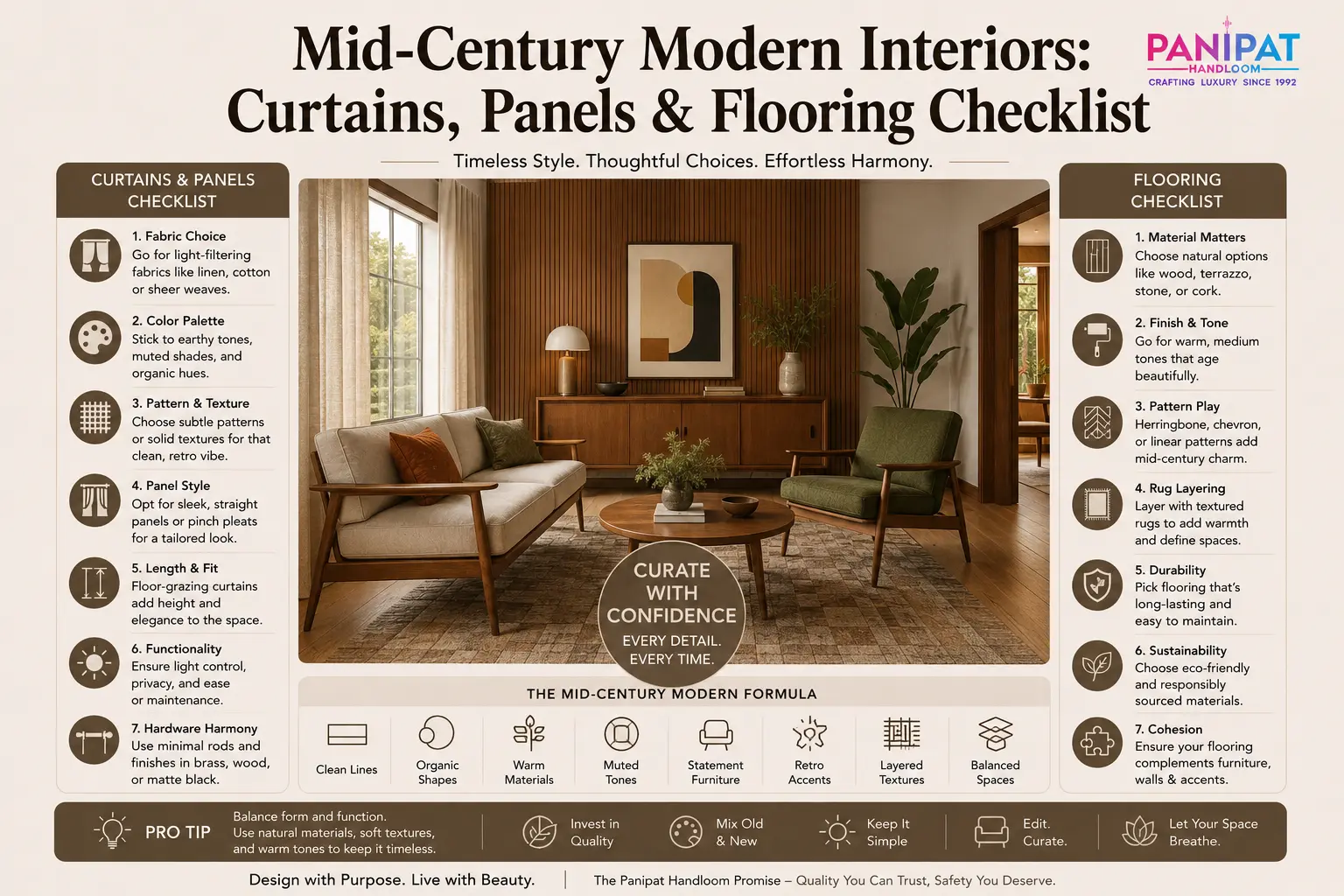
Mid-Century Modern Interiors: Curtains, Panels & Flooring Checklist
Mid-century modern (MCM) refuses to die. The design movement that defined American and Scandinavian interiors from roughly 1945 to 1970 has been having a comeback since the late 1990s and remains one of the most-requested briefs across Delhi and Gurugram consultations in 2026. The reasons are simple. The clean lines age well. The warm wood tones suit Indian sensibilities. The iconic furniture pieces (Eames lounge chair, tulip table, Wishbone chair) still look contemporary 70 years after they were designed. The indoor-outdoor philosophy that defined MCM architecture pairs naturally with Indian climate when adapted thoughtfully.
The Panipat Handloom Interiors Team handles MCM specifications regularly, especially for second-home buyers and architects working on apartments where the mid-century aesthetic carries timeless appeal. This guide is a practical checklist covering the three categories that most define an MCM room: curtains, wall panels and flooring.
What Mid-Century Modern Actually Is
MCM emerged in America in the 1940s and 1950s, heavily influenced by the German Bauhaus school and Scandinavian modernism. The philosophy emphasised clean lines, functional forms, honest materials and an indoor-outdoor relationship enabled by large windows and open floor plans.
The core MCM signatures: tapered legs on furniture, low-slung silhouettes, mixed materials (wood plus metal plus glass), warm mid-tone woods (teak, walnut, rosewood), bold accent colours over a neutral base, geometric patterns used sparingly and iconic statement lighting like sputnik chandeliers and arc floor lamps.
In India, MCM influence arrived through Le Corbusier's Chandigarh project and architects like B.V. Doshi and Charles Correa who blended modernist principles with Indian climate sensibilities. The style never disappeared from premium Indian interiors and is more visible than ever in 2026.
Why MCM Works for Indian Homes
Three structural reasons MCM fits Indian homes particularly well.
Teak is native to India. Karnataka, Kerala and Madhya Pradesh produce some of the world's best teak. The very wood that defined MCM furniture grows in our forests. Sourcing solid wood for MCM specifications is easier in India than in most countries.
Warm accent colours align with Indian heritage. Mustard, terracotta, sage, burnt orange and olive (classic MCM accent colours) are also classic Indian colours. The palette transitions naturally between MCM-modernist and traditional Indian heritage tones.
Indoor-outdoor flow suits Indian homes with balconies. Most modern Delhi NCR apartments have at least a balcony. MCM principles of connecting interior to exterior translate well even in apartment settings through full-length glass doors, sheer curtains and continuous flooring across thresholds.
The Mid-Century Modern Curtains Checklist
Floor-length, never short. MCM curtains touch the floor or slightly puddle. Hung from ceiling for taller perceived height. Avoid sill-length curtains which break the clean vertical line.
Solid colours or sparse geometric patterns. Mustard yellow, sage green, terracotta, olive or warm cream are classic MCM solids. If pattern, keep it geometric (lines, circles, organic abstracts) and use it on one feature window only.
Natural fabrics with subtle weight. Linen, cotton, raw silk and lightweight wool. The linen fabric collection and Panipat curtain linen fabric range cover the matt texture MCM needs. For solid accent colours, the Panipat plain curtains range and Panipat cotton fabric range work. Avoid heavy velvets on curtains (save velvet for upholstery).
Sheer inner layer for indoor-outdoor. A linen or cotton sheer behind the main curtain maintains MCM's bright airy feel during the day. The sheer fabric range covers translucent options.
Sleek rods in brass or matt black. No fancy finials. No swags or valances. The hardware should disappear visually. Brass for warmer rooms. Matt black for cooler-toned rooms.
Skip: Heavy patterns, frilly valances, swag drapes, blackout polyesters, gold tassels, ruffled headers. All anti-MCM.
The Mid-Century Modern Wall Panels Checklist
Wood slat or fluted panelling as the signature accent. Vertical or horizontal wood slat walls are an MCM hallmark. The wall panelling range and designer wall panelling range cover slat profiles suitable for MCM. Teak and walnut tones are most authentic. Light oak works for a Scandinavian-leaning MCM.
Thermo pine cladding for warmer rooms. The thermo pine cladding panels range delivers the warm Scandinavian-MCM feel particularly well in bedrooms and home offices.
Stone or brick accent on one feature wall. Original MCM homes used stone fireplace walls extensively. In Indian apartments, a single textured stone or brick wall behind a TV unit or sofa channels the same feel.
Geometric or organic wallpaper on one wall only. If wallpaper is used, restrict to one feature wall. Geometric patterns (circles, hexagons, lines) or organic patterns (abstract leaves, atomic shapes). The Cole & Son wallpapers and 1838 Wallcoverings ranges carry MCM-suitable patterns.
Painted walls otherwise. Most MCM walls are simply painted white, off-white or warm beige to let furniture and accent walls do the talking.
Skip: Heavy mouldings, ornate cornices, gilt finishes, fleur-de-lis patterns. Anti-MCM.
The Mid-Century Modern Flooring Checklist
Mid-tone hardwood as default. Teak, walnut or rosewood. Wide planks or strip flooring. The hard wood flooring range covers solid wood options. The engineered wooden flooring range offers MCM-suitable mid-tones that handle Indian humidity better than solid hardwood.
Avoid pale Scandinavian whitewashed wood. MCM wood floors are warm, not bleached. The pale Nordic look reads more contemporary Scandi than authentic MCM.
Stone or concrete in select rooms. Bathrooms, kitchens and entry foyers can use polished concrete or natural stone for the MCM feel.
Geometric area rugs in bold accent colours. A single rug in mustard, terracotta or geometric multi-colour anchors the conversation area. Jute, wool or wool-blend in a graphic mid-century pattern. The rugs and flooring section covers options sized for MCM living rooms.
Low-pile or sculpted wall-to-wall carpet for bedrooms. 1960s MCM extensively used wall-to-wall carpet in bedrooms and home offices. The wall-to-wall carpet range covers wool and wool-blend options that suit MCM specifications.
Skip: Glossy white marble (too contemporary luxury), printed wood-look tiles (reads fake), patterned ceramic tiles in stylized florals (anti-MCM).
The MCM Colour Palette
The signature MCM palette uses a neutral base plus bold accents.
- Neutral base: Off-white walls, mid-tone teak or walnut wood, warm beige
- Bold accents: Mustard yellow, sage green, terracotta, olive, burnt orange, teal, deep brown
- Hardware accents: Brass, gold, matt black
- Avoid: Pastels (anti-MCM), saturated brights (too contemporary), all-grey palettes (too modern minimalist)
Common Mistakes
Going too retro-themed. MCM should feel timeless not like a 1960s movie set. Skip the obvious props (lava lamps, shag rugs, kidney-bean tables) unless used very sparingly.
Mixing too many MCM accent colours. Pick two accent tones maximum (mustard plus teal or sage plus terracotta). Three or more together loses the MCM clean discipline.
Using printed wood laminate floors. MCM lives on the wood floor. A printed laminate undermines the entire room's authenticity even if everything else is perfect.
Forgetting the indoor-outdoor connection. Heavy blackout drapes permanently drawn defeat MCM's bright-airy intent. Layer sheers with heavier curtains so the room can switch modes.
Over-furnishing. MCM rooms feel open. Floor space matters. Tapered legs visually float furniture above the ground. Skip bulky cabinets, oversized sofas and decor clutter.
Key Takeaways
Mid-century modern (1945-1970) is defined by clean lines, functional forms, honest materials, warm mid-tone woods (teak, walnut, rosewood) and an indoor-outdoor relationship. Indian homes adapt particularly well because teak is native to India, MCM accent colours align with Indian heritage tones and balcony architecture supports MCM's indoor-outdoor philosophy. The three category checklist: curtains in floor-length linen or cotton with MCM accent colours on sleek brass rods; wall panels in wood slat or fluted profiles with stone or brick accent feature walls; flooring in mid-tone teak or walnut hardwood with geometric area rugs in bold accents. Pick two accent colours maximum. Skip the retro props. Keep it timeless.
The Final Word
Mid-century modern isn't a phase. The fact that 70-year-old furniture designs still look fresh is proof of the philosophy's durability. For Indian homes MCM offers a contemporary look rooted in materials (solid wood, natural fibres, brass) that Indian craftsmanship has produced for centuries. Done well, an MCM Indian home reads as timeless and grounded rather than dated or imported.
The Panipat Handloom Interiors Team handles fabric, panel and flooring specifications for MCM homes across Delhi NCR. Walk in to our N-14 South Extension Part 1 store in New Delhi or the Dharam Plaza store in Sector 62 Gurugram for sample mood boards.
Frequently Asked Questions
Q: What is mid-century modern interior design?
Mid-century modern (MCM) is a design movement from roughly 1945 to 1970 originating in America and influenced by German Bauhaus and Scandinavian modernism. The style emphasises clean lines, functional forms, honest materials (teak, walnut, glass, metal), warm wood tones and an indoor-outdoor relationship through large windows and open floor plans.
Q: What curtains are best for a mid-century modern living room?
Floor-length curtains in solid colours or sparse geometric patterns, made from natural fabrics like linen or cotton. Hung from sleek brass or matt black rods. MCM accent colours include mustard yellow, sage green, terracotta and olive. Layer a sheer inner curtain to maintain the bright airy MCM feel during the day. Avoid heavy patterns, valances and ornate hardware.
Q: What is the best flooring for mid-century modern interiors in India?
Mid-tone hardwood is the default. Teak, walnut or rosewood for solid wood floors. Engineered wood in similar tones for apartments where humidity makes solid hardwood impractical. Add a geometric area rug in a bold MCM accent colour like mustard or terracotta to anchor the conversation area.
Q: What wall treatments work for mid-century modern?
Wood slat or fluted panelling in teak or walnut tones is the signature MCM accent. One feature wall in stone or brick (replacing the traditional fireplace wall). Most other walls painted white, off-white or warm beige. Geometric or organic wallpaper on one wall only if used. Avoid heavy mouldings and ornate cornices.
Q: How do I bring mid-century modern style to my Indian home without major renovation?
Three changes that compound. Add one wood slat feature wall behind the sofa or bed (teak or walnut tone). Replace existing curtains with floor-length linen or cotton drapes in a bold MCM accent colour like mustard or sage. Add one geometric area rug in the living room. These three moves capture the MCM mood quickly and let you build from there.
Contact for site visit and quote:
- Delhi store: N-14, South Extension Part 1, New Delhi-110049
- Gurugram store: Shop No 3, Plot No 101A, First Floor, Left Side, Dharam Plaza, Brahma City, Sector-62, Gurugram, Haryana-122101
- Phone: +91-9899073000, +91-9999999009