

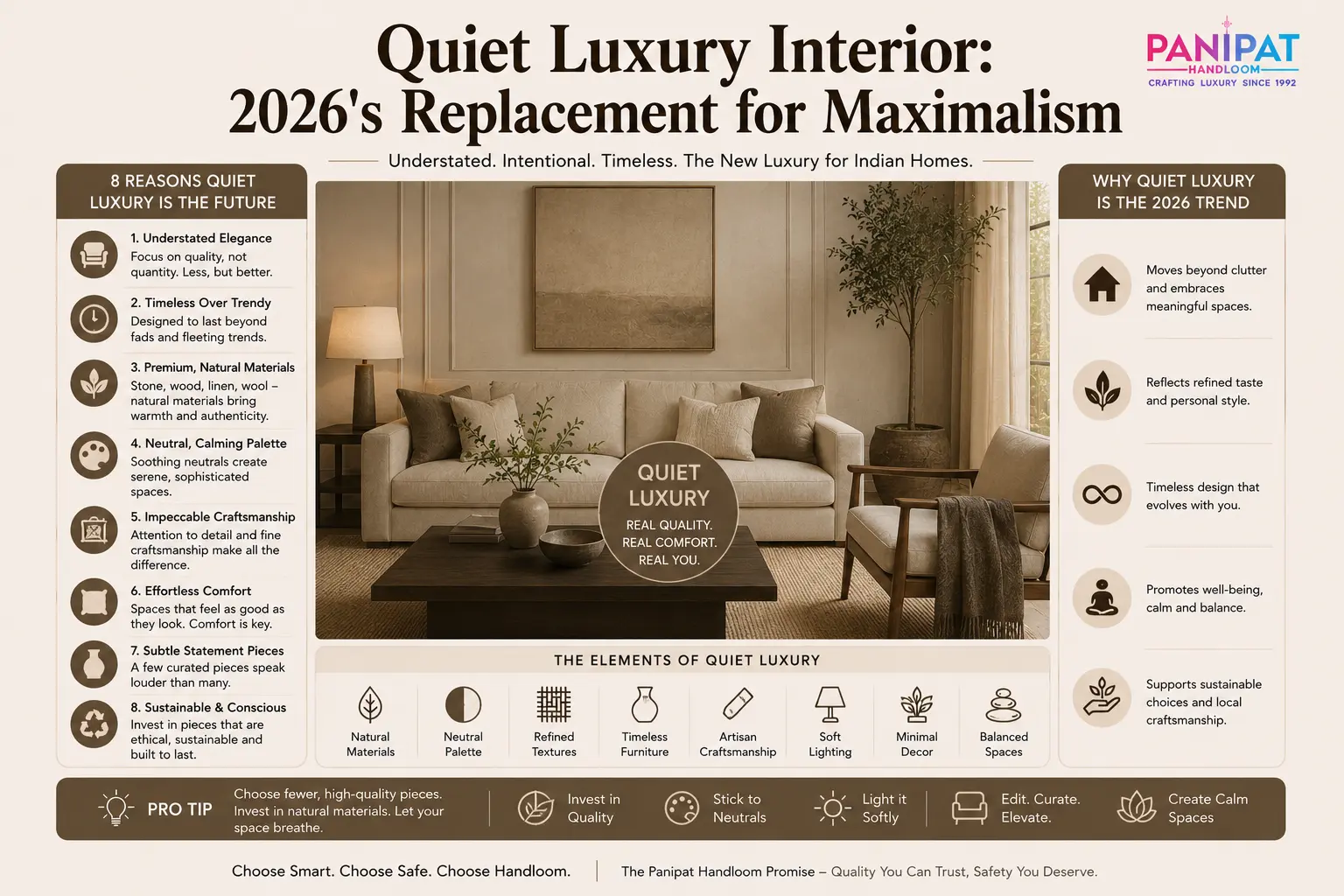
Quiet luxury (sometimes called stealth wealth or luxe minimalism) is the design philosophy that says the most expensive room in the house should be the one you'd notice last. No logos. No statement chandeliers screaming their price tag. No accent walls trying too hard. The luxury lives in things that take time to register: the weight of the linen, the depth of the wood grain, the perfect cove of soft light, the silence when the door closes. After three years of maximalism's bold colours and layered chaos, 2026 has decisively swung back toward restraint.
The Panipat Handloom Interiors Team has watched the brief change through 2025 and into 2026. Younger buyers especially are asking for spaces that feel calm rather than impressive. This guide breaks down what quiet luxury actually means, how it differs from maximalism and stark minimalism, the materials that define it and how to translate the look into Delhi NCR homes.
What Quiet Luxury Actually Means
Quiet luxury originated in fashion as a reaction against logo-heavy designer wear. The "old money" aesthetic of Loro Piana, The Row and Brunello Cucinelli (visible quality without visible branding) crossed into interiors around 2023 and has only strengthened since. By 2026 it's the dominant high-end residential mood across European, American and increasingly Indian design publications.
The core idea is restraint paired with refinement. Every material is high quality but not loud about it. Every surface is considered but not staged. Rooms feel inhabited rather than showroom-fresh. Budget goes into things that age well: solid wood, real stone, natural fibre fabrics, hand-finished hardware, considered lighting. Budget does not go into decorative excess that photographs well but adds nothing.
A designer working in quiet luxury described it as "the discipline to spend the budget where the eye doesn't go first". The visible decorative items get edited down. The invisible quality (the seam stitching, the wood joinery, the fabric drape, the door close) carries the room.
Quiet Luxury vs Maximalism vs Minimalism
The three styles get confused often. A quick clarifier.
|
Aspect |
Maximalism |
Minimalism |
Quiet Luxury |
|---|---|---|---|
|
Philosophy |
More is more |
Less is more |
Less is more, but exceptional |
|
Colour palette |
Bold, saturated, layered |
Stark white, sterile |
Warm neutrals, soft earth tones |
|
Material count |
Many, mixed |
Few, identical |
Few, exceptional |
|
Decorative pieces |
Abundant |
Almost none |
One or two carefully chosen |
|
Mood |
Vibrant, eclectic |
Clinical, fresh |
Warm, refined, calming |
|
Notable for |
Personality, energy |
Discipline, calm |
Quality, longevity |
Quiet luxury sits between maximalism's excess and minimalism's coldness. It's warmer than stark minimalism and quieter than maximalism. The look is often called luxe minimalism or warm minimalism for that reason.
The Quiet Luxury Palette
The palette is the easiest entry point. Warm neutrals do most of the work.
- Walls: Off-white, soft mushroom, plaster pink, oat beige, warm stone grey
- Wood: Walnut, white oak, ash, smoked oak (depending on the room mood)
- Upholstery: Cream linen, oat bouclé, camel wool, ink-blue velvet, sand suede
- Accents: Aged brass, oxidised bronze, matt black, natural stone
- Avoided: Bright colours, glossy chrome, plastic finishes, neon, jewel-tone saturation
Pantone's 2026 Colour of the Year (Cloud Dancer, a refined off-white) sits squarely in quiet luxury territory and reinforces the palette direction.
Materials That Define Quiet Luxury
This is where quiet luxury earns its name.
Natural high-end fabrics. Linen, wool, cashmere, silk, suede, velvet. All in solid or barely-textured weaves. Skip prints. The linen fabric collection and Panipat curtain linen fabric range cover the curtain side. The Panipat velvet range and Panipat suede fabric range cover sofa upholstery in muted quiet luxury tones. For premium projects the D'Decor curtain collection and Vaya Luxury Brands range carry imported fabrics with the refined hand-feel quiet luxury needs.
Solid wood and natural stone. Walnut, oak or wide-plank engineered wood floors. The hard wood flooring range and engineered wooden flooring range cover quiet luxury options. Avoid printed laminates which read as fake on close inspection. Marble, limestone or travertine on accent walls and benchtops where budget allows.
Wall treatments with discreet texture. No statement walls. Either painted in a quiet luxury neutral or covered in subtly textured wallpaper. The Cole & Son wallpapers, GP & J Baker and 1838 Wallcoverings ranges carry refined heritage patterns suited to quiet luxury rooms. The designer wall panelling range covers premium panel options for spaces where panelling replaces wallpaper.
Hidden technology. This is the quiet luxury signature most people miss. Concealed speakers. Recessed lighting. Hidden wiring. Motorised window treatments controlled from a single keypad. The motorised window treatment range and motorised roman blinds deliver the controlled-from-anywhere automation quiet luxury rooms expect without visible cords or chains. Technology should be felt, not seen.
Wall-to-wall carpet in select rooms. Bedrooms and home offices benefit from full carpet in wool or wool-blend. The wall-to-wall carpet range covers options that add the soft acoustic comfort 2026 quiet luxury values.
How to Bring Quiet Luxury Into Indian Homes
Indian homes adapt to quiet luxury well because the philosophy of restrained quality already exists in Indian luxury heritage. Custom-made furniture from a single craftsman. Family silver passed down. Hand-loomed Banarasi or Kanchipuram silks (the wedding fabrics, not the everyday). Quiet luxury just translates these instincts into a contemporary apartment.
Three practical starting moves.
Replace one cheap-feeling thing with one well-made thing each year. Quiet luxury doesn't require renovation. It requires patience. The Rs 8,000 sofa becomes a Rs 80,000 hand-frame sofa over time. The printed cushion becomes a hand-loomed linen one. The polyester curtain becomes pure linen. Each swap shifts the room's tactile register.
Edit decorative items by 50 percent. Quiet luxury rooms have fewer objects but each one matters. Remove half the cushions, photo frames, vases and trinkets. Keep only the pieces with genuine quality or genuine meaning.
Invest in lighting before furniture. A well-lit room with average furniture beats an averagely-lit room with expensive furniture. Use floor lamps, table lamps and pendants with warm white bulbs (2700K to 3000K) on dimmers. Avoid harsh overhead fluorescents which kill quiet luxury instantly.
Common Mistakes
Confusing quiet luxury with minimalism. Quiet luxury is warm. Minimalism is often cold. The difference is in materials (linen and wool vs glass and steel) and decorative items (one or two beautiful pieces vs zero).
Going too sterile. A room with no character isn't quiet luxury. It's just empty. Add hand-crafted objects with subtle warmth. One vintage piece. One personal photograph.
Choosing cheap-looking materials. Plastic finishes, printed laminates, faux leathers and synthetic velvets undermine the entire intent. Quiet luxury requires real materials even on a budget. Better one room done properly than three rooms half-done.
Over-styling with "luxury" decor bundles. Pinterest-perfect ceramic sets and matching candle collections feel staged. Three carefully chosen objects beat thirty branded ones.
Showing technology. Visible cables, exposed motors, dangling chains and remote controls left on tables undermine the quiet half of quiet luxury. Conceal everything.
Key Takeaways
Quiet luxury is the 2026 design philosophy that replaces maximalism's bold layered excess with restrained refinement and high-quality materials. The look is warm minimalism: less than maximalism, warmer than stark minimalism. Core materials are linen, wool, velvet, suede, solid wood, natural stone and aged brass. The palette is warm neutrals (off-white, mushroom, oat, plaster pink, warm grey) plus muted accents. Hidden technology including concealed wiring and motorised window treatments is a quiet luxury signature. Indian homes adapt well because the philosophy of restrained quality already exists in Indian luxury heritage. Edit decorative items by 50 percent. Replace cheap-feeling things one at a time with well-made replacements.
The Final Word
Quiet luxury is the design counterpoint to a world that has spent the last decade screaming for attention. Logo bags. Maximalist Pinterest boards. Loud restaurants. Statement-everything. Quiet luxury says the room you'd want to come home to is the opposite of all that. A room where every object earned its place through quality rather than visibility. A room where you can hear yourself think. For Indian homes navigating the dense pace of Delhi NCR life, quiet luxury isn't just a design choice. It's a recovery strategy.
The Panipat Handloom Interiors Team handles fabric, panel, flooring, window treatment and wall covering specifications for quiet luxury homes across Delhi NCR. Walk in to our N-14 South Extension Part 1 store in New Delhi or the Dharam Plaza store in Sector 62 Gurugram for sample mood boards.
Frequently Asked Questions
Q: What is quiet luxury in interior design?
Quiet luxury is a 2026 design philosophy that emphasises restrained refinement and high-quality materials over visible decoration or branding. The look uses warm neutrals, natural materials (linen, wool, solid wood, stone), refined craftsmanship and considered lighting. It's sometimes called stealth wealth or luxe minimalism. The luxury lives in materials and details rather than statement pieces.
Q: How is quiet luxury different from minimalism?
Minimalism removes things and often feels cold. Quiet luxury edits things down to a few exceptional pieces and feels warm. Minimalism uses glass, steel and stark white. Quiet luxury uses linen, wool, solid wood and warm neutrals. The visual restraint is similar but the materials and tactile feel are very different.
Q: How is quiet luxury different from maximalism?
Maximalism celebrates abundance: bold colours, layered patterns, many decorative pieces, personality on every surface. Quiet luxury celebrates restraint: warm neutrals, few items, materials and craftsmanship over visible display. Maximalism shouts. Quiet luxury whispers. They are opposite design philosophies though both can produce beautiful rooms.
Q: What materials define quiet luxury interiors?
Linen, wool, cashmere, silk, suede and velvet in solid weaves. Solid wood like walnut, oak or ash for flooring and furniture. Natural stone like marble, limestone or travertine for accent surfaces. Aged brass, oxidised bronze and matt black for hardware. Hidden technology including motorised window treatments. Avoid plastic finishes, printed laminates and synthetic fabrics which undermine the look.
Q: How do I start a quiet luxury home in India without a full renovation?
Three changes that compound. Edit decorative items by 50 percent across the room. Replace one cheap-feeling thing (curtain, cushion or lamp) with one well-made replacement in linen, wool or solid wood. Swap cool-white LEDs for warm-white bulbs (2700-3000K) on dimmers in the living room. These three moves shift the room's register within a weekend and let you build from there over months.
Contact for site visit and quote:
- Delhi store: N-14, South Extension Part 1, New Delhi-110049
- Gurugram store: Shop No 3, Plot No 101A, First Floor, Left Side, Dharam Plaza, Brahma City, Sector-62, Gurugram, Haryana-122101
Phone: +91-9899073000, +91-9999999009