

Roller Blinds vs Zebra Blinds: Which Is Better for Indian Homes?
The roller blinds vs zebra blinds comparison is the single most common window treatment question across premium Indian residential projects right now. Both belong to the same broad roll-up family, both mount with a compact tube at the top of the window, and both deliver efficient modern aesthetics.
Yet the dual-band design of zebra blinds solves a specific problem roller blinds cannot touch: adjustable daytime privacy without losing natural light entirely. The Panipat Handloom Window Treatment Team fits both categories every week across Delhi NCR, and the real-world choice pattern is clear: the rooms that ask for precise blackout pick roller, the rooms that ask for variable ambient light pick zebra.
This guide walks through the roller blinds or zebra blinds decision in depth, covering construction differences, cost comparisons, room suitability, and how zebra blinds stack up against other categories including roman, vertical, and cellular shades.
Expect practical numbers, honest tradeoffs, and straightforward answers on which is better roller blinds or zebra blinds for different Indian home contexts.
Difference Between Roller Blinds and Zebra Blinds
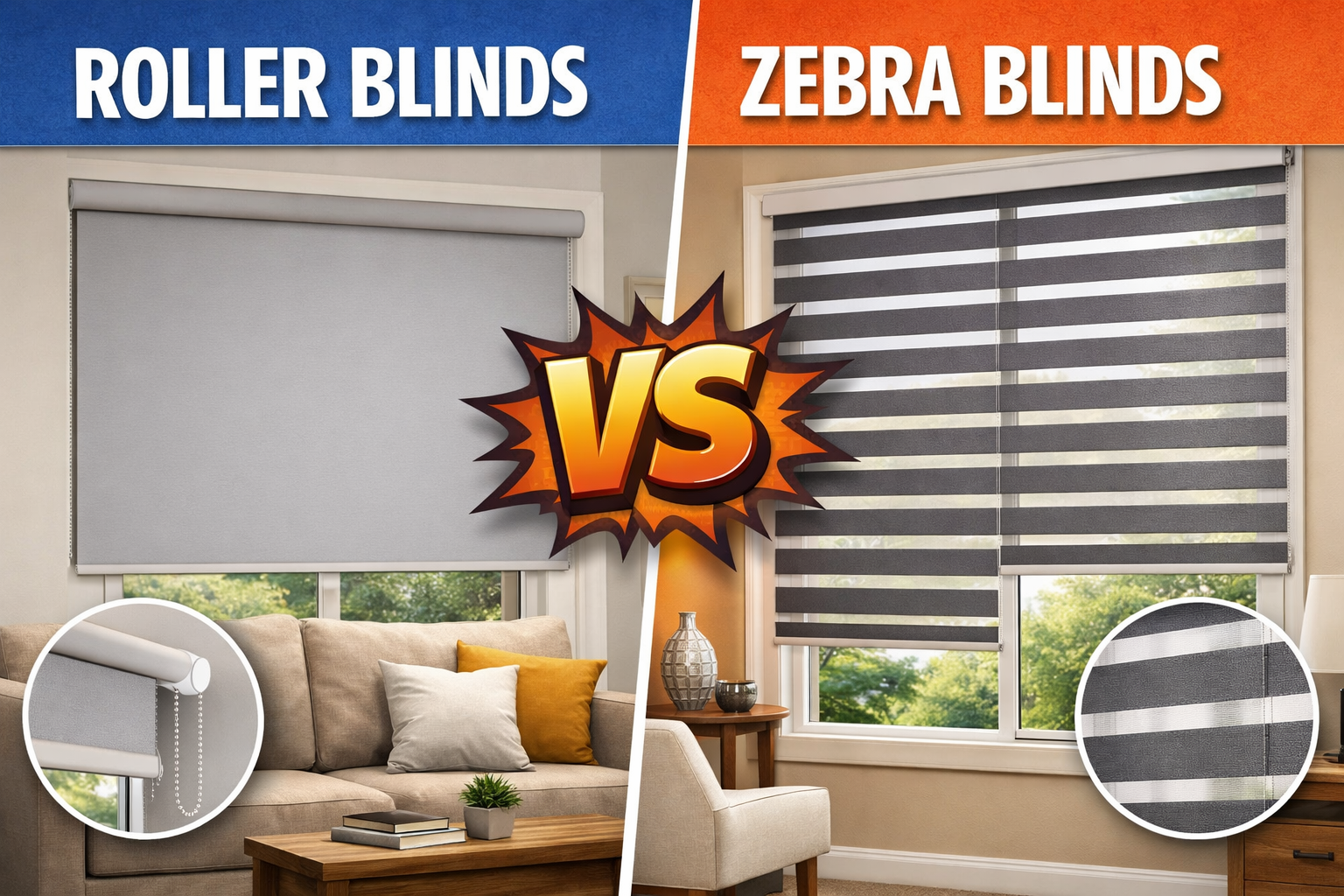
The difference between roller blinds and zebra blinds starts with fabric construction and ripples out from there. A roller blind uses a single continuous fabric panel that wraps around a tubular core.
A zebra blind uses a double fabric layer with alternating sheer and solid bands that can be aligned to either block light completely or let diffused light through. Difference between zebra blinds and roller blinds therefore shows up most clearly in daytime operation, where the zebra can hold an intermediate position that a roller simply cannot.
Difference between zebra and roller blinds also extends to fabric range and price. Zebra blinds sit slightly higher on the price ladder because the dual-band weaving is more complex. Roller blinds cover a wider range of functional fabrics including heavy blackout, waterproof PVC, and sunscreen mesh.
Zebra blinds vs roller blind construction lean toward decorative and mid-weight fabrics where the band pattern reads cleanly. Our roller blind catalogue with full fabric range covers the functional side, while our zebra blind collection with dual-band systems handles the flexible daytime-privacy category.
Roller Blinds vs Zebra Blinds: Head-to-Head Comparison
The table below captures how both categories perform across the factors that matter for real buying decisions. These are the parameters the Panipat Handloom Window Treatment Team reviews during every site consultation.
|
Parameter |
Roller Blinds |
Zebra Blinds |
|
Fabric Structure |
Single fabric layer on tube |
Dual alternating sheer and solid bands |
|
Light Control Style |
Binary, open or closed |
Adjustable between sheer and solid |
|
Privacy Flexibility |
Full privacy only when lowered |
Daytime privacy with light pass-through |
|
Visual Feel |
Clean, minimal, architectural |
Contemporary, layered, textural |
|
Best Rooms |
Kitchens, bathrooms, bedrooms, offices |
Living rooms, dining, balcony facing |
|
Blackout Availability |
Full blackout standard |
Available with blackout band variants |
|
Operation |
Chain, cordless, motorised |
Chain or motorised |
|
Starting Price per Sq Ft |
Rs 120 to 180 entry level |
Rs 180 to 260 entry level |
|
Typical Lifespan |
6 to 10 years |
6 to 9 years |
Two rows in the table drive most buying decisions. First, light control style: roller blinds operate in binary mode (open or closed) while zebra blinds offer stepless adjustment between sheer and solid.
Second, best rooms: the zebra sheer-to-solid flexibility earns its place in living rooms, while roller blinds win wet rooms and bedrooms where binary operation and full blackout matter more than adjustability.
Which Is Better Roller Blinds or Zebra Blinds
Which is better roller blinds or zebra blinds is a question the answer splits on two axes: what the room needs, and how the window is used during the day. Which is better zebra blinds for a living room? Usually zebra, because daytime ambient light matters more than precise blackout.
Which is better zebra blinds or curtains for the same space? Zebra wins on function, curtains win on visual softness, and the best specification often combines both. The layered blind-plus-curtain approach delivers the zebra's daytime flexibility with a curtain's evening warmth.
Which is better zebra blinds or roller blinds for bedrooms swings the other way. Bedrooms prioritise sleep quality, which demands full blackout capability. Roller blinds with blackout fabric and side tracks deliver this cleanly.
Zebra blinds, even in their blackout-band variants, rarely hit the 100 percent light block that a proper blackout roller achieves. For bedroom blackout installations, our Panipat blackout fabric for roller blinds pairs with standard roller hardware for total-darkness results.
Zebra Blinds Vs Roller Shades and Roller Shade vs Zebra Blinds
Zebra blinds vs roller shades is the same comparison in American terminology. Roller shade vs zebra shade and roller shade vs zebra blinds all describe the same choice between a single-layer rolling fabric and a dual-band translucent system.
In India and the UK, blind is the more common term while shade is used interchangeably in international design publications. The product specifications are identical regardless of naming.
Roller shade vs zebra shade buyers in India should note that most dual-band systems sold in the Indian market use Korean or Chinese tube hardware with locally-sourced fabric.
Premium specifications use European tube motors and higher-gsm fabrics that justify their price premium through fabric stability over the first three to five years. The customised blinds manufacturing service covers both categories with fabric options tailored to the Indian market and its humidity conditions.
Zebra Blinds or Roller Shades: Fabric and Light Behaviour
Zebra blinds or roller shades as a category question splits on how the fabric handles ambient daytime light. Zebra blinds deliver a distinctive banded shadow pattern when the sheer and solid stripes overlap at 50 percent alignment, which creates gentle horizontal zones of light across the room. Many interior designers specify zebra specifically for this visual effect in living rooms with large glass walls facing gardens or balconies.
Zebra blinds or roller blinds decisions for kitchens almost always favour roller because of steam and oil exposure. The dual-band construction of zebra fabric attracts cooking residue into the fabric layers where cleaning becomes difficult.
Roller blinds in PVC-coated polyester handle the same kitchen conditions indefinitely with a damp-cloth wipe. For clients wanting the zebra visual effect with roller-grade cleanability, printed wood-grain variants from the printed wooden blind collection offer a banded appearance without the cleaning penalty of real zebra fabric.
Zebra Blinds Dual Roller Shades for Windows
Zebra blinds dual roller shades for windows represent the modern evolution of the category, where the two fabric layers run on a single tube with precise alignment control.
The mechanism uses a continuous loop chain or motorised drive to shift the inner and outer fabric bands relative to each other, creating four functional positions: full sheer, full solid, alternating stripes, and fully raised. This four-mode operation is what sets zebra apart from standard roller shades and justifies the slight price premium.
Zebra curtain roller systems in larger sizes require higher-torque motors because the dual-fabric weight is roughly 60 percent higher than equivalent roller blinds. For windows wider than 8 feet, this torque consideration becomes a real design constraint. Our motorised window treatment range handles the motor specification matching for both single roller and dual zebra applications.
Can Zebra Blinds Be Rolled Up
Can zebra blinds be rolled up completely like a standard roller? Yes. When fully raised, both fabric layers wrap around the tube together, compressing into roughly the same 3 to 4 inch stack height as a single roller blind. Can zebra blinds be rolled up to any intermediate position?
Also yes, and this is where the zebra shines: the blind can hold any height position from fully lowered to fully raised, with independent control of the fabric band alignment at each position.
This dual control is what makes zebra blinds uniquely suited to rooms with varying daytime usage patterns. Morning meetings at a dining table benefit from full sheer mode with lowered blind. Afternoon family time benefits from 50 percent band alignment with partial raise.
Evening TV watching benefits from full solid mode. All four modes operate on the same single blind without hardware changes, which is the functional argument that justifies the category for living spaces.
How to Install Zebra Blinds and How to Install Zebra Roller Blinds
How to install zebra blinds follows most of the same steps as installing roller blinds, with two extra considerations. The installation starts with deciding inside-recess or outside-frame mounting. Inside-recess works for windows with at least 6 cm of depth clearance.
Outside-frame mounting suits shallow recesses or windows where the blind should cover the frame entirely. Standard brackets attach to the wall or ceiling with two screws per bracket, and the tube snaps into place.
How to install zebra roller blinds specifically requires attention to fabric alignment at final install. The dual fabric bands must be pre-aligned at the factory, and rough handling during installation can shift the alignment, which shows up as uneven banding in the first use.
The Panipat Handloom Window Treatment Team handles alignment check as part of the install-day walkthrough, because factory-aligned fabric that shifts during transit happens often enough to warrant a final check before sign-off.
Zebra Roller Blinds Price and Zebra Roller Blinds Review Criteria
Zebra roller blinds price bands in the Indian market start at Rs 180 per square foot for entry-tier fabric with standard chain drive and climb past Rs 500 per square foot for premium fabric with motorised control.
Mid-tier zebra installations sit at Rs 260 to Rs 380 per square foot fully installed for a standard 4 by 5 foot living room window. This places zebra roughly 40 percent above equivalent roller blind pricing but well below motorised premium roller specifications.
Zebra roller blinds review criteria worth checking before finalising any purchase include fabric gsm (30 gsm minimum for durable dual-band construction), tube diameter (38 mm minimum for smooth operation above 5 feet), and chain or drive mechanism quality.
Chinese-import zebra kits at the budget end often use thinner fabric that loses band definition within 18 months. Spending on the fabric side rather than the visible hardware side delivers longer daily satisfaction.
Zebra Blinds Vs Roman Blinds and Zebra Blinds Vs Venetian Blinds
Zebra blinds vs roman blinds is a comparison between two completely different aesthetic families. Roman blinds use horizontal fabric folds with a soft textile feel. Zebra blinds use dual-band rolling fabric with a contemporary technical feel. Zebra blinds vs roman blinds for a formal living room usually favours roman because fabric warmth elevates formal spaces.
Zebra blinds vs roman blinds for a casual family living space usually favours zebra because the daytime flexibility matters more than fabric texture. Our roman blind catalogue with premium fabrics suits the soft-feel applications where zebra would read too utilitarian.
Zebra blinds vs venetian blinds compares a fabric-based system against a slat-based system. Venetian blinds use horizontal aluminium, PVC, or wooden slats with tilt control. Zebra blinds use fabric bands with band-alignment control. For pure light adjustability, venetians offer finer granularity because each slat tilts independently.
For fabric warmth and contemporary visual feel, zebra wins cleanly. The venetian blind range we stock suits study rooms and home offices where precise slat-by-slat control matters more than fabric texture.
Vertical Blinds vs Zebra Blinds and Zebra Blinds vs Cellular Shades
Vertical blinds vs zebra blinds is the comparison for large windows and sliding glass doors. Vertical blinds use tall fabric vanes that sweep sideways on a top track. Zebra blinds run horizontally with a single tube at the top. For sliding doors above 8 feet wide, vertical blinds outperform zebra because the sweep operation works better at that scale than a lowering-raising zebra.
For standard residential windows under 6 feet wide, zebra wins on visual feel and daytime flexibility. The vertical blind systems for wide openings handle the large-door applications where zebra would struggle mechanically.
Zebra blinds vs cellular shades compares dual-band aesthetics against honeycomb thermal performance. Cellular shades use a folded honeycomb fabric structure that traps air between the cells, delivering measurable thermal insulation. Zebra blinds offer no equivalent thermal benefit.
For AC-heavy rooms and bedrooms where summer cooling load matters, cellular honeycomb blinds with thermal cells outperform zebra on pure performance metrics. For visual appeal and daytime privacy flexibility, zebra still wins the head-to-head aesthetic comparison.
Multi-Category Feature Comparison
The table below broadens the comparison across four blind categories, which helps buyers navigating the full window treatment decision rather than just the roller versus zebra debate. Use this reference when the choice isn't binary.
|
Feature |
Zebra |
Roller |
Roman |
Vertical |
|
Daytime Privacy |
Excellent |
Good |
Good |
Good |
|
Light Adjustability |
Stepless sheer to solid |
Binary |
Fold-based |
Vane tilt |
|
Blackout Option |
Limited |
Full |
Strong with lining |
Moderate |
|
Stack Space |
2 to 3 inches |
2 to 3 inches |
6 to 12 inches |
Side-stack |
|
Cleaning |
Vacuum or damp wipe |
Damp wipe |
Spot clean |
Damp wipe |
|
Best Use |
Living rooms |
Wet rooms, bedrooms |
Formal rooms |
Wide sliding doors |
The pattern that emerges from this table: zebra wins on daytime privacy and light adjustability, roller wins on blackout, roman wins on formal visual feel, and vertical wins on wide-opening applications. No single category wins everything, which is why most well-designed Indian homes end up with a mix across different rooms rather than standardising on one category.
What Are the Best Zebra Blinds for Indian Homes
What are the best zebra blinds depends on three practical criteria: fabric gsm, tube and chain quality, and humidity resistance. For Delhi NCR conditions, a 32 to 40 gsm dual-band polyester with aluminium tube and stainless steel chain is the mid-tier sweet spot.
Premium specifications use 45 gsm fabric with European tubes and ball-bearing chain drives, which deliver smoother operation and longer fabric stability but cost roughly 50 percent more.
For coastal and high-humidity regions, fabric mildew resistance becomes a deciding factor. Standard zebra fabric absorbs humidity over monsoon months and can develop visible staining within 18 months in poorly ventilated rooms.
Treated anti-mildew fabric variants address this, but add Rs 40 to Rs 60 per square foot to the base cost. For Gurugram and Dwarka homes, standard fabric works fine because ambient humidity rarely stays elevated long enough to damage properly ventilated zebra installations.
Zebra Curtain Roller Specifications
Zebra curtain roller setups describe the full motorised zebra blind specification with smart-home integration. The motor fits inside the tube, controlled by remote, wall switch, or smartphone app.
For Indian homes planning whole-home automation, motorised zebra integrates cleanly with the same hubs used for lighting and climate systems. The installation cost for motorised zebra runs roughly 35 to 50 percent higher than chain-drive zebra.
The practical benefit of motorised zebra shows up in daily use. Manual chain operation requires stepping to the window, pulling the chain to the desired height, then shifting the alignment control separately.
Motorised zebra handles both operations with a single remote press, which matters significantly for tall windows or rooms where reaching the chain mount becomes awkward. Our complete blinds for windows catalogue lists motorised and manual options together with transparent pricing for each.
Which Is Better Zebra Blinds or Curtains
Which is better zebra blinds or curtains is the question for clients deciding whether to skip blinds entirely and use only curtains. Curtains deliver softness, texture, and visual warmth that blinds alone cannot match.
Zebra blinds deliver precise daytime privacy and light adjustability that curtains alone cannot match. For most Indian living rooms, the best specification uses both: zebra blinds against the glass for functional control, curtains over the frame for visual warmth.
When only one can be specified due to budget or space constraints, the choice depends on which function matters more. For rented accommodations where window coverage changes with tenancy, customised curtains stitched to size offer flexibility that stays with the renter.
For homes owned long-term where precise light control improves daily comfort, zebra blinds earn their place as the primary window treatment. The D'Decor curtain collection pairs well with zebra blinds when both are specified on the same window.
Key Takeaways Before You Buy
Roller blinds win kitchens, bathrooms, bedrooms, and home offices where binary operation and full blackout matter most. Zebra blinds win living rooms, dining areas, and balcony-facing windows where daytime privacy flexibility matters most. The difference between roller blinds and zebra blinds reduces to light control style, with zebra offering stepless adjustability that roller cannot. Zebra roller blinds price sits roughly 40 percent above equivalent roller pricing but well below motorised premium roller.
For bedrooms needing total blackout, roller blinds with blackout fabric and side tracks beat zebra blinds cleanly. For wide sliding doors above 8 feet, vertical blinds outperform both roller and zebra. For AC-heavy bedrooms, cellular shades beat zebra on thermal performance. A mixed specification across the home, matching blind category to room function, delivers better long-term satisfaction than standardising on one category throughout.
The Final Word
Roller blinds vs zebra blinds is a choice that rewards matching category to room function rather than picking a universal winner. Zebra blinds earn their premium in living rooms, dining areas, and balcony-facing windows where daytime privacy and ambient light both matter. Roller blinds earn their place in kitchens, bathrooms, bedrooms, and home offices where binary operation and full blackout dominate the brief.
Roller blinds or zebra blinds decisions made thoughtfully across the home usually end up as a mixed specification, which is a stronger long-term result than forcing one category into every window. For a site walkthrough across Gurugram and Dwarka with fabric samples, motor options, and transparent per-square-foot pricing, the Panipat Handloom Window Treatment Team handles measurement through install in a single engagement. The full shop category for window treatment is the starting point for browsing both categories before the consultation.
Frequently Asked Questions
Q: What is the difference between zebra and roller blinds in simple terms?
Roller blinds use a single fabric panel that rolls around a tube for binary open-or-closed operation. Zebra blinds use dual alternating sheer and solid fabric bands that can be aligned to hold any intermediate privacy level. The difference between zebra blinds and roller blinds therefore shows up most clearly during daytime when the zebra lets in diffused light while maintaining privacy, which roller blinds cannot replicate.
Q: Which is better roller blinds or zebra blinds for a typical Indian living room?
Zebra blinds usually win Indian living rooms because the dual-band system lets daytime light through while maintaining privacy from street or balcony views. Roller blinds in living rooms force a choice between fully open with no privacy and fully closed with no daylight. Which is better zebra blinds for homes with large glass walls facing gardens or balconies tilts firmly toward zebra.
Q: Can zebra blinds be rolled up to intermediate positions?
Yes, zebra blinds can hold any position from fully lowered to fully raised, with independent control of fabric band alignment at each position. This dual control is the main functional advantage over standard roller blinds, which operate in binary mode only. Can zebra blinds be rolled up as tight as roller blinds when fully raised? Yes, the stack height is nearly identical.
Q: Zebra roller blinds price versus standard roller blinds price?
Zebra roller blinds price runs roughly 40 percent higher than equivalent roller blinds at the same fabric tier. Entry-level zebra starts at Rs 180 per square foot versus Rs 120 for comparable roller. Mid-tier zebra sits at Rs 260 to Rs 380 per square foot installed. The price gap reflects the dual-band fabric construction and slightly more complex chain mechanism.
Q: Zebra blinds vs roman blinds for formal rooms?
Roman blinds usually win formal rooms because fabric texture and folded warmth elevate the space visually. Zebra blinds read more contemporary and technical, which suits casual modern rooms better than traditional or transitional formal interiors. Zebra blinds vs roman blinds for a casual family room usually flips the other way because zebra's daytime flexibility earns its place in high-use living spaces.
Q: How to install zebra blinds without professional help?
Self-installation is possible for smaller windows. Start by confirming inside-recess or outside-frame mounting. Attach standard brackets with two screws each, spaced at the width marked on the blind specification. Snap the tube into the brackets, then test band alignment by running the chain through full cycle. How to install zebra roller blinds at larger sizes or above reach requires professional help because fabric alignment issues are harder to spot and fix from a standing position.
Q: Vertical blinds vs zebra blinds for sliding glass balcony doors?
Vertical blinds win cleanly for sliding doors above 8 feet wide because the side-sweep operation works better at that scale than the lowering-raising zebra. Zebra blinds become mechanically stressed at widths above 8 feet because the dual-fabric weight taxes standard tube motors. For standard 6-foot balcony doors, either works, and the choice becomes aesthetic.