

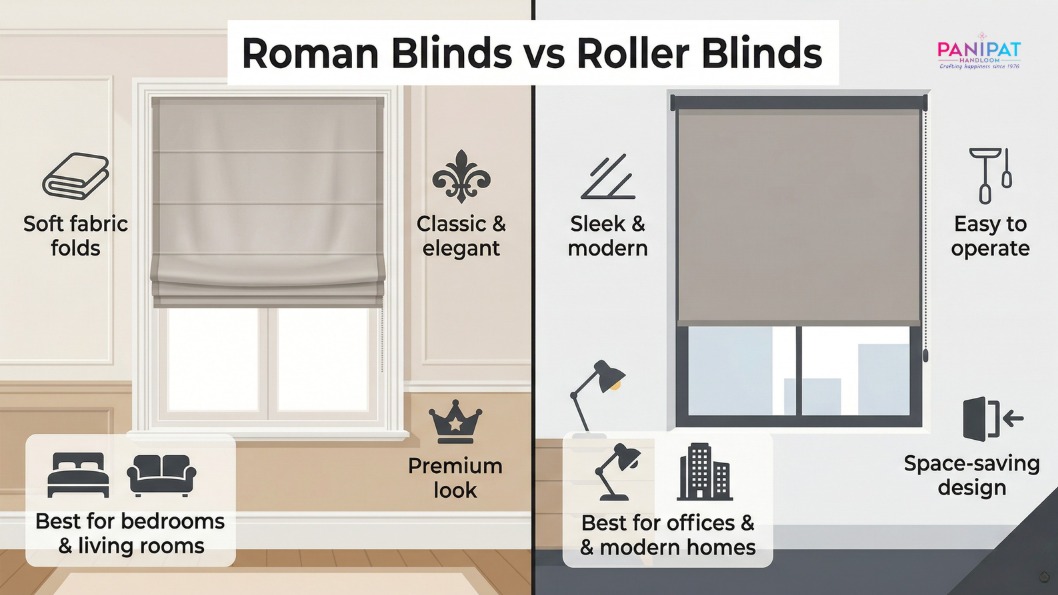
Roman Blinds vs Roller Blinds: Complete Buying Guide
The roman blinds vs roller blinds debate sits in front of almost every homeowner shopping window treatments for the first time. Both belong to the same broad blind category, both mount compactly at the top of the window, and both deliver privacy when drawn. Yet they behave completely differently in daily use, age on different timelines, and suit entirely different rooms.
Picking the wrong one shows up within months as crumpled fabric in a steamy kitchen or a plastic-feeling roller in a bedroom that needed softness. The Panipat Handloom Window Treatment Team has installed both categories across hundreds of Delhi NCR homes, and the pattern of which one works where is remarkably consistent.
This guide breaks down the roman vs roller blinds comparison across construction, cost, fabric options, operation, room suitability, and long-term durability. Expect clear answers on roman blinds vs roller blinds pros and cons, honest numbers on roman blinds vs roller blinds cost differences, and practical guidance on when roman and roller blinds work beautifully together on the same window rather than as competing options.
Difference Between Roman Blinds and Roller Blinds
The difference between roman blinds and roller blinds comes down to one structural detail that drives everything else: roman blinds fold, roller blinds roll. What is the difference between roller and roman blinds in practical terms? A roman blind uses horizontal rods or dowels sewn into the fabric back, which create neat fabric folds stacked on top of each other as the blind lifts.
A roller blind wraps fabric around a hollow tubular core, creating a compact rolled cylinder at the top when fully lifted. What is the difference between roller and roman blinds beyond construction? The fold versus roll distinction drives fabric choice, cleaning method, stack height, aesthetic feel, and price.
This structural difference explains why roman blinds suit heavier fabrics and roller blinds suit lighter, technical materials. Heavy linen or jacquard folds beautifully into roman bands but would make a roller blind so thick it would not fit above the window frame.
Lightweight blackout polyester or PVC-coated fabric rolls smoothly into a tight cylinder but would look limp and shapeless as a roman fold. Our roller blind catalogue with full fabric range covers the lightweight side, while our roman blind manufacturing in premium fabrics handles the heavier textile applications.
Roman Blinds vs Roller Blinds: Head-to-Head Comparison
The table below captures how roman and roller blinds perform across the factors that matter for actual buying decisions. These are the same parameters the Panipat Handloom Window Treatment Team reviews with every client during initial consultation.
|
Parameter |
Roman Blinds |
Roller Blinds |
|
Construction |
Fabric folds into horizontal bands |
Fabric rolls around tubular core |
|
Visual Feel |
Soft, luxurious, textile-rich |
Clean, minimal, modern |
|
Stack Space When Open |
6 to 12 inches of folded fabric |
2 to 3 inches rolled on tube |
|
Fabric Range |
Heavier woven fabrics, prints, jacquards |
Light to medium polyester, blackout, sheer |
|
Light Control |
Medium with lining, strong with blackout |
Full range from sheer to total blackout |
|
Cleaning Ease |
Spot clean or professional wash |
Wipe with damp cloth |
|
Best Rooms |
Bedrooms, formal living, guest rooms |
Kitchens, bathrooms, offices, kids rooms |
|
Operation |
Cord lift or motorised |
Chain, cordless, or motorised |
|
Average Lifespan |
8 to 12 years with care |
6 to 10 years typical use |
Two rows in the table deserve extra attention. First, the stack space difference: roman blinds take 6 to 12 inches of folded fabric at the top of the window, while roller blinds stack to 2 or 3 inches. For rooms with low-mounted blinds or shallow recesses, this alone can decide the category.
Second, the fabric range: roller blinds have a much wider functional fabric range including full blackout, sunscreen mesh, and waterproof PVC, while roman blinds lean decorative. Roman blinds vs roller blind functionality therefore splits along the practical-versus-decorative axis.
Roman Blinds vs Roller Blinds Pros and Cons
Roman blinds vs roller blinds pros and cons comes down to matching strengths to the specific room brief. Roman blind strengths: visual warmth, fabric variety, textile aesthetic, softens hard architecture, elevates formal rooms. Roman blind weaknesses: higher cost per square foot, trickier cleaning, larger stack height, fabric limitations in wet rooms, slower to operate at large sizes.
Roller blinds vs roman blinds pros and cons on the roller side: lower cost, full blackout options, wipe-clean fabric, minimal stack, fits any window recess, faster to operate. Roller blind weaknesses: less visual warmth, limited fabric variety in premium textures, can feel flat in formal rooms.
These tradeoffs are why the pros and cons of each only make sense when mapped against the room's actual needs rather than compared in isolation. A roller blind in a master bedroom feels rental-grade, while a roman blind in a kitchen warps within months. Context decides everything.
Roman Blinds vs Roller Blinds Cost
Roman blinds vs roller blinds cost gap is consistent across the Indian market: roman blinds typically cost 40 to 80 percent more than equivalent roller blinds at the same fabric quality tier. Are roman blinds more expensive than roller blinds in every case?
Yes, because the fabrication is more labour-intensive. A roman blind requires dowel pocket stitching, precision fold measurement, and lining attachment that roller blinds skip entirely.
For a standard 4 by 5 foot bedroom window, a mid-tier roller blind runs Rs 3500 to Rs 6000 fully installed, while a comparable roman blind sits at Rs 6500 to Rs 11000. Premium-tier comparisons show the same gap widening slightly: Rs 8000 to Rs 14000 for premium roller, Rs 14000 to Rs 28000 for premium roman. Motorisation adds Rs 6000 to Rs 12000 to either category.
Our customised blinds manufacturing service handles both categories with transparent per-square-foot pricing rather than rough verbal estimates.
Roman Shade vs Roller Shade: Terminology and Regional Use
Roman shade vs roller shade is the American terminology for the same product pair. In India and the UK, blind and shade are used interchangeably, though blind is the more common term for window treatment discussions.
Roman shades or roller blinds in catalogue descriptions therefore describe the same choice regardless of whether the retailer uses American or British naming. Roman shades roll up blinds and roller blinds all belong to the same roll-and-fold category within the broader window blind landscape.
For buyers shopping internationally or reading international design publications, this terminology overlap matters because the functional specifications are identical.
A premium linen roman shade in a New York design magazine is the same product as a premium linen roman blind from our local supply. The linen fabric range used for roman blinds is the single most-requested fabric base for roman constructions across Gurugram and Dwarka homes.
Are Roman Blinds or Roller Blinds Better
Are roman blinds or roller blinds better is the most common phrasing of the buying question, and the honest answer refuses to pick a winner without room context. Are roman blinds or roller blinds better for a kitchen? Roller, decisively.
Are roman blinds or roller blinds better for a master bedroom? Roman, usually. Are roman blinds or roller blinds better for a multi-window home that wants visual consistency? Either works, as long as the category choice stays consistent across main rooms.
The better question is not which category wins overall, but which category matches the room's primary function. Roman blinds win where fabric warmth matters. Roller blinds win where practicality matters.
For homes that want both aesthetics: the layered blind-plus-curtain approach often solves the tension by using a practical roller blind against the glass plus a decorative fabric curtain over the frame, which delivers both feels on the same window.
Roman Blind or Roller Blind for Kitchen
Roman blind or roller blind for kitchen is the one room choice where the answer is almost always the same: roller blind, without qualification. Kitchens expose window treatments to steam, cooking oil mist, airborne particulates, and regular wiping.
Fabric roman blinds absorb all of these over time. Within 12 to 18 months of daily Indian cooking, a fabric roman in a kitchen develops visible staining, odour retention, and fabric stiffness that even professional cleaning struggles to reverse.
PVC-coated roller blinds in kitchens survive the same abuse indefinitely. They wipe clean with a damp cloth, resist staining, and hold their colour for 8 to 10 years even in heavy-cooking Indian kitchens.
For clients determined to have a fabric-feeling kitchen blind, printed wood-grain roller variants from the printed wooden blind collection deliver visual warmth without the cleaning penalty of real fabric.
Roman Blinds and Roller Blinds Together: The Layered Approach
Roman blinds and roller blinds together on the same window is a specification most first-time buyers skip but premium interior designers often specify. The layered approach mounts a functional roller blind inside the window recess, hidden during the day, paired with a decorative roman blind on the outer frame.
The roller blind handles blackout, sun control, or privacy when needed. The roman blind handles the decorative presence during the day when both are lifted.
Roman blinds and roller blinds running as a pair suit master bedrooms, home theatres, and formal living rooms where fabric warmth and precise light control both matter.
The cost is naturally higher than either single solution, but lower than equivalent blind-plus-curtain setups. Our double roller mounting systems handle the hardware side of dual-blind installations, and the same principles apply when combining roman with roller on separate tracks.
Roman Blinds or Roller Blinds by Room: Complete Recommendation Chart
The table below takes the roman blinds or roller blinds question and answers it room by room, with reasoning and fabric suggestions for each. This is the shortlist reference the Panipat Handloom Window Treatment Team uses during initial client walkthroughs.
|
Room |
Winner |
Why It Wins |
Fabric Suggestion |
|
Master Bedroom |
Roman blind |
Fabric warmth, blackout lining |
Cotton-linen with blackout backing |
|
Kitchen |
Roller blind |
Wipe-clean, steam-resistant |
PVC-coated polyester |
|
Living Room |
Either works |
Style-led decision |
Linen roman or zebra-style roller |
|
Bathroom |
Roller blind |
Waterproof, mould-resistant |
Full PVC roller fabric |
|
Kids Room |
Roller blind |
Cordless safety, easy cleaning |
Cotton-polyester blackout |
|
Study |
Roman blind |
Softens hard desk environment |
Textured linen with medium weight |
|
Formal Dining |
Roman blind |
Elevates visual quality |
Silk or satin-backed cotton |
|
Home Office |
Roller blind |
Precise glare control for screens |
Dim-out polyester |
One pattern worth calling out: roman blinds dominate formal and soft-feel rooms, while roller blinds dominate functional and wet-zone rooms. Living rooms can go either way depending on the overall interior style. Modern minimalist interiors usually favour rollers, while traditional or transitional interiors favour romans.
Coordinate the blind category with other fabric elements in the room for visual coherence. For families wanting a third option that blends roller mechanics with adjustable light filtering, zebra blind dual-band systems sit between the two categories and work well in multi-use living spaces.
Fabric Selection: Where Each Category Shines
Roman blinds accept the widest range of decorative fabrics: linen, cotton, cotton-linen blend, embroidered cotton, printed jacquard, silk, and heavy drapery fabrics. The fold construction shows off fabric texture and pattern at full height.
Our printed fabric collection for roman blinds includes bold botanical prints, subtle geometrics, and solid textured weaves designed specifically for roman fold applications. The pure cotton fabric range we supply handles the casual and breakfast-nook side of the spectrum.
Roller blinds accept a more technical fabric range optimised for performance: blackout polyester, sunscreen mesh, dim-out polyester, PVC-coated polyester, and heat-reflective aluminium-backed fabrics.
The tight roll construction demands fabric that is dimensionally stable and thin enough to wrap cleanly. Our Panipat blackout fabric for roller blinds is the single most-requested fabric for bedroom rollers across Delhi NCR installations.
Operation and Mechanism Differences
Roman blinds traditionally use a cord-lift mechanism with a corded pull on one side. Modern roman blinds often use a chain-drive or motorised mechanism for smoother operation on larger sizes.
The fold construction limits how fast the blind can be raised because the fabric has to settle into neat bands as it lifts. Rapid operation leads to uneven folds, which is the most common post-installation complaint on budget-tier roman specifications.
Roller blinds use three main mechanisms: chain-drive (most common and budget-friendly), cordless spring-lift (safer for kids rooms), and motorised tubular motors.
Motorised roller blinds operate significantly faster than motorised roman blinds because the rolling action tolerates speed better than the folding action. For homes planning whole-home motorisation, the motorised window treatment range covers both categories with smart-home integration options.
Longevity and Care
Roman blinds typically last 8 to 12 years with reasonable care. The failure points are usually the cord lock mechanism, which wears out with daily use, and the fabric itself, which fades with UV exposure. Professional cleaning every 18 to 24 months extends fabric life significantly.
Replacing just the fabric while keeping the hardware is possible for quality roman constructions, which extends the effective lifespan well beyond the fabric-only timeline.
Roller blinds last 6 to 10 years in typical use. The failure points are the chain or cord, the tubular motor in electric versions, and fabric degradation from sun exposure.
Roller fabric is easier to replace than roman fabric because the roll-to-tube construction accepts new fabric cleanly without custom stitching. For wet-room installations, expect the lower end of the range because moisture accelerates bearing wear on the tube mechanism.
Visual Impact and Interior Style Fit
Roman blinds read traditional, transitional, or softly contemporary depending on fabric choice. Deep fabric folds bring visual weight and textile warmth that complement natural wood furniture, upholstered seating, and layered textiles. They work beautifully alongside cotton or linen curtains on adjacent windows without competing visually.
Roller blinds read modern, minimal, or architectural depending on fabric and mount style. They sit flat against the window when lowered, creating clean vertical lines that complement contemporary interiors with clean-lined furniture and hard surfaces. Roller blinds paired with structured pleated curtains over the frame deliver the best of both feels on formal windows.
Key Takeaways Before You Buy
Roman blinds suit bedrooms, formal living rooms, studies, and dining areas where fabric warmth elevates the space. Roller blinds suit kitchens, bathrooms, kids rooms, and home offices where practicality and easy cleaning dominate the brief. Are roman blinds more expensive than roller blinds? Yes, by 40 to 80 percent at matching fabric quality tiers.
Roman blind or roller blind for kitchen decisions almost always resolve to roller because of steam and oil exposure. Roman blinds and roller blinds together on the same window deliver both practical light control and decorative warmth for premium master-bedroom installations. Fabric choice matters more than brand name in both categories, and operation mechanism matters more than aesthetic for daily user experience. Motorisation adds significant convenience on tall windows and suits roller blinds slightly better mechanically than roman blinds.
The Final Word
Roman vs roller blinds is a decision that rewards matching category to room rather than picking a universal winner. Roman blinds bring fabric warmth and visual luxury where those qualities matter most. Roller blinds bring practicality, blackout performance, and easy cleaning where those qualities matter most. Roman blinds or roller blinds used thoughtfully across the home often end up as a mixed specification: romans in the bedrooms and formal rooms, rollers in the kitchen and bathrooms, either or both in the living room depending on style direction.
For a site walkthrough in Gurugram and Dwarka with fabric samples and clear per-square-foot pricing, the Panipat Handloom Window Treatment Team covers measurement, fabric selection, and install in a single engagement. The complete window treatment catalogue is the starting point for browsing both categories before the consultation.
Frequently Asked Questions
Q: What is the difference between roller and roman blinds in simple terms?
Roller blinds roll fabric around a tubular core for a compact cylinder at the top. Roman blinds fold fabric into horizontal bands using sewn-in dowels. Roller blinds suit technical fabrics and wet rooms, while roman blinds suit decorative fabrics and formal rooms. The difference between roman blinds and roller blinds therefore drives both aesthetic feel and practical use.
Q: Are roman blinds more expensive than roller blinds at matching quality?
Yes, consistently by 40 to 80 percent. Roman blinds require dowel pocket stitching, precision fold measurement, and lining attachment that roller blinds skip entirely. For a standard bedroom window, budget Rs 6500 to Rs 11000 for mid-tier roman versus Rs 3500 to Rs 6000 for comparable roller. The cost gap is real but the quality difference is equally real in the right rooms.
Q: Roman blind or roller blind for kitchen applications?
Roller blind, almost without exception. Kitchen steam, cooking oil mist, and daily wiping destroy fabric roman blinds within 12 to 18 months. PVC-coated roller blinds handle kitchen conditions indefinitely and wipe clean easily. For a wood-grain visual appeal in the kitchen, printed wooden roller variants deliver warmth without the fabric-cleaning penalty.
Q: Are roman blinds or roller blinds better for a formal living room?
Roman blinds usually win formal living rooms because the fabric texture elevates visual quality noticeably. Pairing a roman blind with a layered curtain gives the softest, most luxurious feel. For ultra-modern or minimalist living rooms, roller blinds in a premium fabric work well, especially when the overall scheme leans clean-lined and architectural.
Can roman blinds and roller blinds together work on the same window?
Yes, and this layered approach is a premium specification for master bedrooms and home theatres. A roller blind inside the recess handles blackout and precise light control. A roman blind on the outer frame provides decorative presence when both are raised. Double-bracket hardware keeps both layers operating independently.
Q: What are the main roman blinds vs roller blinds pros and cons summarised?
Roman pros: fabric warmth, visual luxury, textile variety, softens hard architecture. Roman cons: higher cost, trickier cleaning, larger stack height, fabric limitations in wet rooms. Roller pros: lower cost, full blackout options, wipe-clean fabric, minimal stack space, faster operation. Roller cons: less visual warmth, limited premium texture options, can feel flat in formal rooms.
Q: Do roman shades or roller blinds clean more easily over time?
Roller blinds clean dramatically more easily. A damp cloth wipes most staining off PVC-coated or polyester roller fabric. Roman blind fabric usually requires professional cleaning for deep stains, and some fabrics must be removed from the hardware for washing. For households with young children, pets, or cooking-heavy lifestyles, the cleaning ease tilts the decision firmly toward roller blinds for most rooms.