

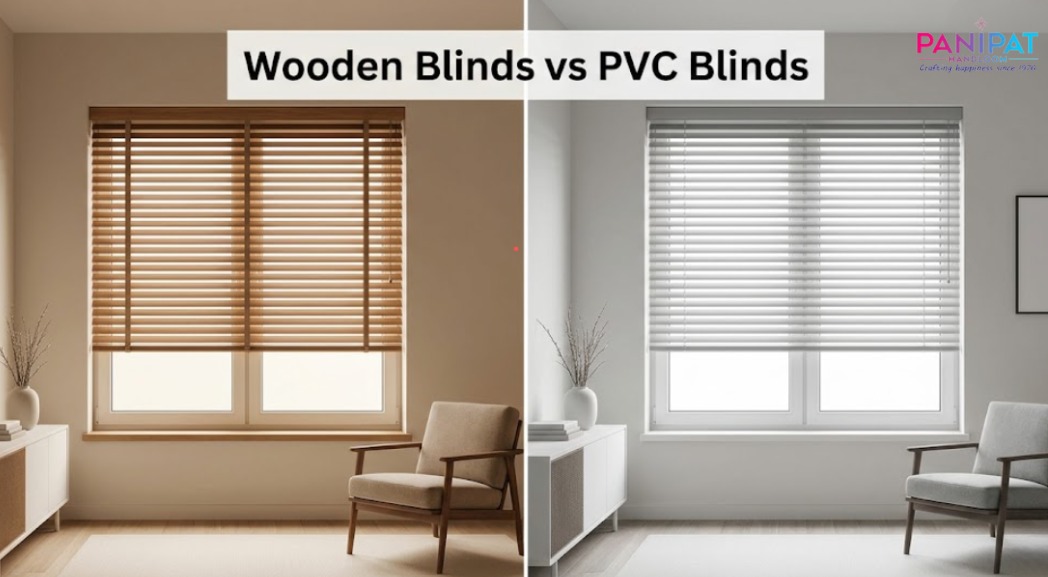
Wooden Blinds vs PVC Blinds: Which Lasts Longer?
When choosing between wooden blinds and PVC blinds, most Indian homeowners start with looks and end up confused about durability. Wooden blinds look warmer and more premium. PVC blinds look clean and are cheaper. But which one actually lasts longer in the heat, humidity, and dust of Indian homes? This guide answers that question with complete data and a clear verdict.
What Are Wooden Blinds?
Wooden blinds — also called wood venetian blinds — are made from horizontal slats of real timber, typically basswood, paulownia, or pine. The slats are suspended by fabric tapes and ladder cords and can be tilted to control light direction, or raised fully to reveal the window. They have a natural, warm aesthetic that complements wood flooring, rattan furniture, and earthy interior palettes.
- Slat thickness: 25 mm, 35 mm, or 50 mm. Wider slats give a bolder look with better light control per slat.
- Finish options: Natural wood grain, stained, painted white or cream, or wrapped in fabric tape.
- Weight: Heavier than PVC, especially at larger widths. Mechanism strain is greater over time.
What Are PVC Blinds?
PVC (polyvinyl chloride) blinds use rigid plastic slats that mimic the look of wood but are completely synthetic. They are also known as faux wood blinds or vinyl blinds. Modern PVC slat manufacturing has improved significantly — quality PVC blinds at a distance are nearly indistinguishable from wood, and they offer practical advantages that real wood cannot match in certain environments.
- Slat thickness: 25 mm or 50 mm typically. More limited range than wood.
- Finish options: White, cream, grey, and wood-effect prints that closely mimic timber grain.
- Weight: Significantly lighter than wood, making them easier to operate and less stressful on the mechanism.
Head-to-Head Comparison
|
Factor |
Wooden Blinds |
PVC Blinds |
Winner |
|---|---|---|---|
|
Aesthetics |
Warm, natural, premium texture |
Clean, modern, wood-effect print |
Wooden (for natural look) |
|
Durability in Dry Climate |
Excellent — 8–12 years |
Very good — 10–15 years |
PVC (lasts longer overall) |
|
Durability in Humidity |
Poor — warps, cracks, swells |
Excellent — completely unaffected |
PVC |
|
Water Resistance |
Low — avoid kitchen, bathroom |
High — fully waterproof |
PVC |
|
Starting Price Delhi |
Rs. 180–280 per sq.ft |
Rs. 90–150 per sq.ft |
PVC |
|
Cleaning |
Wipe each slat — dust traps easily |
Same, but also can be wiped with damp cloth |
PVC (easier) |
|
Weight |
Heavy — mechanism strain at width |
Light — easy operation |
PVC |
|
Eco-Friendliness |
Natural material, biodegradable |
Synthetic — not biodegradable |
Wooden |
|
Light Control |
Excellent — tilting slats |
Excellent — same mechanism |
Equal |
|
UV Fade Resistance |
May fade and dry out in direct sun |
UV-stabilised — no fading |
PVC |
|
Best Room |
Living room, bedroom, study |
Kitchen, bathroom, office, humid rooms |
Depends on room |
Durability in Indian Climate — The Real Answer
- Delhi's Climate and Wooden Blinds
Delhi's climate is characterised by extreme heat (up to 48 degrees Celsius in May–June), monsoon humidity (July–September), and dry cold winters. Real wood is a hygroscopic material — it absorbs and releases moisture with changing humidity levels. In Delhi's monsoon season, wooden blind slats can absorb enough moisture to warp, bow, or develop mildew on the fabric tapes. After drying in the post-monsoon period, the slats may crack or splinter.
For rooms that are air-conditioned year-round with stable humidity, wooden blinds perform well and can last 8–12 years. For rooms with fluctuating humidity — particularly north-facing rooms that receive monsoon moisture — PVC is the safer long-term investment, similar to other moisture-resistant materials like Wpc-pannels and Stone vener used in modern interiors.
- PVC Blinds in Indian Climate
PVC blinds are completely waterproof and dimensionally stable — they do not warp, swell, crack, or fade regardless of humidity and temperature fluctuations. They are the ideal choice for kitchens, bathrooms, laundry rooms, and any space exposed to moisture or steam. In Delhi's dust-heavy winters, PVC slats are also easier to wipe clean without the risk of damaging a wood finish, and they pair well with practical flooring options like Carpet tile in modern homes.
Price Comparison — Delhi & Gurugram 2026
|
Category |
Wooden Blinds (Rs./sq.ft) |
PVC Blinds (Rs./sq.ft) |
Notes |
|---|---|---|---|
|
Economy |
Rs. 180–220 |
Rs. 90–120 |
Basic slat quality |
|
Mid-Range |
Rs. 230–280 |
Rs. 125–160 |
Better mechanism, finish quality |
|
Premium |
Rs. 290–400 |
Rs. 165–220 |
Import-grade wood/PVC, fabric tape |
|
Motorised Add-on |
Rs. 4,000–7,000/blind |
Rs. 3,000–5,500/blind |
Per blind motor + remote |
Which Should You Choose?
Choose Wooden Blinds if: you want a natural, warm aesthetic for a living room, study, or master bedroom; the room is air-conditioned with stable humidity; budget allows a premium product; and you appreciate natural materials.
Choose PVC Blinds if: the room is a kitchen, bathroom, or any moisture-prone space; budget is a priority; the room faces heavy dust or pollution; or you want a low-maintenance product that requires no special care.
Expert Verdict: PVC blinds last longer in Indian conditions overall — particularly across the monsoon season. Wooden blinds look more premium and are the right choice for the right room, but require more care.For a whole-home installation, use wooden blinds in dry, air-conditioned rooms and PVC blinds everywhere else, and enhance the space further with premium wall finishes like Sabyasachi wallpapers.
Frequently Asked Questions
Q1. Can wooden blinds be used in a kitchen?
Not recommended. Kitchens generate heat, steam, grease, and moisture — all of which will damage real wood over time. The slats can warp from steam, absorb cooking odours, and develop mildew on the fabric tapes. PVC blinds are the correct product for any kitchen window.
Q2. Do PVC blinds look cheap compared to wooden blinds?
Quality PVC blinds with a wood-grain print are difficult to distinguish from real wood at normal viewing distances. The main difference is tactile — wood has a natural texture and warmth that PVC cannot replicate perfectly. For rooms where the blind is a design feature, wooden blinds remain the premium choice. For functional rooms, PVC is a perfectly respectable and good-looking solution.
Q3. Are wooden blinds heavier to operate than PVC?
Yes. Real wood slats are significantly heavier than PVC, especially at wider widths. A wooden blind covering a 180 cm window can be noticeably harder to raise than the equivalent PVC blind. For wide windows, PVC is recommended for operational comfort. For wooden blinds over 120 cm width, motorisation is a worthwhile investment.
Q4. What is the typical lifespan of each type in Delhi?
In a temperature-controlled, low-humidity room: wooden blinds last 8–12 years; PVC blinds last 10–15 years. In a room with monsoon humidity fluctuations: wooden blinds may show warping within 3–5 years; PVC blinds will last the full 10–15 years unchanged. Both types require replacement of the lift cord every 5–7 years as standard maintenance.
RELATED READING
- Roller Blinds vs Zebra Blinds: Which Is Better for Indian Homes?
- Blackout Blinds for Bedroom: Top Options to Block 100% Light
- How to Choose the Right Blinds for Every Room in Your Home
CONTACT THE PANIPAT HANDLOOM EMPORIUM
New Delhi: N-14, South Extension Part 1, New Delhi – 110049
Gurugram: Shop No. 3, Dharam Plaza, Brahma City, Sector-62, Gurugram – 122101
Phone: +91-9899073000 / +91-9999999009
Email: team@thepanipathandloom.com
Website: thepanipathandloom.com