

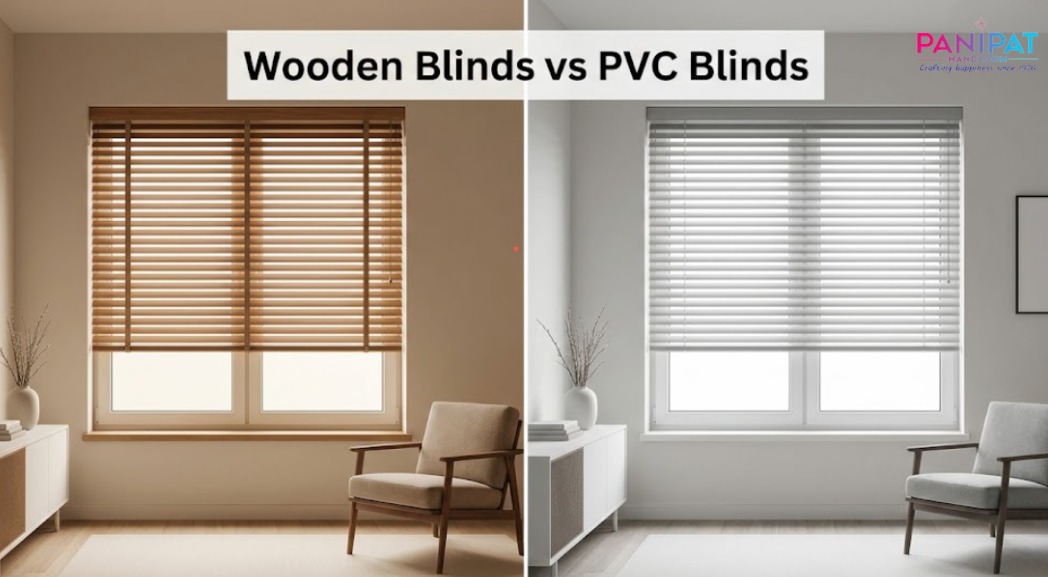
Wooden Blinds vs PVC Blinds: Which Lasts Longer
The wooden blinds vs plastic blinds debate really boils down to one question most homeowners actually care about: which one will still look good a decade from now without daily babysitting? Wooden vs pvc blinds is the same question phrased differently, and the answer matters more than the catalogue suggests. A bad choice here shows up in peeling slats, warped frames, and a window that reads tired within two summers. A good choice disappears into the architecture and stays invisible for years. The Panipat Handloom Window Treatment Team has handled both categories across Delhi NCR for long enough to see exactly how each one ages.
This guide breaks the wooden blinds vs plastic blinds comparison into the factors that decide real-world lifespan: material behaviour against humidity, UV stability, slat thickness, cleaning demands, cost per year of service, and visual retention. By the end, which one lasts longer in your specific room will be a clear call rather than a coin toss.
Wooden Blinds vs Plastic Blinds: The Honest Starting Point
Wooden blinds vs plastic blinds comes down to a tradeoff, not a winner. Wood delivers natural grain, measurable weight, and a decade-plus lifespan when kept away from wet zones. PVC delivers waterproof durability, low maintenance, and a lower entry price. Pvc blinds vs wood blinds therefore maps cleanly onto room type: PVC earns its place in kitchens, utility areas, and bathrooms, while wood owns living rooms, bedrooms, and studies. The wooden blinds collection we supply is the starting point for most living room specifications.
Are wooden blinds better than plastic in every scenario? No. Are wooden blinds better than plastic in dry, temperature-stable rooms where visual quality drives the decision? Almost always yes. Wooden blinds wooden construction means slats behave like furniture: they expand and contract slightly with humidity, they take polish beautifully, and they develop a patina rather than cracking. PVC slats never change, which is both their strength and their ceiling.
Wooden Vs PVC Blinds: Head-to-Head Comparison
The table below captures how wooden and PVC blinds actually perform across the parameters that decide longevity. These are the same checks the Panipat Handloom Window Treatment Team runs on every consultation before recommending either category.
|
Parameter |
Wooden Blinds |
PVC Blinds |
|
Material Base |
Basswood, oak, or bamboo slats |
Polyvinyl chloride polymer |
|
Average Lifespan |
15 to 25 years with care |
7 to 12 years typical use |
|
Water Resistance |
Low, warps in humidity |
High, fully waterproof |
|
Weight Feel |
Substantial, premium |
Light, plasticky |
|
Visual Warmth |
Natural grain, rich tones |
Uniform, synthetic finish |
|
Cleaning |
Dry cloth or wood polish |
Damp wipe or detergent |
|
UV Stability |
Fades gradually over years |
Yellows faster in direct sun |
|
Repair Options |
Slats can be replaced individually |
Usually whole unit replacement |
|
Starting Price |
Higher, tracks timber cost |
Lower, tracks polymer cost |
Two numbers in the table deserve a second look. First, the lifespan gap: a well-cared-for wooden blind outlasts a PVC blind by roughly a decade, which changes the cost-per-year math significantly even though the upfront price looks higher. Second, water resistance: PVC wins outright in wet zones, and no amount of premium timber selection closes that gap. Our PVC blind options in multiple finishes exist precisely for these moisture-exposed rooms.
Are Wooden Blinds Better Than Plastic: The Long Answer
Are wooden blinds better than plastic is a fair question that deserves a room-by-room answer rather than a sweeping verdict. Are wooden shutters better than plastic in formal living rooms? Yes, without qualification. Wood carries a visual weight and acoustic dampening that PVC cannot replicate. Are wooden blinds better than plastic in a kitchen exposed to steam, oil mist, and daily wiping? No. PVC wins because it survives the abuse.
Are wooden blinds better than faux wood? This is the sharper question, because faux wood is often the halfway product people actually compare. Faux wood blinds vs plastic blinds and faux wood blinds vs vinyl blinds both fall into the same category, since faux wood is a composite of PVC or vinyl with a wood-grain surface print. Faux wood blinds or vinyl blinds often read identically in catalogues, and they perform similarly in wet zones. Real wood still wins on grain authenticity, weight, and longevity, but faux wood closes the gap on cost and moisture resistance. The printed wooden blind collection covers the faux category with realistic grain prints.
Wood Blinds Vs Vinyl Blinds: Where Vinyl Makes Sense
Wood blinds vs vinyl blinds is the version of the debate that matters most in Indian homes, where vinyl has become the default synthetic alternative to polymer PVC. Vinyl handles humidity better than many early PVC formulations and accepts wood-grain finishes more convincingly. Faux wood blinds vs vinyl blinds therefore often comes down to brand quality rather than material type, since the two overlap significantly in finished product.
Wood shutters vs vinyl shutters follows the same pattern at a larger scale. For full plantation shutters on balcony doors, real wood carries the day on finish quality. For compact shutters in kids rooms and bathrooms, vinyl survives longer without warping. Wood shutters vs vinyl shutters in a humid climate like Mumbai or coastal Chennai almost always favours vinyl. In drier Delhi NCR conditions, both perform well, and the choice becomes aesthetic. Clients planning a full window treatment refresh usually browse our full shop category for window treatments to compare finishes side by side. For extra-wide sliding glass panels, vertical blind tracks for large openings handle the sweep more cleanly than any shutter or horizontal blind.
Bamboo Blinds Vs PVC Blinds: The Third Option
Bamboo blinds vs pvc blinds deserves its own section because bamboo sits in a different category than either wood or plastic. Bamboo is technically a grass rather than a timber, which gives it several advantages: natural water resistance higher than most hardwoods, lower weight than standard wooden blinds, and a distinctive visual texture that works beautifully in casual and eco-conscious interiors. Bamboo blinds vs pvc blinds is therefore a different decision than wooden blinds vs plastic blinds, and treating them as the same category usually leads to the wrong choice.
Bamboo does have its limits. It ages with visible texture changes, can feel less formal than polished wood, and does not take paint finishes as cleanly. PVC remains the better call for strict colour matching or formal-room uniformity. For family rooms, balcony screens, and outdoor-indoor transitions, bamboo often outperforms both. Our collinear bamboo-style blinds fit this niche for clients wanting a natural fibre look.
Wooden Blinds Thickness: Why Slat Size Matters
Wooden blinds thickness is the single specification that most often separates a premium-feeling blind from a budget-feeling one, and it is also the spec most buyers skip over during the shortlist stage. Slat thickness ranges from 25 mm to 63 mm, and each thickness creates a visibly different effect. Thinner slats look cleaner and let in more horizontal light when tilted. Thicker slats display more grain, block more light when closed, and read more formal. Wooden blinds thickness also affects weight, which in turn affects how smoothly the mechanism operates over years of use.
The table below pairs slat thickness with recommended room use. This is the reference the Panipat Handloom Window Treatment Team uses when clients have not specified a thickness preference during initial briefing.
|
Slat Thickness |
Wooden Blind Use |
PVC Blind Use |
Best Room Fit |
|
25 mm slat |
Light, cleaner look |
Entry-level PVC standard |
Small windows, kitchens |
|
35 mm slat |
Balanced, common default |
Mid-grade PVC |
Living rooms, bedrooms |
|
50 mm slat |
Premium grain display |
Heavy-duty PVC |
Large windows, studies |
|
63 mm slat |
Plantation-style wooden |
Rarely offered in PVC |
Balcony doors, tall glass |
For most Indian homes, the 35 mm and 50 mm slats handle the widest range of rooms. The 50 mm slat in particular has become the default for living rooms and studies because it reads premium without feeling heavy. Our customised blinds manufacturing service accepts slat specifications from 25 mm right up to 63 mm, with wood grade choices matched to budget. Clients preferring a metal alternative with similar tilt control can also consider venetian blind systems in aluminium which retain fine slat adjustability while sidestepping the humidity concerns entirely.
Wooden Blinds Price Per Sq Ft and Wooden Blinds for Windows Price
Wooden blinds price per sq ft in the Indian market tracks three variables: wood species, slat thickness, and finish quality. Basswood sits at the entry level, oak and cherry in the mid-range, teak and walnut at the premium end. Price per sq ft roughly doubles from basswood to teak at the same slat thickness. Add motorisation, premium cord-free mechanisms, or wider-than-standard slats, and the price climbs further.
Wooden blinds for windows price quotes almost always come in on a square-foot basis rather than a per-window basis, which can confuse first-time buyers comparing wood to PVC. PVC is usually quoted per-window at a flat rate because the material cost is predictable. Wood requires the sq-ft method because wastage and grain matching add variables. A realistic wooden blinds for windows price calculation for a standard 4 by 5 ft bedroom window sits in a middle band once installation and finishing are included. The Panipat Handloom Window Treatment Team shares a full written quote after site measurement rather than rough verbal estimates, because the sq-ft variables need room-specific inputs. For a quick indicative browse, our wooden blind pricing options list starting ranges by slat thickness.
Are Wooden Blinds Good and Are Wooden Blinds Better
Are wooden blinds good for modern Indian interiors? For living rooms, bedrooms, studies, and formal dining spaces, consistently yes. They deliver warmth, weight, and longevity that synthetic alternatives still cannot match at equivalent quality grades. Are wooden blinds better than the alternatives for someone building a ten-to-fifteen-year home investment? Also yes, because the amortised cost drops below PVC once you factor in replacement cycles.
Are wooden blinds better in every case though? No, and pretending otherwise leads clients to specify wood in kitchens where it will warp within three years. The Panipat Handloom Window Treatment Team recommends wood where visual quality and lifespan matter most, and alternatives where moisture exposure or daily heavy cleaning will damage timber. For full room-wise guidance on blind selection, our complete blinds for windows category catalogues each type with suitability notes.
Are Wooden Blinds Outdated or Are Wooden Blinds In Style
Are wooden blinds outdated? This question gets asked more often than it deserves, usually after a homeowner sees a Pinterest board full of motorised roller blinds and cellular shades. The honest answer: wooden blinds have shifted in how they are styled, not in whether they remain relevant. Plantation-style wide-slat wooden blinds in muted tones are genuinely trending in premium Indian interiors right now, and demand has climbed rather than dropped over the past three years.
Are wooden blinds in style therefore carries a yes answer, with a qualifier. Orange-stained wooden blinds from two decades ago do read dated, and those installations almost always benefit from replacement. Modern wooden blinds in natural oak, walnut, or white-washed finishes read timeless rather than trendy. Paired with appropriate fabric drapes, such as those in the premium linen fabric collection or the D'Decor curtain range we stock, they anchor a room beautifully.
Are Blinds Better Than Curtains: The Bigger Picture
Are blinds better than curtains is the parent question behind every wooden vs PVC decision, because before the material debate matters, the category decision matters more. Blinds and curtains solve different problems. Blinds deliver precise light control, compact stacking, and architectural cleanliness. Curtains deliver softness, texture, and emotional warmth. The highest-satisfaction installs almost always use both on the same window: a functional blind against the glass, a decorative curtain over the frame.
Are blinds better than curtains in a purely functional sense? For light and privacy control, yes. In a visual sense? Curtains soften rooms that blinds alone would leave feeling stark. Which is why specifying only blinds for a living room often reads incomplete, while pairing blinds with customised curtains stitched to size delivers the balanced result most clients actually want. For rooms where a blind alone is the right call, roller blind options with various finishes and zebra blind dual-band systems both pair well with either wood or PVC shutters on adjacent windows.
Key Takeaways Before You Buy
Wooden blinds outlast PVC blinds by roughly a decade when kept out of wet zones. PVC wins outright in kitchens, bathrooms, and utility rooms because moisture resistance matters more than aesthetic depth there. Faux wood and vinyl blinds overlap significantly and usually deliver the same real-world result. Bamboo blinds sit in their own category and suit casual and eco-conscious interiors better than either wood or PVC. Slat thickness between 35 mm and 50 mm handles the widest range of Indian rooms. Wooden blinds price per sq ft tracks wood species and thickness rather than brand name, so always request written quotes after measurement. Modern wooden blinds are genuinely in style, not dated, as long as the finish stays in the natural or muted range.
Frequently Asked Questions
Q1. Are wooden blinds better than plastic for every room in a typical Indian home?
Not every room. Wooden blinds win in living rooms, bedrooms, studies, and formal dining areas. PVC wins in kitchens, bathrooms, and utility areas where moisture exposure is regular. The honest answer to wooden blinds vs plastic blinds is to mix both across the home, matching the material to the room rather than forcing one material everywhere.
Q2. What is the difference between wooden blinds and faux wood blinds?
Faux wood blinds are a composite material, usually PVC or vinyl with a wood-grain surface print. Real wooden blinds are solid timber slats. Faux wood blinds vs vinyl blinds are essentially the same product marketed differently. Real wood outperforms faux on weight, grain authenticity, and longevity, but faux closes the gap on cost and moisture resistance.
Q3. What wooden blinds thickness should I specify for a standard living room window?
The 50 mm slat is the default for living rooms because it displays grain clearly without feeling heavy. Wooden blinds thickness of 35 mm works for narrower windows where the larger slat would look overbuilt. Specify 63 mm only for tall balcony-door applications where the plantation-style look is the intent.
Q4. How much does wooden blinds price per sq ft vary across wood species?
Roughly double from basswood at the entry level to teak at the premium end, for the same slat thickness. Add motorisation and the price climbs another 20 to 30 percent. Wooden blinds for windows price is always quoted per sq ft rather than per window, so request written estimates after site measurement for an accurate figure.
Q5. Are wooden blinds outdated in modern interior schemes?
No. Plantation-style wide-slat wooden blinds in natural oak, walnut, or white-washed finishes are actively trending in premium Indian interiors. Are wooden blinds in style therefore has a clear yes answer, with the qualifier that older orange-stained finishes do read dated and usually benefit from replacement.
Q6. Bamboo blinds vs PVC blinds for a humid climate?
Bamboo handles humidity surprisingly well because it is a natural grass rather than timber. For coastal and high-humidity climates, bamboo outperforms standard hardwoods though not PVC on pure waterproofing. PVC still wins in direct wet zones like bathrooms, while bamboo wins in casual living spaces and balcony transitions.
Q7. Wood shutters vs vinyl shutters for a kids room?
Vinyl shutters win for kids rooms because they survive cleaning, spills, and general abuse better than wood. Wood shutters vs vinyl shutters in a master bedroom flips the answer, because the visual finish of real wood matters more and the moisture exposure is lower. Always match shutter material to room usage rather than defaulting across the home.
The Final Word
Wooden blinds vs PVC blinds is less about picking a winner and more about matching material to room function. Real wood delivers the longer lifespan, richer visual quality, and stronger investment case in dry rooms. PVC and vinyl earn their place in moisture-exposed and high-traffic zones where wood would fail. Are wooden blinds better than plastic overall? In the rooms wood is designed for, yes. In the rooms it is not, clearly no. For a proper site visit across Gurugram and Dwarka or a detailed written quote after measurement, the full window treatment consultation remains the cleanest starting point.